|
|
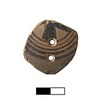
| Complete disk, cut from body of Late Protogeometric or Early Geometric Circles Skyphos.
Wall of skyphos rising steeply. Exterior decorated with one partially preserved set of five mechanically-drawn circles, ... 11 April 1932 |
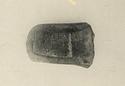
| Knidian type, slightly descending, broken before curve.
Coarse, dark red clay, greyish at core. Traces of light slip.
Impression with framed rectangle with thick letters; worn but clear. Modern cellar ... Modern |
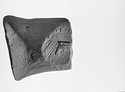
| Broad, broken at curve.
Coiarse, light brown clay; blackened discolorations over surface including break.
Upper left part of the impression incomplete; left end shallow, right end letters clear. Above ... 11 April 1932 |
| Shape similar to Knidian; broken before curve.
Coarse pink clay, grey core; slipped.
Outer edge of the impression broken away; shallow set, circumference incomplete. Cxt: see nt of 7.vii.75 made for ... Late Hellenistic |
| Late Roman B fragment mended from two pieces. Grooved rim and narrow ring base. Feather pattern outside, leaf pattern round center.
Red clay, slipped outside, red glazed inside. Leica, 2-319 PD 1171-66, ... 12 April 1932 |
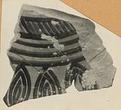
| Fragment from a large vase, probably a krater or an amphora.
Decorated with concentric circles within border of lines and zigzags.
Reddish clay with light slip, also inside.
Protogeometric style. Geometric ... 11-12 April 1932 |
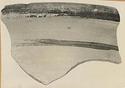
| Fragment from rim, neck and shoulder.
Rim glazed. Glazed band around neck.
Sandy clay. Dull paint (cf. P 1713).
Subgeometric style. Geometric area outside house; from area A-C. Leica, 3-58 PD 388 ... 11-12 April 1932 |
| Fragment from base. Flat bottom.
Decorated with hatched band, lines and petals on outside.
Developed style. Cf. P 1626; CVA Cambridge, I, pl. I:19b. Geometric area outside house; from above bedrock between ... 10 April 1932 |
|
|