|
|
| Mycenaean Small Chamber tomb.
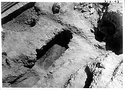
The cist measures 1,90m E to W, 0.75-0.90m N to S, max. depth -1.30m. Nothing was found in it; cleaned in modern times and used as a cesspool. Some of the SW part of it had ... Myc. IIIA, early 14th c. |
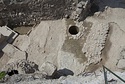
| Pit and drain at SE corner of Apollo Temple. Antedates building of Apollo Temple which was assigned to a date 'late in the third quarter' ... 3rd quarter 4th c. B.C. |
| Mycenaean tomb: Myc. III A:1-2.
SAI
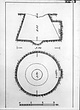
Small rectangular chamber, 2.30m wide by 1.80m deep,, entered from the east through a dromos 1.10m wide which contracted to a doorway 0.92m. wide. the doorway preserved ... 2nd half of 14th c. |
| Side-chamber at the bottom of a circular shaft. AA 27; ST 103 from shaft above burial. PD 427 ... Neolithic |
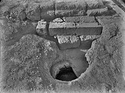
| Well in Room 7 of Roman House H, partially covered by caldarium of added bath complex (Room 6). Stone well-head; 0.85m in diameter. Stpped because of danger of collapse. Cut through bedrock, water from ... 6th c. A.D. |
| Deposit of terracottas, molds and pottery in a shallow pit sloping downward from north to south. This deposit was located beneath a layer of fill under a Late Roman plaster floor (Lots ΒΕ 2093-2095). The ... 1st c. A.D. |
| Marcie Handler ... Located in the south section of Room E in the Byzantine Building east of the North-South Road. The uppermost 1.5 meters of well lining was built of well-coursed stones (some reused marble blocks) and tiles ... 12th c. A.D. |
| Well at 99/ΜΕ.
Just outside of SE corner of Fountain House. This well was used in at least two periods; the marble well curb of the second period, certainly Byzantine, was found in place. The fill was ... 5 May 1952
5-14 July 1952 |
| Well west of the Eponymous Heroes monument. The shaft was of irregular width (ca. 0.81m where the full circle was first preserved), sunk in soft bedrock clay much of which had collapsed around the top ... Ca. 600-550 B.C. |
| Eugene Vanderpool ... Infant grave near Phaidon street cistern. No offerings.
Roughly rectangular, almost elliptical cutting in bedrock, measuring 0.70m long, 0.35m wide, and 0.40m deep, oriented south-southwest to north-northeast ... Late Helladic III C/Early Protogeometric (date uncertain) |
| Well at 52/Ι, on the lower northeast slopes of the Areopagus. It was cut down and re-used in the late Roman period, in connection with the water channel. Use fill of 1st to early 2nd c.
Dump fill 5th to ... Early to Late Roman |
| Large tile-lined well in SW Bath, Room A4. The top had been sealed with ca. 1.30m of concrete, and the floor to carry the hypocaust columns of the room in Phase C had been carried over it.
The well was ... Late 2nd-early 1st c. B.C. |
| Laura Gawlinski ... Well in courtyard of Early Building I, adjacent to wall of Room B. Tile lined; upper course in situ, lower two collapsed probably in antiquity. Letters inscribed on rims (eta, phi, omicron, theta). Medium ... First quarter of the 4th c. B.C. |
| Cistern at 53/ΚΓ and channels. The pottery in the cistern and in the two channels was a thoroughly mixed lot of broken material from 5th c. B.C. to 4th c. A.D. and all seemed the same except the bottom ... 5th c. B.C.-4th c. A.D. |
| Well O: EG. AS 875-878 ... Middle Geometric |
| Cistern at 79/ΜΗ.
A well dug through at a later date destroyed all cistern filling.
No filling preserved. No typed list ... Probably 3rd cent. B.C. |
| Roman Bath, Herulian destruction debris in A3. The high proportion of vessels for eating suggests that this was not the actual bath fill but was probably dumped in from the ruined houses higher on the ... Second half of 3rd and into 4th c. A.D. |
| The cistern was lined with stones at the top with an opening 0.80 m in diameter. For the most part, it seemed to cut into bedrock except along its northern edge where some 5th c. B.C fill remains and main ... 2-19 July 2010 |
| Grave XII in notebook = RSY Grave 9 ... Just after the middle of the 6th. c. B.C. |
| Sacrificial Pit II in notebook = RSY Grave 7 ... Ca. 540 B.C. |
| Sacrificial Pit III in notebook = RSY Grave 6.
Small bit of calcined bones (discarded?) ... Ca. 550-530 B.C. |
| Cistern with dumped filling, second quarter of 4th c. B.C. Also Lot Φ 187bis (selected coarse).
No coins ... Ca. 375-350 B.C. |
| Dumped filling mostly of 3rd c. A.D., but dumped as late as 5th century. Nbp. 143: The fill in this cistern was of three kinds: to within .60m. of the floor plain broken bedrock with no sherds; then a ... 10-17 February 1937 |
| Construction filling of well N 20:3 which was dug through this cistern; a few later sherds at upper levels may result from late repairs to well tiling. Coins:
6 April 1938 #14-#15
8 April 1938 #4 Some ... Second half 1st c. A.D. |
| Eugene Vanderpool ... Mycenaean Chamber Tomb.
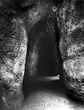
Although badly disturbed at various times in antiquity, it was clearly a chamber tomb with the chamber little more than a cubby-hole at the end of a steep dromos, entered at the ... Myc. III A-B |
| Well cut into bedrock under late Roman building in ΕΛ. 1.2m in diameter with small cutting of unclear function at south edge about 0.2m wide. Walls cut straight down, tapering near bottom to 0.8m. Footholds ... Late Archaic |
| Phaidon Street Cistern: South Chamber.
Connected by tunnel to O 17:5.
Knidian stamped amphora handle; fragments of five long-petal bowls, one made in worn mold. Type 35 A lamp. Coins
9 August 1957 #1-#3 ... Late 2nd c. B.C. |
| Margaret Crosby ... Grave 1 (Grave XXVI: EG) Urn cremation (trench-and-hole), adult male?
[JP]
Boots or Booties Grave. Near the west branch of the Great Drain, about 100m to the southwest of the Agora horos inscription ... Early Geometric I |
| At the northwest foot of Areopagus. Square stone-curbed well with no clear evidence for a period of use; appears to be a single dump ... Ca. 500 B.C. |
| Cistern at 75/ΜΓ connected with cistern N 18:3 by tunnel.
Only coin is Bioiotian dating between 220 and 197. Only indications of date are 1st c. lamps, two long-petal bowls, and fragments of early Roman ... 1st. c. B.C. |
| Homer A. Thompson ... Cremation burial (trench-and-hole) under S. edge of E-W Street, northern burial. In some records as Grave XLVII.
The western part of the offering trench of the tomb was lost to a Turkish cess pit, and ... Middle Geometric I |
| Enclosure within Roman Circular Building. The finds apparently reflect the entire area inside the enclosure. Pottery lot ΒΓ 515 identifies the deposit as layer 10 and coin #895 from layer 11 says "layer ... 12-18 August 1971
9-10 May 1972 |
| Well at 89-90/ΙΗ-ΙΘ (diameter at top 1.10m), between the southeast corner over the mouth of of the Odeion and the Panathenaic Way. The well lay a thin layer of dug bedrock containing a few Hellenistic ... 650-625 B.C. |
| Well cut into bedrock, associated with late Roman building G in ΕΛ 1.2m in diameter, narrows to 0.5m at bottom. Disturbed by later pits at top. Excavated from 85.77-79.25m (6.52m), but bedrock at 85.91m ... Late 4th/early 5th AD |
| Marcie Handler ... The contents of this Hellenistic cistern shaft were excavated in a series of layers: the preserved top of the shaft, six layers in the shaft and the fill within the tunnel. At the bottom of the shaft on ... POU: Mid-3rd c. BC
Dumped fill: after 225 BC |
| Cistern on lower north slope of Areopagus.
Latest of thirteen amphora handles dated ca.199; twelve legible coins, the latest dating ca. 196-190. Three intrusive pieces:two semiglazed fragments and piece ... 260-190 B.C. |
| Grave I in notebook = RSY Grave 2.
Inhumation burial in Cemetery on West Slope of Areopagus. Outline of grave disturbed by later cutting. Outstretched skeleton, probably of adult female. PD 731-a ... Late 8th century B.C. |
| Stucco-lined bottle-shaped cistern, with tunnel and subsidiary manhole, in SW Baths, Room Α 10. Homogeneous dumped fill, mostly of mold-made bowls and and molds for terracotta figurines. Sixteen stamped ... 225-190 B.C. |
| Mycenaean Chamber Tomb occupies a considerable part of the western half of section ΕΕ; lies about half way up the north slope of the Areopagus towards its eastern end, just below the highest point of the ... Myc. III A:1 |
| Tiled Well at S edge of E-W Road, 73/ΜΗ. Contemporary upper and lower fills separated by layer of sterile mud.
Latest coin dates ca. 200. Koan amphora handle with stamped handle dates slightly after 200 ... 210-160 |
|
|