|
|
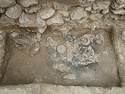
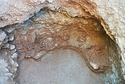
| Marcie Handler ... Cist grave for two infants. The grave was cut into a sterile rocky layer on its southern and western sides, and a sterile fill layer on its northern and eastern sides. No obvious grave marker was present, ... Early Iron Age |
| Brian Martens ... Located in the southern section of Room I, now bound by the scarp of Wall U at the north,, the scarp of Wall L at the east,, and a modern pit at the south. At its now low elevations, excavated in the 2015 ... Third quarter of 5th c. B.C. |
| Marcie Handler ... Pyre under floor no. 9 in the center of Room 4. It was adjacent to the southern face of Wall 4, but at lower elevation than the lowest course of the wall foundation (which was found at 52.250 masl.), suggesting ... 375-350 B.C. |
| Marcie Handler ... This deposit is a Mycenaean cist grave with two cover slabs, a type of burial described by Immerwahr in Agora XIII (pp. 103-104). Cist graves appear side by side with chamber tombs in the Mycenaean cemeteries ... LHIIB-LHIIIA:1 |
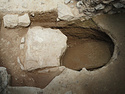
| Brian Martens ... Mycenaean Chamber Tomb J 1:11, located in the area north of Wall K, was partially excavated during the 2014 season. At this point the full western extent of the chamber has not been located because of ... LHIIIA |
| Brian Martens ... It was partially excavated during the 2012 and 2013 seasons. The tomb, located at the center of Room III in the NE area of section ΒΖ, was found under fill surrounding perpendicular mid-to late 6th c ... LHIIIA |
| Marcie Handler ... The contents of this Hellenistic cistern shaft were excavated in a series of layers: the preserved top of the shaft, six layers in the shaft and the fill within the tunnel. At the bottom of the shaft on ... POU: Mid-3rd c. BC
Dumped fill: after 225 BC |
|
|