|
|
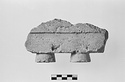
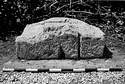
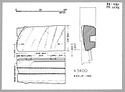
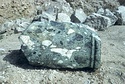
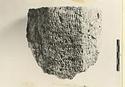
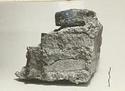
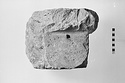
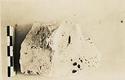
Both ends and top cut away. Block comprised three triglyphs and two metopes with a triglyph in the middle. Both ends and top cut away. The block rested on a raised bearing surface in its middle above the ... 6 July 1966 |
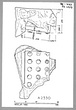
Top and one end cut away, one end broken. Back rough finished with long vertical chisel strokes of a single point. Undercutting in middle of back for a shift bar. Metope faces finished with toothed chisel; ... 6 July 1966 |
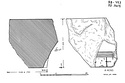
| Both ends and top cut away. Face of metope shows toothed chisel, face of triglyph finished with drove; back shows long vertical striations of a single point. Undercutting at middle of back for a shift ... 6 July 1966 |
| Two drums, a) lower drum, b) upper drum, found lying side by side and, since their dimensions are congruous, probably from the same column. Lower 0.20m. of lower drum left unfinished. Lead for centering ... 16 December 1953 |
| The figure is nearly intact except for some object in the right hand. Mended from three pieces.
A standing male figure clad in himation and Phrygian cap and carrying pine cones and fruit. The man is nude ... 2nd century A.D. |
| The nose and chin have been considerably damaged. At the base of the neck, a roughly picked tongue indicates that the head was inserted into a separate body.
Head, larger than life-size, perhaps of Trajan ... Flavian period. |
| The base has been hacked away on top and in the back; great, rough cuttings extend from the central rectangular cutting on the top, presumably made when the base was first cut, to support what ever stood ... 4th c. B.C. |
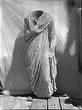
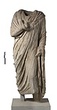
| Head, set in socket, missing; socket fully preserved. Feet and lower part of drapery broken off, also upper part of right arm and most of the fingers of the right hand. Left forearm and hand largely missing ... 16 March 1937 |
| Both feet, parts of right hand, all of left, head and top of shoulders, missing. Minor chips from drapery.
Himation clad figure, the weight resting on right foot, left knee thrust a little forward. Right ... 20 May 1937 |
| Head, set in socket, missing. Feet and lower part of drapery broken off; likewise all of right shoulder, arm and chest, left hand missing.
Standing male figure wearing loose himation, one end of which ... 16 March 1937, 24 July 1965 |
| Two guttae, and part of regula and taenia preserved.
From Square Peristyle, South Stoa II.
Poros.
Cf. A 2925. Disturbed fill. Leica, 93-56-16 (14,15) PD 1552 ... May 1951 |
| Broken at top, back and sides. Part of mutule, one gutta, and lower part of front fascia preserved.
Hard gray limestone with many holes in it. Surface very fresh.
From Square Peristyle.
Same series as ... 10 March 1952 |
| Broken at back and sides; edges of molding broken away. Top much worn: tramped on in some reuse. One original edge of mutule preserved, and approximately full depth, with three row of guttae, of which ... 22 April 1948 |
| Broken to left and right. Part of via and mutule with hawk's beak molding preserved. No mason's marks. No traces of color.
From Square Peristyle.
Poros. From wall, S.W. corner of Byzantine Room E 1. Leica ... 24 April 1950 |
| Composed of five fragments, broken while removing from wall, block mended 1966. Bottom, back and left face preserved. Probably part of top preserved, although badly worn and cut away by later use as water ... 24 April 1950 |
| Fragment from front top. Cutting for a patch at right end. Fine work.
Material and workmanship as of A 2915, i.e. Square Building - South Stoa II series.
Hard creamy poros. From demolition of tower of ... 21 July 1959 |
| Hawk's beak molding, fragment of beak alone. Similar in material and profile as A 2915, but appreciably larger. Note relieving surface on top as on A 2921.
Blackened by fire.
From Square Peristyle.
Poros ... July 1959 |
| A flake from the lower outer part of a base drum preserving parts of two flutes. Lower part of flute (0.07m.) finished delicately with the drove, upper part more carelessly. Very slight relieving surface ... 13 July 1960 |
| Corona has been cut away and the back part of the block reused as a water channel, the channel cut in the original underside. Preserved length of the block is probably very close to original.
From Square ... 29 May 1964 |
| Greatest part of one mutule preserved with right and back edge and lower part of the molding above; eight guttae preserved; some completely, some partly, and traces of four more.
Heavy Roman cement preserved ... May 1953 |
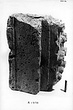
| Broken all around. Part of one glyph and full width of projecting fascia with edge of slot for metope. Hard poros with many holes.
From Square Peristyle.
Same series as A 1925 (Τ 1092), A 2239 (Τ 2026) ... 28 May 1953 |
| Fragment of hawk's beak only cut from hard gray poros. Blue and red pigment is fresh.
From Square Peristyle, cf. A 1476. Area of Stoa Pier 22, Stoa fill. 3674 Leica PD 1549 ... 26 February 1954 |
| Broken left, right, back. Top and bottom surfaces preserved. Flute with flattened arris, 4 annulets, part of echinus preserved.
From Square Peristyle?
White marble, similar to A 4185 (ΡΡ 136) and Α 4196 ... 26 April 1971 |
| Part of resting surface, of three flutes and of annuli remain. Probably to be associated with the many cornice fragments and one triglyph of similar stone and workmanship. Retains traces of late Roman ... 5th c. B.C. (?). |
| Much weathered. One flat face preserved and possibly another adjacent rough surface. The same marble as the columns assigned to the Circular Building (the Monopteros) in section Σ.
Green Karystos marble ... 23 April 1951 |
| From an inner angle. Full height preserved, though badly broken almost all around. Of the triglyphs only the vertical member between the two is preserved.
Kara stone.
Cf. A 3386 and A 3387, complete blocks ... April 1954 |
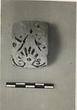
| Some of the upper part of a triglyph and a bit of the adjacent metope.
Hard buff travertine.
From same building, Square Peristyle, South Stoa, as cornice A 1926 etc., A 1824 etc., A 2924, A 2931 and ... 28 April 1952 |
| Fragment of outer glyph, broken above, below and at left, and behind. Parts of three faces preserved with traces of blue paint. Very much worn.
From Square Peristyle.
Poros. Exact provenience unknown, ... January 1953 |
| Small fragment preserves part of original bottom, of one fascia and half of channel at each side.
From Square Peristyle.
Hard gray poros.
Cf. A 2209 (Τ 1808), triglyph of same material and workmanship ... 31 March 1953 |
| A mass of bricks bonded with mortar, probably from domed roof of Circular Building.
Uneven bottom surface corresponds with rough top of cornice block, which retain traces of similar mortar. The one preserved ... 17 June 1951 |
| One front corner remains with complete profile of hawk's beak.
Travertine-like limestone presumably to be stuccoed.
From Square Peristyle, South Stoa II. From a marble pile to east of south end of Stoa ... 28 June 1950 |
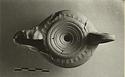
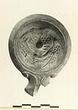
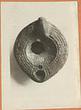
| Mended from many pieces; half of the top of the nozzle missing, and small fragments from rim, wall and bottom.
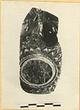
Rim, impressed ovules; discus, concentric grooves and ridges; handle, large, double-grooved ... 29 July 1947 |
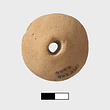
| Roughly double conical, stamped (?).
One side flatter than the other. On the flatter side, a rough impression, as if from a round or oval seal, probably representing an animal.
Unglazed. Handmade. Finished ... 12 June 1935 |
| Right half without nozzle. Fragment of small discus with rays and surrounding raised band.
On rim, raised vine pattern; rather high relief, curling stalks.
Handle perforated, triple grooved above; set ... 19 February 1932 |
| The lower part of the lamp is preserved on one side to just above the point where it curves in and is joined by the top. Blackened inside and out and along the break, at the top of the fragment, the lamp ... 11 April 1933 |
| Fragment from back part.
Panelled rim with raised rosette and impressed ovolos. Pierced handle, double-grooved above and below.
On the reverse double concentric grooves enclosing the signature.
Type XXVII ... 2 June 1933 |
| Complete.
Herringbone on rim; jewelled Christian cross on discus, with tail of "rho" to right and filling holes in the other three quadrants. Solid handle, the upper part very low; double grooved above ... 5 June 1933 |
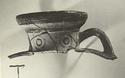
| Missing are: fragments from the wall and rim, one handle and the upper part of the other. Partially restored in plaster. Stemless kantharos with horizontal handles and moulded, heavy hollow lip. A scratched ... 23 May 1932 |
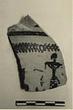
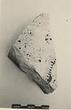
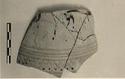
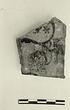
| From a large open bowl, glazed black insided. Outside, along upper edge, guilloche; below it, three bands from which are pendent hooks; in field, procession of stags to right. Faces and ears of stags reserved ... 11 March 1935 |
| From a great open bowl, glazed black inside. Hatching and zigzags on upper and outer faces of rim. Two horses facing, the one to the left grazing. Eye reserved. Glaze very much peeled. Zigzags in field ... 11 March 1935 |
| Small piece from base; letters incised within two grooves.
No glaze.
Light red clay.
Type XXVII of Corinth collection, type 28 of Agora collection.
Latest Roman fill. Leica PD 1020, 1471 ... 19 April 1947 |
| The reverse, with the wall on one side, preserved.
Low simulated base ring from which a rib starts upwards towards the handle.
In relief within the base ring, the signature.
Light brown clay.
Type XXIX ... 18 June 1947 |
| About a quarter of the rim, with the base of the semi-pierced handle and the edge of the discus preserved.
Letters incised on discus before firing.
Purple-brown glaze.
Brown clay.
Type XXVIII of Corinth ... 23 April 1948 |
| End of nozzle broken.
Disc, decorated with wreath tied above and below, surrounded by grooves. Narrow sloping rim. Pointed nozzle with half volutes.
On base, within circular groove, incised signature ... 1955 |
| Fragments from two large vases with decoration on neck in thin brownish-red glaze.
a) Mended from two pieces; lip and bit of shoulder covered with streaked glaze. Between, on neck, reserved, large irregular ... 14 March 1932 |
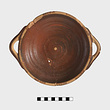
| Handles and much of wall missing. Moulded base ring; shallow lower bowl; high side wall; hollow rim; loop handles, horizontal. On the floor are four palmettes stamped within a circle of rouletting. A reserved ... 2 May 1934 |
| Large hemispherical basin; mended from four pieces; base and one handle missing. Plain rim; lug handles.
Coarse clay with many stones. Badly fired and very brittle. No glaze. Geometric well east of Stoa, ... 11 May 1950 |
| Wall fragment; mended from two pieces.
Standing figure, facing, in relatively high relief with confused scene of horse and chariot behind him.
Buff clay. Metallic glaze.
ADDENDA Herakles and the Mares ... 30 April 1953 |
| Upper wall fragment broken all around. Zeus in the form of an eagle carries off Ganymede. At either side a winged Eros. Rim zone, simplified guilloche below double spirals.
Metallic black glaze, slightly ... 5 May 1954 |
| Part of foot and floor preserved. Moulded ring foot. Impressed decoration: linked palmettes surrounded by rouletting.
Pinkish-buff clay; underside reserved, with two wide and three narrow glazed circles ... 15 March 1939 |
| Foot, floor and part of wall preserved. Traces of handle attachment. Moulded foot, a groove in the resting surface. Impressed decoration: seven linked palmettes surrounded by rouletting.
Pinkish-buff ... 8 April-16 May 1936 |
| Parts of rim, wall, and foot restored. Moulded rim and foot. Impressed decoration: four palmettes in the form of a rough cross surrounded by rouletting.
Pinkish-buff clay; completely glazed except reserved ... 8 April-16 May 1936 |
| Part of foot, floor, and wall preserved. Low foot, a groove in the resting surface. Impressed decoration: eight linked palmettes surrounded by rouletting.
Pinkish-buff clay; completely glazed except ... 8 April-16 May 1936 |
| Floor, most of foot, and fragment of wall preserved. High foot, a groove in the resting surface and a scraped line at the junction of the foot and bowl. Within, eight impressed palmettes surrounded by ... 8 April-16 May 1936 |
| Concave lid for a large pot; plain rim. Arched handle across the middle of the top.
Coarse pinkish-buff clay, unglazed. Grave 5. 2084 Leica, 81-279 PD 1057 ... 19 March 1947 |
| Profile preserved from lip to lower wall.
Double upper zone: above, row of horizontal spirals and upright leaves; below egg and dart; line of beading between the two zones. Wall: to left, a nude bearded ... (1935) |
| The base and much of the lower wall remain. Around the middle of the vase a band of hounds and foxes.
The black glaze has become a dull yellow color and has almost entirely flaked away.
Protocorinthian ... 27 April 1938 |
| Wall fragment; four pieces joining to one. The open muzzle of a lion to right, in front of him the rear part of another beast(?).
Flaky black glaze; incision.
Possibly belongs with P 6481 (from the ... 4 June 1938 |
| Part of a charioteer to right, with the forepart of a following horse. The charioteer is in outline; his upper garment dotted; his skirt indicated with applied white. Tholos trench U, from filling of 'furnace' ... 4 June 1938 |
| Neck preserved without handles. Thickened rim; lower part of mouth concave, ridge at beginning of neck. Vertical wavy lines flank a thick dotted circle. Rim black; black band at lower part of neck.
Attic ... 23 April 1951 |
| Neck, handle and part of body missing. Restored in plaster. Very low base, flat underneath; ovoid body.
Above a black base and four horizontal lines, at the lower part the decoration is in panels set ... 26 April 1951 |
| Vertical rim, the upper face decorated with groups of strokes, the outer with a pair of bands. On the wall, figured zone showing two bearded oarsmen in a boat, right.
Glazed inside; drawing glaze somewhat ... 21 April 1951 |
| Broken all around. A single fragment preserves part of the neck of a good-sized pot, flaring outward slightly at top. A man standing, head turned left, arms held out from elbows; legs below thighs missing ... 27 April 1938 |
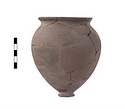
| The lip preserved complete, with most of the neck, and a small part of the shoulder, with one handle. Heavy echinus lip, a raised band below it outside; short slightly concave neck; broad shoulder; thick ... 2-7 April 1938 |
| Nine non-joining fragments from neck, shoulder and wall. Rays around lower body; elaborate scrolls on shoulder. In a panel on the neck, the lower part of a bird (cock?), right.
Pinkish-buff clay; thin ... 2-7 April 1938 |
| A single fragment preserves most of ring foot and floor and a bit of the low rolled rim of Type D plate. On floor, within a circle of rouletting, seven stamped palmettes with interlaced stems. At center, ... 11 May 1939 |
| Medallion and part of wall preserved. Medallion: rosette surrounded by leaves; calyx of small leaves. On the wall: Nike with Erotes on either side and below Erotes on dolphins.
Attic. Cistern, container ... 9 April 1949 |
| Rim with three grooves for side panels.
On discus, central filling hole. Handle, solid, triple grooved.
On reverse, double concentric groove, signed.
Unglazed.
Red clay.
Type XXVIII of Corinth collection ... 13 June 1931 |
| Three fragments of a large elaborately moulded lamp with two nozzles and handle-shield.
Fragment a), the handle-shield, three out of five palmette petals preseved.
Fragment b), a large piece of the body ... 14 April 1937 |
| Fragment a), large flat leaf-handle .
Fragment b), part of the flat base and side wall. Underneath, incised beneath the glaze.
Dull glaze, red to brownish and somewhat peeled.
Type XXI of Corinth collection ... 16-21 May 1937 |
| Fragment preserves part of flat bottom, separated from side by groove.
Raised letters in a stamped band.
Thin black to brown glaze.
Gray clay. Late Roman fill on broken tile strosis. Leica PD 1020 ... 10 March 1938 |
| Fragment of bottom and wall of a lamp.
On bottom, within single groove, the signature.
Type XXVII of Corinth collection.
Late fill. Leica PD 1020, 1375-23 ... 17 April 1935 |
| The base outlined by two circular grooves.
Traces of dilute glaze wash (?). Much worn.
Very pale soft buff clay, resembling Corinthian.
Type XXVII of Corinth collection.
In first 0.35m. below strosis ... 13 May 1935 |
| Handle, nozzle and about half the discus missing. Fragmentary.
Rosette on discus, separated by double groove from plain rim. Single groove separates flat bottom from sides. Signature in raised letters ... Late 1st. or early 2nd. century A.D. |
| A fragment remains from the shoulder of the handle. On its outer face are two superimposed palmettes, their petals alternately white and black. Bouleuterion, inside porch, dug bedrock filling. 1894 Leica, ... 11 May 1935 |
| The start of the wall, and about half of the flaring base preserved, concave underneath and grooved on the outer edge. On the interior, around a glazed center, four broad concentric bands of glaze, separated ... 26 February 1935 |
| From a large open pot with straight rim, krater or large bowl, glazed inside. On rim, vertical strokes. Below, part of man driving chariot. Filling ornament. Roman fill. Leica, 80-684, 81-530, 81-572 PD ... 26 February 1936 |
| Five non-joining pieces, one from rim, four from wall. Stripes on lower part, above them band of squat rays; above them, on incurving shoulder lower part of chariot scene. At right, a man's legs, then ... 13 May 1937 |
| From the neck of an amphora or a stand. Bands of glaze inside. Part of the head of a woman, right; she wears a fillet of added purple, her flesh is covered with white added directly to the clay.
ADDENDA ... 23-29 April 1937 |
| From a krater or large open bowl with vertical rim; glazed inside. On the shoulder, procession of cocks to right. In field, N's and hanging hooked spiral.
Brownish clay and somewhat peeled black glaze, ... 23-29 April 1937 |
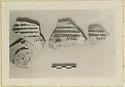
| Six non-joining pieces, five from the neck and one from the wall; rim with sloping top surface preserved. Decoration starting at top; maeander; narrow band of vertical lines set between zones of three ... 13 May 1937 |
| Fragment from wall of large heavy vase. Preserved is the forepart of a ship, to left, probably from under the handle, part of the attachment for which is preserved at the left.
Buff clay; black glaze ... 26 May-5 June 1936 |
| Broken all around. Fragment of very large vase.
Part of a chariot car, right, and lower part of draped figure standing in it. At left, part of a rosette.
Decoration in dull black glaze, somewhat peeled ... 27 February 1937 |
| Complete. Flat bottom; two horizontal handles applied at rim. On bottom, four-petalled rosette with swastikas; bands on body. Inside glazed, with reserved dot at center. On upper face of rim, series of ... 21 March 1936 |
| Three fragments, probably from the lower part of a krater on a high stand. Bordered at the top with four (or more) horizontal glaze bands. Below, procession of warriors to right, with spears and shield ... 1935 |
| About half of rim and fragments of wall missing. Restored in plaster. Small flat-bottomed knob as base; deep ovoid body; short concave neck; flat-topped rim.
Buff clay. Traces of black glaze on inside ... 9-12 February 1937 |
| From the neck of a large closed pot. At left, a tall narrow plant or tree, made of spirals flanking a stem. At right, what appears to be mane and part of the neck of a horse, right; filling, a swastika ... 12-21 May 1938 |
| a) Mended from five pieces, preserves part of a large object with flat floor and low ring foot, with the start of a vertical wall. Part of the finished edge of the wall, cut down in a curve, where the ... 10-13 May 1937 |
| Neck fragment. Glaze bands along top and bottom; a large long-necked bird walks right in figure zone.
Dull brownish glaze, much worn and peeled. Geometric well, lower fill, basket 11. Leica, 81-352 PD ... 17 March 1938 |
| Fragment from the wall of a kantharos(?), broken all around.
Black glaze on inside. On wall, a bearded male(?) figure to left; animal figure to right. Bodies in silhouette; head and limbs in outline; ... 16 February 1938 |
| Broken all around; fragment from upper part of wall of krater. Interior: dull black glaze. Exterior: part of a lion running right, head in outline. Filling ornament of dotted hook spirals from top and ... 13 June 1938 |
| From the body and shoulder of a closed pot: amphora or oinochoe. Below the shoulder, bands and a dotted lozenge chain. On the shoulder, a band of grazing deer right, birds in the field.
Dull black glaze, ... 12-15 March 1938 |
| Fragment from an open-work stand. Broken away above and below; but the top of the panel remains. In the panel, a composite palmette in flaky black glaze. Tholos trench BB, layer XI. 2691 Leica, 80-684, ... 4 May 1939 |
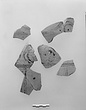
| Body fragments.
a) Part of a wing with incisions at the edges; guilloche in field.
b) Legs(?) and vertical running dog in field.
Glaze badly peeled. From tin. Protoattic pit. Leica PD 1045 ... March-April 1936 |
| About half. Similar to P 8178 (ΠΘ 1847), but much smaller, and with narrower plain rim. Two rings at center of floor; then linked stamped palmettes and rouletting.
Firm black glaze over all.
Cf. Agora ... April-May 1936 |
| One end of a hollow rectangular clay object; altar(?), fenestrated handle of large vase(?). Broken on all sides; one wall pierced. Tooth pattern and zigzag with diminishing triangles, and hook spirals ... 8, 25 February 1936 |
| From a very heavy walled pot.
a) the head of a bird (cock?) right. Filling ornament in field.
b) Mended from many pieces; horizontal and vertical zigzags between bands.
c) A bit of a lozenge pattern ... 22-28 February 1935 |
| Cuttings in under side for two channel dowels placed on radii alternating with dowels in top of base; dowels centered 0.20m. in from periphery.
From Stoa of Attalos.
Removed from poros bedding below base ... 5 August 1955 |
| Many fragments. Handle and base missing. Banded up to shoulder. Then solid, except for neck panel with grazing horse, head in outline.
Late Geometric.
ADDENDA In all respects = horse on Benaki amphora, ... (June 1955) |
| Low base ring with convex bottom.
Letters in relief about edge of base.
Unglazed.
Buff clay.
Type XXIX of Corinth collection.
Burned fill. Leica PD 1020 ... 19 May 1936 |
|
|