|
|
"Deep Pit" at 8/ΜΗ ... 6th-4th centuries B.C. |
4th century sandy fill west of Peribolos of the Twelve Gods, with animal bones, metal waste and much pottery. Estimated Grid ... 350-325 B.C. |
Fills from construction and reconstruction of a house. "Brown House" = House A (RSY Hesp. 20) (and pit under Layer 4) in the industrial area west of the Areopagus.
Under the original floor of this house ... Second half of the 5th. c. B.C. |
Trench at 11/ΚΕ cut into the stereo (length 1.40m, width 0.50m). Coins:
5 April 1932 #5 (illegible).
Red figure pottery; coarse ware ... Mid-5th c. B.C. |
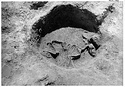
| Dog's Grave, the bones carefully disposed. It contained a small amount of contemporary pottery in the fill, of which some deposited nearby, may have been intended as offerings ... Third quarter of 4th c. B.C. |
Well under Poros Building Drain at 62/ΛΣΤ, west of the Areopagus. Digging abandoned at 6.10m due to a collapse of the soft bedrock at the west. Small amount of supplementary filling was added in the upper ... Ca. 520-480 B.C. |
Pit along house wall foundations to south = footing trench. Uncertain context, possibly no later than ca. 425 B.C ... 450-400 B.C. |
Unfinished well, south of the annex to the Poros Building, west of the Areopagus. The shaft was apparently never used as a well. The lower dumped filling contained a quantity of clean red clay, as if from ... Ca. 350-325 B.C. |
See cistern system wells F 11:2 and F 12:3, part of Tholos water system. Estimated Grid ... Ca. 350-294 B.C. |
Well on the lower north slope of the Areopagus. The pottery apparently belongs to a filling of one period, since it exhibited no marked difference in character to the bottom. No where was the deposit very ... Ca. 410-390 B.C. |
Narrow trench in bedrock; one section found to NE of Circular Building west of the Stoa of Attalos, another (Q 8:1) beneath the terrace of the Stoa of Attalos opposite Pier 19. A single filling in both ... Ca. 450-425 B.C. and shortly after |
"Foundry Pit": N-S Cut on 50m. line (area of Stoa, Layer VII, with slag). A foundry pit in the courtyard of a small metalworking establishment outside the Agora to the northwest.
Both the courtyard and ... Ca. 375-350 B.C. |
Square pit in bedrock southwest of the Hephaisteion. Many marble chips from the construction of the temple of Hephaestus were found here together with a large quantity of pottery and other objects ... Ca. 450 B.C.
Ca. 390-380 B.C. |
It is a considerable deposit including both figured and plain wares, the red-figure consistently of the second quarter of the 4th c. Estimated Grid ... Ca 375-340 B.C. |
Filling behind retaining wall of Stoa of Zeus. The remains of unfired clay adhering to the interior of various pieces make it probable that the material in this filling is a mass of debris from the floor ... Ca. 435-425 B.C. |
Bottle-shaped cistern with dumped fillings on NW slopes of Areopagus; appears not to have been finished in antiquity: the walls and floor show no traces of stucco.
Lower filling, ca. 375-340 B.C.
Upper ... Ca. 375-275 B.C. |
| An extensive cistern system on the lower north slope of the Areopagus, south chamber with blind tunnel extending further south (south tunnel); north chamber; drawshaft further north, extends to north tunnel ... Ca. 320-240 B.C. |
A small flask-shaped cistern on the lower southeast slope of Kolonos Agoraios. Lined with hydraulic cement and containing a large quantity of glazed table ware and a fair amount of coarse ware; a homogeneous ... 350-325 B.C. |
South Stoa II Construction Fill.
About 85 stamped amphora handles, many with parallels in building fills of Middle Stoa and Stoa of Attalos. Fragments of long-petal bowls confirm date after mid-2nd c ... To ca. 140 B.C. |
Well to N of Nymphaeum at 115/ΙΣΤ. A good water supply but no evidence for a period of use.
Exceptionally heavy dumped filling, including much fine tableware, many wine- jar fragments and other objects ... Ca. 420-400 B.C. |
|
|