|
|
| [Originally identified as kantharos]
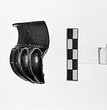
Two joining fragments from wall.
Three horizontal lines, above and below with groups of three concentric semicircles.
Very good glaze inside and out. Stoa Terrace, ... 1 December 1953 |
| Three joining fragments preserve part of lip and wall to just above foot. Body vertically ribbed; flaring lip separated from shoulder by raised moulding, cabled.
Good black glaze; reserved groove just ... 17-24 May 1940 |
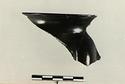
| Fragment from rim and wall. Very broad petal ribbing on the wall.
Excellent blue-black glaze. Rectangular pit. 1210 Leica ... 25 April 1957 |
| About half of wall and lip, with handle, missing; restored in plaster. Broad low ring foot; squat body with convex outline; neck slightly drawn in; wide mouth; plain everted lip. At base of neck a ridge ... 2-19 May 1939 |
Handle missing.
Ring foot. Bulbous wall. Incised on the front of the body opposite the handle, an olive branch. Reserved: the resting surface and underside ... Ca. 460 B.C. |
Part of rim, neck and wall.
Broad ribbing on the wall; flaring rim ... Ca. 470 B.C. (?) |
Part of rim, wall and neck.
Deep vertical ribbing on wall, joined at the top by arcs. Reserved line on the lowest part of wall ... 450-425 B.C. |
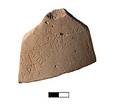
Fragment of wall.
Three horizontal incised lines, with groups of three con- centric semicircles above and below ... Ca. 450 B.C. |
| Black Glaze Mug: Ribbed ... AMS Horizontal (normal) ... 1989 |
Rectangular pit at 54/ΛΓ.
The pit's plan is irregular; its measurements approximately 2.00x1.10x1.15m. The wall foundations run a little over a meter deep at 53/ΛΓ-ΛΕ, consist of irregularly shaped and ... Ca. 450-425 B.C. |
West Terrace, South End, Layers IV and V. Heavy dumped filling associated with terrace walls at the extreme south end of the excavations in the Areopagus industrial area. The proportion of figured and ... Ca. 420-390 B.C. |
| This filling is the largest deposit of its time found in the Agora. It may be compared with H 6:5 and with N 7:3.
Dug in soft bedrock to a depth of 11.40m; footholds cut on opposite sides of the shaft ... Ca. 490-450 B.C. |
|
|