|
|
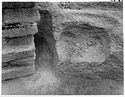
Cut down through the west back foundation of the Royal Stoa immediately to the east of the 'Cave' ... Byzantine ... Cut down through the west back foundation of the Royal Stoa immediately to the east of the 'Cave'. |
Fills associated with construction of New Bouleuterion, i.e. inside porch, unused foundation trenches on west side and south side ... Down to last quarter of 5th c. B.C ... Fills associated with construction of New Bouleuterion, i.e. inside porch, unused foundation trenches on west side and south side. |
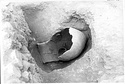
Well Y, in area North of the West end of the Yellow Poros Foundation. The shaft had cut through the wall of an earlier well and the cavity had been packed with stones by the diggers of the new well. In ... Earth 5th c. B.C ... Well Y, in area North of the West end of the Yellow Poros Foundation. |
Child's Chamber Tomb opposite piers 16-17.
Miniature chamber tomb complete with a dromos and a door closed with stones, but with a chamber measuring only 0.50m by 0.70m and just large enough to contain ... Myc. III B ... Lying about 15m se of Tomb XVIII, it is only a few meters to the west of teh foundation for the terrace in front of the Stoa of Attalos. |
| Hellenistic Pyre below packed clay floors of Room 2; west of Late Roman wall extension, below tile platform terracotta drain installation, bordered on the north by bedding foundation stones of crosswall ... Ca. 300 B.C ... Hellenistic Pyre below packed clay floors of Room 2; west of Late Roman wall extension, below tile platform terracotta drain installation, bordered on the north by bedding foundation stones of crosswall between rooms 2 and 3. |
| Mycenaean Grave to W of Pier 12 (Burial 11).
The northern part of the tomb had been cut away by the foundation trench for the south stylobate of the Square Building that preceded the Stoa, and the dromos, ... Myc. IIB-IIIA:1 ... The northern part of the tomb had been cut away by the foundation trench for the south stylobate of the Square Building that preceded the Stoa, and the dromos, if one existed, must have been lost in this operation. The chamber was small with an original east-west dimension of 1.60m and a preserved north-south dimension of 1.20m, the walls preserved to a maximum height of 0.90m. |
| RSY Grave 51.
The grave lay on the slope of the Areopagus in Roman house O, just east of the line where the hillside is scarped for the foundation of the west wall of the house.
Cutting:the pit cut in ... Archaic period/6th or 7th c ... The grave lay on the slope of the Areopagus in Roman house O, just east of the line where the hillside is scarped for the foundation of the west wall of the house.
Cutting:the pit cut in bedrock into which the burial was set measured 0.95m from north to south and 0.55m from east to west. Its depth was 0.65m. The burial urn, a pithos, was laid in the pit on its side, the mouth toward the south. A foundation wall of the Roman house passed close to the mouth of the pithos, for which we found no cover; one may have been removed when the foundation was laid. |
| Marcie Handler ... Continued from 2000 season, 10-12 July 2000; BZ XXIII p. 4472.
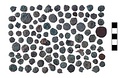
The hoard was originally excavated during the 2000 season (Lot BZ 1049, 5th-6th centuries AD), from a higher elevation through a gap in the ... 10-12 July 2000
21-22 July 2003 ... The hoard was originally excavated during the 2000 season (Lot BZ 1049, 5th-6th centuries AD), from a higher elevation through a gap in the stones of Wall A, and was thought to be the bottom of a foundation trench for the wall. ... A.D.
Foundation trench of N/S street wall, in ash pit. 53.505m-53.089m. -Basin on the west side of Room F. 53.084-53.275m. (2003)
17 coins: ΒΖ-1418 - ΒΖ-1434 |
| Pyre in Room 2, area west of street (RSY=Pyre 12).
In courtyard. Artifacts, bone, ash, carbon, and cinders in pit in floor sequence. The rectangular pit was cut into a white strosis with marble chips (ΠΠ ... 315-300 B.C ... Pyre in Room 2, area west of street (RSY=Pyre 12).
... It was disturbed by a robbing trench, not by an original foundation trench of the shed. |
| Pyre in House D, Room 4 (RSY=Pyre 4) in the industrial area west of the Areopagus.
Notebook refers to House N.
Pottery belongs late in third quarter of the 4th. c. BC. Pyre burned near beginning of last ... 350-300 B.C ... Pyre in House D, Room 4 (RSY=Pyre 4) in the industrial area west of the Areopagus.
... The pyre pit was dug through layer 1 and into layer 2, both of which overlay the foundation of the wall between rooms 3 and 4. |
| Pyre in House N, room 4 (RSY=Pyre 7), in the industrial area west of the Areopagus.
Pottery, mall pieces of calcined bone, log, wood cinders, and charcoal in diamond-shaped pit in floor sequence. The pyre ... Late 4th-early 3rd c. B.C ... Pyre in House N, room 4 (RSY=Pyre 7), in the industrial area west of the Areopagus.
... Layer 4 ran over the foundation of the wall between rooms 5 and 6; a layer of decayed mudbrick covered layer 4. |
Construction fill below floor of Brick Building.
Areas involved:
a) Western portion of Room A: packing below floor.
b) Room B: packing below floor of northern,larger room.
c) Fill over water channel in ... First quarter 2nd century, before its end ... Areas involved:
a) Western portion of Room A: packing below floor.
b) Room B: packing below floor of northern,larger room.
c) Fill over water channel in smaller, southern room B; channel discovered by builders of Brick Building,rebuilt by them and covered over.
d) Foundation trench of earlier building beneath Brick Building, filled and covered by builders of Brick Building.
e) "Apparently from below floor of building" (nb.p. 1282).
... Lot 20 "Ash, Carbon and Slag Fill, against the west face of dividing wall between Rooms A and B" of 1936 excavations including P 19790, SS 5379 and coin ΣΑ-16. |
|
|