|
|
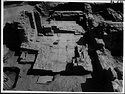
| Well in Room 7 of Roman House H, partially covered by caldarium of added bath complex (Room 6). Stone well-head; 0.85m in diameter. Stpped because of danger of collapse. Cut through bedrock, water from ... 6th c. A.D. |
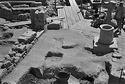
Well in Room 1 of south aisle of Stoa. The well is lined with bricks and tile. This lining is preserved to a level of 52.733 m., which is approximately the same as the level off the late threshold of the ... 5th-6th c. A.D ... Well in Room 1 of south aisle of Stoa. ... It was ca. 0.60 m. wide, and led from Well H 4:3 to a well in Shop IIa to the west. Broken drain tiles were found further up in the channel. Pottery from the channel was the same as that from the well. |
| Kevin Daly ... Grave in north room of Roman temple, west of well J 2:4; adult inhumation ... Late Helladic IIIC Late-Final Mycenaean/Submycenaean ... Grave in north room of Roman temple, west of well J 2:4; adult inhumation. |
| A well in the courtyard (Room 8) of a Byzantine House of Period II. The well was covered by a large squared poros wellhead and a marble puteal (apparently neither inventoried). Within the well shaft, the ... 14 July-9 August 1989
2-13 July 1990 |
Well at U/10-14/4, in Byzantine Room I.
Well is ca. 1.20m in diameter, dug into bedrock. Excavated to depth of roughly -8.00m; sides started collapsing and thus did not dig to full depth. Some stone-lining, ... June 15-16, 17-31 July 1972 ... Well at U/10-14/4, in Byzantine Room I.
Well is ca. 1.20m in diameter, dug into bedrock. ... Some stone-lining, varying in depth from 0.50m to 0.75m., between stone floor of room and beginning of bedrock. |
A well in room A of the Archaic House. Well with very irregular outline, cut down in the bedrock some 10m NE of the Tholos. Its filling yielded a handful of plain potsherds and the oinochoe P 13256 of ... Sub-Mycenaean(?) |
Well East of Stoa Room 11; no appreciable change in pottery top to bottom; dumped fill of Augustan times. Coins:
4 May 1950 #1-#3
15 May 1950 #1 Estimated Grid ... Late 1st c. B.C.-early 1st c. A.D ... Well East of Stoa Room 11; no appreciable change in pottery top to bottom; dumped fill of Augustan times ... Coins:
4 May 1950 #1-#3
15 May 1950 #1 |
Pit (Well?) under Building A, Room 2. Coins:
9 May 1949 #1-#2
11 May 1949 #4
12 May 1949 #3 (not a coin, bronze fragment in lotted metal tins ΠΠ 295). Estimated Grid
Remains of coloring matter found with ... Hellenistic-Early Roman ... Pit (Well?) under Building A, Room 2 ... Coins:
9 May 1949 #1-#2
11 May 1949 #4
12 May 1949 #3 (not a coin, bronze fragment in lotted metal tins ΠΠ 295). |
| Pyre in House N, room 2, layer 5 (RSY=Pyre 8).
Near northern corner of room 6. Artifacts, bone, burnt logs, and cinders in square pit dug from level of layer 5, through layers 5 and 6; thin clay floor ... 325-300 B.C ... Pyre in House N, room 2, layer 5 (RSY=Pyre 8).
Near northern corner of room 6. Artifacts, bone, burnt logs, and cinders in square pit dug from level of layer 5, through layers 5 and 6; thin clay floor laid over it. ... The pyre lies well below the mudbrick layer of wall decay in this room. |
| Well in Room 6 of Street Stoa U/2,U/3-13/15.
Associated with the building lying under the Roman Street Stoa. Its fills divided into 5 separate layers, with the bulk of finds belonging to Layer 1, the ... 14 June-21 August 1973 ... Well in Room 6 of Street Stoa U/2,U/3-13/15.
... It was noted at the time the well was dug that objects seem to come out in groups, i.e. ... It was also noted that there were joins between objects found in the well and those found in the fill immediately above it, suggesting that the whole area was raised at the time the well was filled in.
|
Pit at 79-83/ΜΒ-ΜΖ (or 81/ΜΣΤ=pit under floor of Room 11 in Roman Bldg. 2, 82/ΜΓ, 83/ΜΕ=well at 83/ΜΗ). Purpose of pit obscure. Evidently filled in Hellenistic times and disturbed in Roman times. Coins: ... 275-200 B.C. with later disturbance ... Pit at 79-83/ΜΒ-ΜΖ (or 81/ΜΣΤ=pit under floor of Room 11 in Roman Bldg. 2, 82/ΜΓ, 83/ΜΕ=well at 83/ΜΗ). ... Evidently filled in Hellenistic times and disturbed in Roman times ... Coins:
26 February 1937 #1-#2
27 February 1937 #2-#3
1 March 1937 #1
3 March 1937 #1
6 March 1937 #1-#3
9 March 1937 #1-#4
29 March 1937 #4
3 April 1937 #4-#6
5 April 1937 #3-#4
6 April 1937 #4-#8
7 May 1937 #1(well dump) |
Tile well at 52/ΛΣΤ, in the northern late Roman building in the room with the apse. The top was covered by a large stone, and the well had never been filled after the last period of use. water stood to ... Late 1st (?) cent.-early 3rd to 6th cent ... Tile well at 52/ΛΣΤ, in the northern late Roman building in the room with the apse. ... Below this point, there is much less pottery, and the last few baskets show clearly that the well was in use at least as early as the first half of the third century ... Coins
15 June 1938 #3-#4
18 June 1938 #1 |
| Brian Martens ... It was partially excavated during the 2012 and 2013 seasons. The tomb, located at the center of Room III in the NE area of section ΒΖ, was found under fill surrounding perpendicular mid-to late 6th c ... LHIIIA |
Fillings associated with early houses on the lower north slopes of the Areopagus; various levels and dates.
Both houses were built in the 6th century B.C. and destroyed by the Persians; both also have ... 6rd c. B.C.-3rd c. A.D ... Both houses were built in the 6th century B.C. and destroyed by the Persians; both also have later histories.
Southwest House, Rooms I-VIII, 42-55/ΚΖ-ΜΖ:
The earliest house had a court on the west with a Well (B) and two small rooms at the north. ... See also L 17:3 where objects SS 14318 and T 3576 are listed as part of the well deposit but are actually from the filling over the undug well, i.e. strosis 3, Room IV in Southwest House (nbp. 1393). |
|
|