|
|
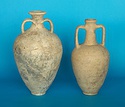
Amphora dump at P/2,3-6/6,8.
Layer "8b" in Room 6 of Greek House δ.
Trench cut into lower levels next to west wall of Room 6. Fragments of amphorai, tiles.
No coins ... Early Hellenistic ... Amphora dump at P/2,3-6/6,8.
Layer "8b" in Room 6 of Greek House δ.
Trench cut into lower levels next to west wall of Room 6. |
Pocket in bedrock behind stepped retaining wall ... 7th c. B.C. |
Unlined Pit at N/9-6/3,4 partially cut into wall of Mudbrick Pithos (N 6:1). Dimensions 1.20x 2.m.
Soft green-gray with wet sandust consistency. Large number of sea shells, fish and animal bones. No pottery, ... Turkish ... Unlined Pit at N/9-6/3,4 partially cut into wall of Mudbrick Pithos (N 6:1). |
| Pyre in layer 2a in Room 9 SE of Greek House δ. Sand, gravel, ashes, iron nails, carbon, some bones partially cut away by foundation trench of SYPE wall.
Coin
1 July 1971 #459 ... 260-200 B.C. |
Found while cleaning wall running east-west over 57. Contained late glazed pottery ... Byzantine |
Pit along house wall foundations to south = footing trench. Uncertain context, possibly no later than ca. 425 B.C ... 450-400 B.C. |
Plaster dump at Q/2,5-6/7,9.
Layer 5 in "Wall Painted Room" of Roman House ε. Layer resting on bedrock and covered partially by good strosis (55.26m.). Fill was red with mudbricks, tiles, much plaster ... Late 1st-early 2nd c. A.D ... Plaster dump at Q/2,5-6/7,9.
Layer 5 in "Wall Painted Room" of Roman House ε. ... The plaster fragments were restored into a large panel exhibited on the inner wall of the Upper Colonnade. |
Mudbrick Pithos at N/8-6/3.
Constructed in conical shape of mudbricks, including the floor. Top cut by modern basement wall. Diameter at floor 1.45m Coin
30 May 1930 #113 ... Byzantine ... Mudbrick Pithos at N/8-6/3.
Constructed in conical shape of mudbricks, including the floor. Top cut by modern basement wall. Diameter at floor 1.45m |
Pocket in bedrock, 50/Λ (= Trench, 50-54/Λ), measuring 4.00x0.60m, 0.60-0.90m deep; possibly cutting for wall foundation Coins:
22 April 1932 #1 ... 330-300 B.C. |
P.H. 1.98m; greatest diameter 1.70; wall thickness 0.20. The walls are of rubble set in clay, and the bottom is flat. Pottery was coarse Byzantine sherds but discarded except for one graffito ... 25 May 1956 |
| "Koumanoudes' Well.
Tile-lined well (diam. 0.85m) at SE corner of courtyard of Roman House E, at top built wall of stones and mortar, bedrock at bottom. Coin
7 August 1971 #495-#500
13 August 1971 #507 ... 28 July-6 August 1971 |
Well at 71/ΛΒ (diameter ca. 1.10m) near the east wall of the entrance porch.
Narrows toward bottom, collapsed at top. Six footholds preserved at south, three at north, spaced at ca. 0.50m. Uniform fill ... Late 8th in early 4th c. B.C. |
Investigations within the Stoa of Zeus, the north part, various levels.
Notebook references: Stoa Trench E Layers IV and V, Stoa Pits A, B and C, and Layers I and II of area between back wall and retaining ... 5th c. B.C. |
| Hole at 57/ΛΣΤ = Pottery Dump at 57/ΛΣΤ. May well have accumulated on the spot where it was found, its fragmentary state being attributable to the later rubble wall laid over it.
Cf. also P 19982 (ΟΟ ... Ca. 400-375 B.C. |
Nb page 5044: Great shapeless pit with a well (62/Ξ) at its bottom which we were unable to dig because it was too dangerous. Fill in the pit was of sand and white ash. The finds and pottery 4th. and perhaps ... Late 4th.-early 3rd. c. |
| Marcie Handler ... The remnants of a disturbed pyre in a layer of dumped Hellenistic fill. The fill was found in the area on top of and east of the eastern wall of the Classical Commercial Building at its north end. Fragmentary ... Ca. 225 B.C. |
| Marcie Handler ... The Pyre was revealed in a layer of 4th c. fill in the north end of Room 6, just south of Wall 8. Room 6 is defined by the street wall (Wall A) on the west, Wall 7 on the east, Wall 9 on the south (preserved ... 4th c. B.C ... The Pyre was revealed in a layer of 4th c. fill in the north end of Room 6, just south of Wall 8. Room 6 is defined by the street wall (Wall A) on the west, Wall 7 on the east, Wall 9 on the south (preserved only as a stub on the east side of the area), and possibly Wall 8 or Wall 6 on the north.
2.5 meters SW of the pyre, a patch of floor surface at J/10-1/20 at 52.188 masl. was found. |
Pits in area 96-100/ΝΕ-ΝΘ (lower east slopes of Hill of the Nymphs, near extreme west edge of excavated area).
Shallow pit in bedrock against N. face of wall. dMax. depth 0.20m.d.
Many fills in areas ... Ca. 325-300 B.C. |
| Pyre in House N, room 4 (RSY=Pyre 7), in the industrial area west of the Areopagus.
Pottery, mall pieces of calcined bone, log, wood cinders, and charcoal in diamond-shaped pit in floor sequence. The pyre ... Late 4th-early 3rd c. B.C ... Layer 4 ran over the foundation of the wall between rooms 5 and 6; a layer of decayed mudbrick covered layer 4. |
| Pyre in cut in E-W street, layer 7 (Pyre 14). North edge of Piraeus street, west of the Great Drain Bridge, in the area west of Areopagus.
RSY-Pyre.
Pottery, a little burnt bone, and patches of charcoal ... 250-240 B.C. |
| Disturbed pyre dispersed in fill of Room 5, House D.
Pyre pots in very fragmentary condition were noticed by Barbara Tsakirgis in later analysis of pottery that had been excavated in 1938; no mention of ... 14 June 1938 |
A well (diameter 1.10m) at the east edge of the valley road leading from the SW corner of the Agora, about 90m SW of the Tholos. The mouth of the well was subsequently covered by the east wall of the Great ... Ca. 500-480 B.C. |
| Laura Gawlinski ... Well in courtyard of Early Building I, adjacent to wall of Room B. Tile lined; upper course in situ, lower two collapsed probably in antiquity. Letters inscribed on rims (eta, phi, omicron, theta). Medium ... First quarter of the 4th c. B.C. |
Filling behind retaining wall of Stoa of Zeus. The remains of unfired clay adhering to the interior of various pieces make it probable that the material in this filling is a mass of debris from the floor ... Ca. 435-425 B.C. |
Filling in the footing trench of the late Roman Fortification.
Includes Layer 1 and Layer 2 of Library Colonnade opposite Room 2. "Note: both these layers are fill thrown into V.W. footing trench." (nb.p ... End 3rd. c. A.D ... Coins:
23 March 1933 #16-#19
24 March 1933 #4-#5(below layer of bricks 1.00m. east of
Ven. wall 24/ΙΗ)
26 April 1933 #1-#5
1 May 1933 #5-#8 (yellow fill against Venetian wall 36/ΙΑ)
27 May 1939 #6-#7
13 June 1939 #3 |
Small pit north of Wall C (appr. 0.50 E-W x 0.35m N-S). Coins:
11 August 1994 #1125-#1127 ... 3rd c. B.C. |
Burnt Layer inside retaining wall of Middle Stoa Terrace (Θ) and NW Corner of Middle Stoa, burnt debris inside terrace retaining wall (Ζ). Coins Ζ: Coins Θ:
1 June 1951 ... Mid-3rd c. A.D ... Burnt Layer inside retaining wall of Middle Stoa Terrace (Θ) and NW Corner of Middle Stoa, burnt debris inside terrace retaining wall (Ζ) ... Coins Ζ: Coins Θ:
1 June 1951 #2-#5 8 July 1947 #1-#4
2 June 1951 #1-#2 9 July 1947 #1-#4
4 June 1951 #1-#4
5 June 1951 #1-#2
6 June 1951 #1-#4
7 June 1951 #1-#2
8 June 1951 #1
9 June 1951 #1 |
Roman Water Mill: construction fill in footing trench of mill race wall Coins:
24 April 1933 #2-#30, #39-#40, #43-#44, #46-#67, #69-#76, #82-#95
25 April 1933 #30, #32-#35, #37-#40, #42-#43, #45, #47 ... 450-475 A.D ... Roman Water Mill: construction fill in footing trench of mill race wall ... Coins:
24 April 1933 #2-#30, #39-#40, #43-#44, #46-#67, #69-#76, #82-#95
25 April 1933 #30, #32-#35, #37-#40, #42-#43, #45, #47
26 April 1933 #16-#21, #23-#28, #30-#31
28 April 1933 #6-#9, #11
8 May 1933 #4-#8
9 May 1933 #2-#11, #14-#15
10 May 1933 #6-#10, #12-#23
15 May 1933 #4-#7
23 May 1933 #1-#2, #4-#6, #13
20 June 1933 #4, #6
21 June 1933 #9-#10
22 June 1933 #1-#3
23 June 1933 #10-#11
26 June 1933 #1-#3, #6-#19
27 June 1933 #3-#5
28 June 1933 #2
6 July 1933 #6-#7
7 July 1933 #1-#12, #14-#15, #18 |
Called a Turkish pit, located under a Byzantine wall and filled with an upper level of Byzantine material under which a level of Roman material. Coins:
5 April 1932 #1-#3
6 April 1932 #1-#5
7 April 1932 ... 6-11 April 1932 ... Called a Turkish pit, located under a Byzantine wall and filled with an upper level of Byzantine material under which a level of Roman material ... Coins:
5 April 1932 #1-#3
6 April 1932 #1-#5
7 April 1932 #1-#2 |
House C, Room 4 (Pottery dump of stamnos wall and fill below floor). Coins:
1 July 1947 #13
2 July 1947 #1
Coins from House IV:
14 May 1947 #1-#2
19 May 1947 #6-#7
20 May 1947 #32 ... First half 3rd c. B.C ... House C, Room 4 (Pottery dump of stamnos wall and fill below floor) ... Coins:
1 July 1947 #13
2 July 1947 #1
Coins from House IV:
14 May 1947 #1-#2
19 May 1947 #6-#7
20 May 1947 #32 |
Hellenistic fill, north of Temple of Ares, on either side of wall running east-west over 50/ΙΓ. Mostly coarse pottery including many stamped amphora handles.
Cf. also nb. P XII, pp. 2297-2298. Coins:
13 ... 275-200 B.C. |
| John Camp ... Burial north of Roman temple, E. of polygonal wall.
The tomb, as preserved, consisted of the cinerary urn, which stood in an upright position, its upper part damaged by later disturbance. It contained ... Late Helladic IIIC Late-Final Mycenaean/Submycenaean ... Burial north of Roman temple, E. of polygonal wall.
The tomb, as preserved, consisted of the cinerary urn, which stood in an upright position, its upper part damaged by later disturbance. It contained the cremated remains of a child aged 6-8 years at death |
The data in the Deposit Notebook is presented by trench; an attempt is made here to accumulate data from similar layers across the trenches. Subdivisions:
.1=Post Hadrianic cleanup
.2=Marble working waste ... 2nd c. B.C.-3rd c. A.D ... Subdivisions:
.1=Post Hadrianic cleanup
.2=Marble working waste
.3=Iron working waste
.4=Industrial period
.5=Construction fill of South Stoa II
.6=Drain and drain channels/trenches at Stoa back wall |
Trial trench IV. A thin strip of undisturbed fill excavated on the north side of the upper terrace, just inside the line of the Archaic peribolos wall.
Probably this small patch of clay represents part ... Protoattic ... A thin strip of undisturbed fill excavated on the north side of the upper terrace, just inside the line of the Archaic peribolos wall.
Probably this small patch of clay represents part of the ground surface of the sanctuary in the 7th century, pressed into the high bedrock.
Uncatalogued material: 43 sherds and 6 figurines ... Terracotta Figurines (6): 3 columnar type.
|
| Marcie Handler ... A deposit of six amphorae and one micaceous water jar was excavated between 20 June and 6 July 2005 in the area north of Wall K. The neck and one handle of one of the amphorae (BZ 1213) had been poking ... Ca. 1st c. A.D ... A deposit of six amphorae and one micaceous water jar was excavated between 20 June and 6 July 2005 in the area north of Wall K. |
Two pebble floors of Roman date, broken into at the SE and north, covered a 6x5m trench in ΕΛ, bounded by the unexcavated east trench and a wall from Byzantine Building D (Wall A). Under these pebble floors ... 220 - 150 B.C. |
Ostrakon Pit (Horos Terrace Trench). Oval pit cut into bedrock. Packed filling of stones, coarse sherds and roof tiles; among these a few fragments of finer vases and 22 ostraka, probably from the ostracaphoria ... Ca. 490-480 B.C. and later ... Some joins also from Strosis 6-7 against polygonal terrace wall, outside pit. |
Investigations to the south of the Metroon, in the passageway between the Metroon and the Tholos; accumulated layers, from the Geometric and earlier periods to the 3rd and 2nd centuries B.C.
Cf. Hesperia ... Geometric to second c. B.C ... Hesperia 6 (1937), p. 131, fig. 71, for a section of the layers, and notebook p. 1169 for a sketch plan of the area delineated by this deposit.
... However, as it represents an area south of the polygonal wall it has been included with G-I 11-12 and the other Tholos Trenches of section Ζ. |
| Pyre in House N, room 2, layer 5 (RSY=Pyre 8).
Near northern corner of room 6. Artifacts, bone, burnt logs, and cinders in square pit dug from level of layer 5, through layers 5 and 6; thin clay floor ... 325-300 B.C ... Near northern corner of room 6. Artifacts, bone, burnt logs, and cinders in square pit dug from level of layer 5, through layers 5 and 6; thin clay floor laid over it. Young identified layer 6 as the latest house floor and concluded that this pyre was buried after the abandonment of the house. ... The pyre lies well below the mudbrick layer of wall decay in this room. |
Investigations in the Hellenistic Metroon, various levels. Stoa Pits A, B, C, D, E, F, H and I (various layers).
Locations include:
SW corner of Primitive Bouleuterion; from contemporary filling alongside ... 8th-6th c. B.C. |
A filling lying over a cobbled floor in a house-complex on the lower north slopes of the Areopagus.
Area in front of E-W retaining wall, just above cobble pavement, disturbed by coins and pottery as late ... 375-275 B.C ... Area in front of E-W retaining wall, just above cobble pavement, disturbed by coins and pottery as late as the 3rd c. ... Coins:
21 May 1932 #2
25 May 1932 #6-#7
26 May 1932 #1-#3 |
| North of House G (RSY=Pyre 13).
Concentration of artifacts, small pieces of bone, and burnt material in stratum, no pit discerned. The pyre is cut by the trench of a wall of a Roman house to north. It ... 290-250 B.C. |
Two chambers connected by a tunnel, all filled at the same time, but with slight Hellenistic disturbance. Chamber A, to west at 14/ΛΗ, B to east at 14-15/ΛΒ on grid for section RR.
Cistern system ca. 20.00m ... Ca. 325-275 B.C ... B.C. very possibly ca. 277/6 (see Garden article), the southerly side of Kolonos, outside the Precinct Wall, was levelled off and the double cistern were cut down and filled p. 833 ... Coins:
4 February 1936 #1
5 February 1936 #1
6 February 1936 #1-#2
8 February 1936 #3
10 February 1936 #1-#3
12 February 1936 #1-#13
13 February 1936 #1-#6
14 February 1936 #1 |
Built against the south wall of the annex to the Poros Building
west of the Areopagus. At the west the upper layer of marble chips carried against it, the lowest were cut by it.
Part of same system as ... 225-100 B.C ... Built against the south wall of the annex to the Poros Building
west of the Areopagus. ... Coins:
8 April 1949 #17-#20
9 April 1949 #1-#6 |
Well at 115/ΣΤ (all the 5th c. fills of 116/ΣΤ). The lower part of the shaft contained a heavy deposit of pottery and other objects of the late archaic period, both coarse and finer wares; probably a post-Persian ... Ca. 500-480 B.C.-Roman ... A Roman well at 116/ΣΤ (D 15:2) was subsequently dug beside it, and later the party wall between the two broke at two points, allowing some of the filling from D 15:1 to fall into the deeper shaft of D 15:2; there is thus no stratification.
... Coins:
7 June 1937 #1-#6 |
West Road and Drain. (Road, drain and closely related cuts.) Packing in line of ancient road running along the northwest shoulder of the Areopagus. Includes excavation of 1957 titled "Road Area to North", ... Late 6th c. B.C. - Roman ... Coins:
19 April 1939 #2
24 April 1939 #4-#9
25 May 1939 #2-#3
29 May 1939 #1-#3
30 May 1939 #16
31 May 1939 #1-#4
5 June 1939 #1
13 June 1939 #1-#2
16 June 1939 #1
17 June 1939 #1-#2
20 June 1939 #1-#3
21 June 1939 #15-#22
22 June 1939 #1-#6
23 June 1939 #1-#8
17 April 1957 #2-#3
30 April 1957 #2, #7-#8
7 May 1957 #2-#3
9 May 1957 #1-#3
10 May 1957 #1-#3
11 May 1957 #1-#7
13 May 1957 #1-#5
14 May 1957 #1-#20
15 May 1957 #8
16 May 1957 #1
20 May 1957 #6 (east of road against east face of road)
25 May 1957 #1-#4 (late drain in A9 ... around lead pipe)
29 May 1957 #2 (E-W drain next to South Wall of A2)
30 May 1957 #2 (East drain in road ca. |
|
|