|
|
Drain Trench at 62/ΜΗ.
The presence of a number of fairly well preserved vases of good quality suggested to the excavator the possibility that the cutting might once have contained a burial. No skeletal ... 325-300 B.C. |
Well at SE corner of Court of Late Roman Building (Trench C). Estimated Grid ... 12th c. A.D. |
Unstratified pit below east part of Odeion Cavea (Trench K).
Brann Well or Pit O. Estimated Grid ... To ca. 725 B.C. |
7th c. well below east part of Odeion Cavea Trench K). Use filling negligible; dumped filling of the second half of the 7th c. B.C.
Brann Well H. Diameter 1.10m. Cut into bedrock. During excavation seepage ... 650-600 B.C. |
| Eugene Vanderpool ... Grave (E.L. Smithson: Grave XVI: PG). Bones discarded.
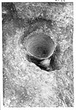
Only the lower portion of the urn-hole was preserved in bedrock, roughly oval in outline, with a maximum preserved width at the top of 0.70m narrowing ... Late Protogeometric/Early Geometric I |
| Eugene Vanderpool ... Grave (adult female). (In some records as Grave XXXI).
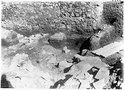
The tomb was partly destroyed in antiquity; there are sherds of all periods down to Late Roman (and later) note din the fill immediately above it ... Middle Geometric I ... The cinerary urn, probably once stood in a shallow sinking a little in from the northwest end (cf. trench-and-hole). the cutting itself proved to be an enlargement of the mouth of the filled in Protogeometric well M 17:5. |
| Eugene Vanderpool ... Grave (E.L. Smithson: Grave II: SM).
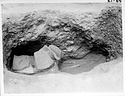
Unlined trench, roughly the size of the deceased, cut into bedrock to a depth of just over 1.50m. Oriented north-south, the tomb pit measured 1.69m in length (length ... Late Mycenaean/Submycenaean-Earliest Protogeometric |
| Dorothy Burr Thompson ... Grave 2. Urn cremation (trench-and-hole). In some records as XXIII.
Variously labeled as grid 7/Δ, 7/Γ and 7/Γ-Δ.
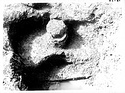
Rectangular pyre trench cut through earth into bedrock, with only the lowest 0.04m surviving ... Transitional Late Protogeometric/Early Geometric I ... Urn cremation (trench-and-hole). In some records as XXIII.
... Rectangular pyre trench cut through earth into bedrock, with only the lowest 0.04m surviving. ... The pyre trench measured about 1.25m long and was 0.52 m wide. |
|
|