icon

[Agora Notebook Page] Η'-12-53 (pp. 2249-2250)

Temple of Zeus and Athena. Fragments of Doric Entablature. Clearing East Front. Great Drain. Clearing South Part of Section. In North Part of Section. Clearing in South. Rehabitation for Re-use in North ... Η'-12 2249, 2250 A 376 A 377 A 378 A 379 S 1222 A 1198 A 1199 ... 1934 ... Temple of Zeus and Athena ... Fragments of Doric Entablature ... Traces of Parapet on West

icon

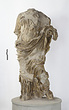
[Agora Object] S 1882: Draped Female Figure and Fragments: Aphrodite

a) Fragment showing folds of himation over left arm. Arm was inset and attached with a square dowel. b) Draped torso (?) fragment. On one face flat folds appropriate to himation on back of figure. This ... a)-c) (ΚΤΛ 375) November 1954 (Ι 1680) 1959 ... fragment. On one face flat folds appropriate to himation on back of figure. This is from the left side of the figure at knee. c) An end of drapery, probably himation, modeled only on front. ... a)-c) (ΚΤΛ 375): Among miscellaneous sculpture fragments in west court. (Ι 1680) Figure: Demolition of the south and west walls of the tower of Late Roman Fortification Wall at the S.W. corner of the Library of Pantainos.

[Agora Webpage] AgoraPicBk 16 2003: Middle Stoa

http://agathe.gr/guide/middle_stoa.html

Middle Stoa The appearance of the south side of the Agora was radically changed during the 2nd century B.C. with the construction of several new buildings. This South Square, as it is called, was made ... First to be built was the Middle Stoa, which ran east–west across the old square, dividing it into two unequal halves and obscuring one of the original boundary stones at its western end. At just under 150 meters long, it is the largest building in the Agora, with colonnades at both north and south as well as down the middle. Traces of a narrow parapet that ran between some of the columns can be made out on individual drums. The original steps and three columns remain in situ at its eastern end; to the west, only the heavy foundations of reddish conglomerate survive.