|
|
Half of wall and rim missing.
Flaring foot; flat, narrow resting surface; pointed underside.
Strongly flaring rim. Rouletting on floor. Very micaceous, reddish yellow fabric (5YR 6/6); shiny red glaze ... 150-125 ... Agora V, p. 14, under F 34 ... H. A. Thompson 1934, D 12, p. 371 |
One-third of rim restored.
Outwardly beveled resting surface; slightly convex underside. Lower body nearly horizontal, upper body slightly flaring. Two circles on floor. Very micaceous, reddish yellow ... 150-125 ... Agora V, p. 14, under F 34 ... H. A. Thompson 1934, D 10, p. 371, fig. 56 |
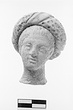
| First interpretation: female head.
Broken off at neck.
Heavy draped wreath around head.
ADDENDA, D. Burr-Thompson: Male head.
Blond clay. 100-104/* Great Drain to east and west overflow.
Sand Hellenistic ... 25 May 1939 |
Intact.
Flat underside with string marks. Shallow bowl with echinus profile.
Two small lug handles opposite one another at rim, one larger one between them. Soft, micaceous, reddish yellow fabric (5YR ... 325-275 ... Nearly identical: P 252 (H. A. Thompson 1937, pp. 207--208, fig. 125:d). ... Miller 1974, no. 70, p. 239, pl. 34 [F 16:8]), P 11755 (J 18:7), P 22831.
|
Floor fragment with start of stem. Part of surface pitted. Max. dim. 0.082. H. A. Thompson, Hesperia 23, 1954, pl. 15:d.
I, symposiast (head, shoulders, upper part of left arm, both legs from the knee ... Ca. 500 B.C ... H. A. Thompson, Hesperia 23, 1954, pl. 15:d.
... For a symposiast with a stick, but not holding it, see Göttingen, no no. by the Antiphon Painter (Paralip. 362, 9 ter; Addenda 218); Berlin 2286 by the Triptolemos Painter (ARV2 365, 59; Addenda 223); two by the Foundry Painter: Kassel T 664 (ARV2 401, 10 bis; Paralip. 370, 10 bis) and Christchurch, N.Z., Univ. of Canterbury 17 (ARV2 403, 34; Paralip. 370, 34); two by the Painter of the Paris Gigantomachy: Toronto 357 (ARV2 419, 34) and Seattle 20.35 (ARV2 420, 62); Munich 2646 by Douris (ARV2 437, 128; Paralip. 375, 128; Addenda 239; Buitron-Oliver, Douris, p. 83, cat. no. 173, pl. 96). |
Body fragment with small missing pieces restored in plaster and painted. P.H. 0.123; P.W. 0.172. M. F. S. Hood, ArchReports, 1957, p. 4, fig. 1:b; H. A. Thompson, AA, 1957, cols. 59--60, fig. 2; Fasti ... Ca. 490 B.C ... Hood, ArchReports, 1957, p. 4, fig. 1:b; H. A. Thompson, AA, 1957, cols. 59--60, fig. 2; Fasti arch. 12, 1957, pl. 7:18; H. A. Thompson, Hesperia 27, 1958, pl. 45:d; BCH 82, 1958, p. 666, fig. 16; B. ... Graffito to left of panel (Fig. 34). Preliminary sketch. |
Wall and shoulder fragment with start of neck. Thin, brownish glaze here and there on inside. Max. dim. 0.069. H. A. Thompson, Hesperia 17, 1948, pl. 68:5; Choes and Anthesteria, p. 93, cat. no. 245 bis, ... Ca. 450-440 B.C ... H. A. Thompson, Hesperia 17, 1948, pl. 68:5; Choes and Anthesteria, p. 93, cat. no. 245 bis, fig. 388:g; F. ... McNiven, JHS 109, 1989, pl. 3:d; B. Andreae and C. ... For the subject, see Brommer, Heldensage3, 445, B 1; in more detail, with discussion of the various times Odysseus disguised himself, see Brommer, AA, 1965, cols. 115--119, where he opts for the scene on 689 as the one in which Odysseus is wounded by Thoas; also Brommer, Odysseus, pp. 34--35. Brommer has misunderstood the curved lines on Odysseus' right arm when he calls them welts or wounds inflicted by Thoas.
|
|
|