|
|
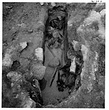
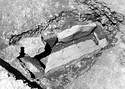
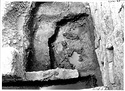
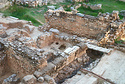
| David Scahill ... Roman temple north. Adult male inhumation. Pit tomb, partially stone-lined ... Late Mycenaean or Final Mycenaean/Submycenaean ... Adult male inhumation. Pit tomb, partially stone-lined. |
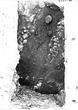
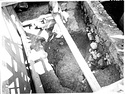
Pit under fallen stone at 13/ΜΔ Recorded in Ω Books (no page) ... Pit under fallen stone at 13/ΜΔ |
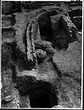
| Stone-curbed Pit (Sacred Pit) to North of Altar of Ares.
An accumulation of votives dating at least from the middle of the 7th. c. B.C. into the early 5th. c. Finds include those from the immediate area ... 7th-5th c. B.C ... Stone-curbed Pit (Sacred Pit) to North of Altar of Ares.
... Finds include those from the immediate area around and above pit, as well as those from inside the pit proper. |
Mycenaean Grave (grave with kylikes).
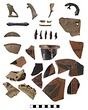
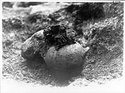
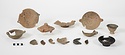
Small irregular pit (about 0.70m by 0.45m by 0.50m deep). it was full of Mycenaean sherds and fragmentary pots, mostly kylikes, but also contained occasional scraps ... Mycenaean IIIB-C ... Small irregular pit (about 0.70m by 0.45m by 0.50m deep). it was full of Mycenaean sherds and fragmentary pots, mostly kylikes, but also contained occasional scraps of bone and several small stone slabs lying in no order. ... Therefore the identification as a refuse pit seems more likely.
|
Slag pit in front of South Stoa II. The filling consisted ... of a very miscellaneous lot of stone and marble. ... In among the stones was a loose filling of ash and charcoal and iron slag ... (nbpp. 6510, ... Second half 1st c. A.D ... Slag pit in front of South Stoa II. The filling consisted ... of a very miscellaneous lot of stone and marble. ... |
Pit in Tholos Trench V (below Layer e).
In plan it would seem to have been oval, though its east end is c/../ by the south wall of the North Archaic Home. Its N-S width is 1.25m, its E-W length is 1.40m ... 7th-early 6th c. B.C ... Pit in Tholos Trench V (below Layer e).
... We found it full of gravel and fine, broken stone. |
| Eugene Vanderpool ... Infant grave near Phaidon street cistern. No offerings.
Roughly rectangular, almost elliptical cutting in bedrock, measuring 0.70m long, 0.35m wide, and 0.40m deep, oriented south-southwest to north-northeast ... Late Helladic III C/Early Protogeometric (date uncertain) ... The skeleton of what was stated to be a "newborn infant," head to the south-southwest, was laid out within the pit and covered by a stone slab.
|
| E.D. Townsend Vermeule ... Protogeometric Grave no. 2 at North of Temple of Ares (Grave XXXVII). Rectangular stone-lined pit in filling of Mycenaean chamber tomb (J 7:2); the skeleton of a boy. Cf. P 21275 which is from the "preliminary ... Middle Protogeometric ... Rectangular stone-lined pit in filling of Mycenaean chamber tomb (J 7:2); the skeleton of a boy. |
| John Camp ... Protogeometric Grave about 0.60m to the southeast of T 15:2.
Unlined roughly rectangular-elliptical pit, oriented north-south, neatly cut into bedrock to a depth of 0.70m, with rounded corners. The pit ... Early-Developed Protogeometric ... Unlined roughly rectangular-elliptical pit, oriented north-south, neatly cut into bedrock to a depth of 0.70m, with rounded corners. The pit measured 1.70m long by about 0.67=0.72m wide; its floor is at 68.40masl. ... There were no trace of stone slabs or ledges. |
| Mycenaean Double Grave (Graves A and B).
Grave A was in Layer II. We laid a skull and a few other bones, three vases and a stone bead. We have dug to a maximum of about 0.06m below the top of Layer II ... Myc. IIIA/B |
| Eugene Vanderpool ... Grave (E.L. Smithson: Grave II: SM).
Unlined trench, roughly the size of the deceased, cut into bedrock to a depth of just over 1.50m. Oriented north-south, the tomb pit measured 1.69m in length (length ... Late Mycenaean/Submycenaean-Earliest Protogeometric ... A roughly rectangular stone slab rested on the ledges above the head of the deceased, while fragments of a pithos (or pithoi), also resting on the ledges, covered the deceased down to the thighs. ... Within the tomb pit, the body of a middle-aged 45-49 years at death was placed in an extended position, on her back, head to the south. The body of the deceased was roughly the size of the tomb pit, and the head, turned toward the west, facing west-northwest, lay right up against the cutting of the tomb pit. |
| Grave 2 in notebook. Child of about two (or 10?) months, body placed in plain pithos, which rested on its side at the bottom of a pit; the mouth closed with a stone slab.
The burial forms a group with ... 750-725 B.C ... months, body placed in plain pithos, which rested on its side at the bottom of a pit; the mouth closed with a stone slab.
|
Rodney S. Young ... Grave 1 in notebook. Slightly disturbed by the digging of Pit A.
A large oil jar/amphora lay on its side with a flat stone stopping its mouth. The three small vases offered at the burial were found, together ... Ca. 600 B.C ... Slightly disturbed by the digging of Pit A.
A large oil jar/amphora lay on its side with a flat stone stopping its mouth. |
| Rodney S. Young ... Grave 2 in notebook (E.L. Smithson: Grave XV: PG). Urn cremation (trench-and-hole), adult female.
JP
It consists of a roughly rectangular pit or trench cut into bedrock to a depth of 0.35m., measuring ... Late Protogeometric ... JP
It consists of a roughly rectangular pit or trench cut into bedrock to a depth of 0.35m., measuring 1.12m long and 0.67m wide. ... The urn-hole, cut to a depth of 0.62m., measured roughly 0.40m in diameter. the urn-hole itself, but not the rectangular trench of the tomb, was sealed by a large, flat stone, broken in situ. |
| Susan I. Rotroff ... Burial 3 beneath the floor of the Stoa Basileios. It consisted of a rectangular pit cut into bedrock to a depth of 0.44m, lined on all sides and covered with an admixture of narrow stone slabs of soft ... Final Mycenaean/Submycenaean ... It consisted of a rectangular pit cut into bedrock to a depth of 0.44m, lined on all sides and covered with an admixture of narrow stone slabs of soft limestone, sandstones, and schist, varying in thickness between 0.020 and 0.150m. Most of the cover slabs were small, but the larger, main cover stone measured 0.46mx0.85m; it had collapsed on one side into the grave, but caused virtually no damage to the contents of the tomb.
|
| Dorothy Burr Thompson ... Grave 1. Urn cremation (trench-and-hole), adult female 30-40 years old).
Mentioned as Grave XVII in Deposit list.
Consisted of a roughly circular pit, approximately 0.30-0.40m in diameter, cut into ... Late Protogeometric ... Consisted of a roughly circular pit, approximately 0.30-0.40m in diameter, cut into soft bedrock against the face of an outcrop of natural rock, described by the excavator as limestone, to a depth of about 0.35m. P 325 served as cinerary urn and was placed upright within the pit and firmly fixed in place by small stones packed tightly around the amphora from shoulder to mouth.
... A few remnants of a stone packing beside the urn-hole, on the north side, probably once continuous with the packing around the urn, contained a few burned sherds, clearly pyre debris.
|
| Eugene Vanderpool Homer A. Thompson ... Mycenaean Grave to W. of "Court Room" below Stoa Terrace with "Ballot Box" (Grave XXIX).
Unusual type, conforming neither to our pit nor to our cist graves, and consisted of two parts. The outer part was ... Mycenaean III A-B ... Unusual type, conforming neither to our pit nor to our cist graves, and consisted of two parts. The outer part was a rectangular pit (2.10 by 1.30m) cut down in the soft bedrock to a depth of ca. 0.90m, with both long sides walled with field stones, leaving a passage only 0.45m wide in the middle. ... The inner part of the grave was revealed when the stone packing along the north side had been removed. |
Mycenaean Deposit (Gully) in front of NE Stoa (corrected from P 7:1).
It consisted of a series of irregular pits, some gradually linked up with one another to form what seemed a natural gully. The largest ... Mycenaean IIIA-B ... The largest pit measuring 1.70m east-west by about 1.20m north-south and having a maximum depth of 0.90m was situated from five to ten meters northeast of the gully proper and was cut at the north by the back wall of Northeast Stoa, which was set down a little into it.
The gully itself ran in a southwesterly direction and yielded about twenty small painted sherds, fragmentary cooking pots, unglazed kylix stems, fragments from pithoi and other coarse pots, as well as part of a stone grinder and many animal bones.
Apparently in both pit and gully we are dealing with a mixed fill, not of one homogeneous phase, and consisting partly of household refuse. |
| Mycenaean tomb: Myc. III A:1-2.
SAI
Small rectangular chamber, 2.30m wide by 1.80m deep,, entered from the east through a dromos 1.10m wide which contracted to a doorway 0.92m. wide. the doorway preserved ... 2nd half of 14th c ... SAI
Small rectangular chamber, 2.30m wide by 1.80m deep,, entered from the east through a dromos 1.10m wide which contracted to a doorway 0.92m. wide. the doorway preserved its rough stone blocking wall to a height of 0.70m to 0.80m., and the dromos the firm red earth with which it had been packed to a height of 1.30m.
... Several earlier interments had been swept aside; some bones were found in the corners of the chamber. others in a small pit (0.55x0.30x0.23 deep)near the southeast corner |
| Marcie Handler ... The pyre was revealed under a layer of mixed fill with pottery dating from the 3rd century B.C. to the 1st century A.D. Five pots were immediately visible (BZ 1318-1321, 1333) in a shallow pit surrounded ... 23 June-4 July 2006 ... Five pots were immediately visible (BZ 1318-1321, 1333) in a shallow pit surrounded by grayish black ashy fill, and all but one of the pots were placed upside down. The pots were arranged in a crescent-shaped array along with a lump of slag and a stone (both saved in the lot). |
| Mycenaean Tomb to NE of Pier 19 (Burial #1)
Most of the doorway and the dromos had been cut away by the ancient Stoa builders. The dimensions of the chamber were 2.90m wide by 1.60m deep. Unusual features ... Myc. III A:1 ... Unusual features of the tomb were a small recess in the back or south wall, in which stood the askos, and a rough stone slab which was found on the floor near the center of the east side, but which may once have been a grave marker at ground level.
... In the southeast corner and along the west wall there were swept-up piles of bones and offerings from earlier burials, and in the northwest corner there was a small round pit (0.50m in diameter by 0.20m deep) full of bones. |
| Margaret Crosby ... Grave 1 (Grave XXVI: EG) Urn cremation (trench-and-hole), adult male?
[JP]
Boots or Booties Grave. Near the west branch of the Great Drain, about 100m to the southwest of the Agora horos inscription ... Early Geometric I ... According to Young's publication "the burial found in 1948 to the southwest of the Agora, was made in a pit cut into the bedrock, roughly rectangular in shape, with a maximum east-west width of 0.65m. ... There were no traces of burning on the bottom or the sides of the pit itself, which was in any case too small to have held the pyre. ... A deeper hole at the southwest corner of the pit, going to a total depth of 0.80m, served to hold the amphora containing the ashes, which was placed upright in it and packed around with small stones to keep it in place. |
| Marcie Handler ... Cist grave for two infants. The grave was cut into a sterile rocky layer on its southern and western sides, and a sterile fill layer on its northern and eastern sides. No obvious grave marker was present, ... Early Iron Age ... The cutting for the grave pit measured 0.91m in length and o.64 m. in width. During excavations, only one skeleton was visible in-situ on the stone bedding. A vertical-handled amphoriskos (ΒΖ 2187) was found near the left shoulder of the skeleton, while a one-handled cup (ΒΖ 2189) was found alongside the skeleton's lower right leg. |
|
|