|
|
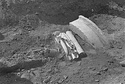
| The moulding Σ 2243 and the piece of sculpture Σ 2244, as found. From the southeast ... AMS Horizontal (normal) ... The moulding Σ 2243 and the piece of sculpture Σ 2244, as found. |
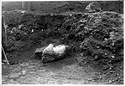
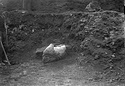
| Statue of Dionysos as found in wall ... 6 Mar 1935 |
| Statue of Dionysos as found in wall ... AMS Horizontal (normal) ... 6 Mar 1935 |
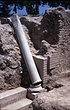
| East column at entrance to Room 3, as found ... =86-401/Roman House H in notebooks. (SD) east ... August 1970 |
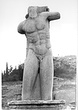
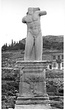
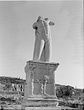
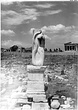
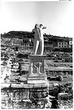
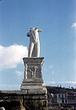
| Giant in easternmost position in the "Gymnasium" series. The Late Roman Complex was identified as a Gymasium because of its scheme and of an inscription found by Pittakis in 1848 alongside the colossal ... This is OD 181. The neg. was destroyed and replaced by one that is not 88-461 as mentioned on print.(SD) south |
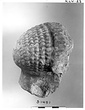
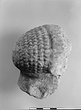
| Fragment of female head, hair in wavy locks drawn towards nape. Proper right side. Pentelic marble. Found in a pit between the Temple of Ares and the altar foundation. Possibly from the same series as ... 4 Aug 1950 |
| Fragment of female head, hair in wavy locks drawn towards nape. Proper right side. Pentelic marble. Found in a pit between the Temple of Ares and the altar foundation. Possibly from the same series as ... AMS Horizontal (normal) ... 4 Aug 1950 |
| Giant in easternmost position in "Gymnasium" series. The Late Roman Complex was identified as a Gymnasium because of its scheme and of an inscription found by Pittakis in 1848 alongside the colossal figures ... south Horizontal (normal) ... ca. 1946 |
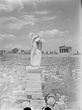
| Giant in easternmost position of the "Gymnasium" series. The Late Roman Complex was identified as a Gymasium because of its scheme and of an inscription found by Pittakis in 1848 alongside the colossal ... AMS southwest Horizontal (normal) ... 1949 |
| Giant in easternmost position of the "Gymnasium" series. The Late Roman Complex was identified as a Gymasium because of its scheme and of an inscription found by Pittakis in 1848 alongside the colossal ... southwest ... 1949 |
| Giant in easternmost position of the "Gymnasium" series. Front view. The Late Roman Complex was identified as a Gymasium because of its scheme and of an inscription found by Pittakis in 1848 alongside ... AMS south Horizontal (normal) ... 1949 |
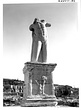
| Giant in easternmost position of the "Gymnasium" series. Proper right side. The Late Roman Complex was identified as a Gymasium because of its scheme and of an inscription found by Pittakis in 1848 alongside ... AMS west ... July 1939 |
| Giant in easternmost position of the "Gymnasium" series. Proper right side. The Late Roman Complex was identified as a Gymasium because of its scheme and of an inscription found by Pittakis in 1848 alongside ... west ... July 1939 |
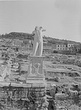
| Giant in easternmost position of the "Gymnasium" series. Front view. The Late Roman Complex was identified as a Gymasium because of its scheme and of an inscription found by Pittakis in 1848 alongside ... south ... 1949 |
| Giant in easternmost position of the "Gymnasium" series, front view. The Late Roman Complex was identified as a Gymasium because of its scheme and of an inscription found by Pittakis in 1848 alongside ... south ... 1949 |
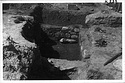
| Tomb U, west of the Church of Elias and Charalambos: statue of Herakles from the East Pediment of the Hephaisteion, as found built face down into wall of tomb. Cf. Hesperia 18 (1949), p. 214.
DUPLICATE ... No deposit given yet. Horizontal (normal) ... 19 Mar 1948 ... Site | By Area | South | Miscellaneous | Objects as Found ... Site | By Area | West | Temple of Hephaistos | Sculpture | East Pediment | Standing Male Torso (S 1313) |
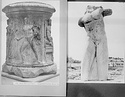
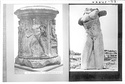
| On the left, representation of Hephaistos on the Madrid puteal (Einzelaufnahme 1729) and at right the easternmost Giant in the "Gymnasium" series. The Late Roman Complex was identified as a Gymasium because ... AMS Horizontal (normal) ... ca. 1948 |
| On the left, representation of Hephaistos on the Madrid puteal (Einzelaufnahme 1729) and at right the easternmost Giant in the "Gymnasium" series. The Late Roman Complex was identified as a Gymasium because ... ca. 1948 |
| Tomb U, west of the Church of Elias and Charalambos: statue of Herakles from the East Pediment of the Hephaisteion, as found built face down into the wall of the tomb. Cf. Hesperia 18 (1949), p. 214 ... Horizontal (normal) ... 19 Mar 1948 ... Site | By Area | South | Miscellaneous | Objects as Found ... Site | By Area | West | Temple of Hephaistos | Sculpture | East Pediment | Standing Male Torso (S 1313) |
| Tomb U, west of the Church of Elias and Charalambos: statue of Herakles from the East Pediment of the Hephaisteion, as found built face down into the wall of the tomb. Cf. Hesperia 18 (1949), p. 214 ... Horizontal (normal) ... 19 Mar 1948 ... Site | By Area | South | Miscellaneous | Objects as Found ... Site | By Area | West | Temple of Hephaistos | Sculpture | East Pediment | Standing Male Torso (S 1313) |
|
|