|
|
| Grave V, under room 18 in House 3, plus burned deposit at 94/IΘ. Identified as sacrificial pyre by SIR on Agoraios Kolonos:
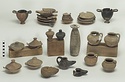
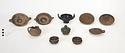
In southeast corner of house 3. 35 artifacts, bone and charred material in pit, ... Ca. 300-275 B.C. |
| Sacrificial pyre in Poros Building, NW Room (RSY= Pyre 1).
Against east wall of room 5 west. artifacts, bone, carbon and ash in pit in floor sequence. the pyre lay below a floor covered with marble dust, ... Middle of 4th c. B.C ... Sacrificial pyre in Poros Building, NW Room (RSY= Pyre 1).
Against east wall of room 5 west. artifacts, bone, carbon and ash in pit in floor sequence. the pyre lay below a floor covered with marble dust, the lowest floor that can be associated with the north wall of the room. The pit extends down into a layer with marbleworking waste. |
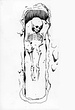
| James H. Oliver ... (E.L. Smithson: Grave IX: PG). Two children's skeletons one on top of the other. Cf. PD 329 for PD 430 for second skeleton, same deposit.
PG grave about 25m. SW of Cistern A at 46/ΜΔ.
[In some records, ... Developed Protogeometric ... [In some records, erroneously as ΠΘ Grave 5 (an empty pit cleared in 1936), cf. nb. p. 321.]
... The bedrock forming the edges of the tomb pit was stepped in to provide an irregular ledge, running round all four sizes. maximum width of the pit at the bottom was about 0.30m. a partial lining of fieldstones was bedded on the ledges; the uppermost stones were interrupted at the southeast corner by an irregular recessed pocket containing two lekythoi.
... The latter were thought to be from a sacrificial animal or animals, but the bones were not analyzed,nor were they saved.
|
|
|