|
|
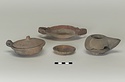
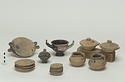
| Above bedrock in N.W. corner of room S, House of Greek Mosaic. Contents suggest "saucer-pyre" ... Late 4th-early 3rd c. B.C. |
In Southeast House, Room E. The inventoried material consisted entirely of loomweights, all of the 4th c. B.C ... 5th-4th c. B.C ... In Southeast House, Room E. |
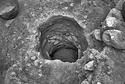
| Large tile-lined well in SW Bath, Room A4. The top had been sealed with ca. 1.30m of concrete, and the floor to carry the hypocaust columns of the room in Phase C had been carried over it.
The well was ... Late 2nd-early 1st c. B.C. |
Pit at 79-83/ΜΒ-ΜΖ (or 81/ΜΣΤ=pit under floor of Room 11 in Roman Bldg. 2, 82/ΜΓ, 83/ΜΕ=well at 83/ΜΗ). Purpose of pit obscure. Evidently filled in Hellenistic times and disturbed in Roman times. Coins: ... 275-200 B.C. with later disturbance |
Dug as Tholos Trench V, Room E, burnt filling of plundered wall trench of S wall of court. See also lot Ζ 484 ... Late 6th c. B.C ... Dug as Tholos Trench V, Room E, burnt filling of plundered wall trench of S wall of court. |
| Marcie Handler ... Located in the south section of Room E in the Byzantine Building east of the North-South Road. The uppermost 1.5 meters of well lining was built of well-coursed stones (some reused marble blocks) and tiles ... 12th c. A.D ... Located in the south section of Room E in the Byzantine Building east of the North-South Road. |
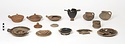
| Laura Gawlinski ... Fill excavated south and west of Early Building Ii, Room E latrine, with a high concentration of votive material, such as pyre saucers, miniature loom weights, and ribbon handled plates. Some traces of ... 400-350 B.C ... Fill excavated south and west of Early Building Ii, Room E latrine, with a high concentration of votive material, such as pyre saucers, miniature loom weights, and ribbon handled plates. |
Early Roman fills E of Stoa (Room 17, Rooms 13-16) xx ... Early Roman ... Early Roman fills E of Stoa (Room 17, Rooms 13-16) |
Fifth century Pit E of Stoa Room 11 with coarse pottery and a few black-glazed, some with stamping and red-figured pieces ... Ca. 450-425 B.C ... Fifth century Pit E of Stoa Room 11 with coarse pottery and a few black-glazed, some with stamping and red-figured pieces. |
| Terracotta deposit in SW corner of Room K and E of Roman Wall L. Roman layer of red, compact earth.
Baskets 50,52,54. Coins:
18 July 2002 #1282
19 July 2003 #1295 ... 4th c. A.D ... Terracotta deposit in SW corner of Room K and E of Roman Wall L. |
In front of room III from the South. Coins:
28 June 1933 #1
1 July 1933 #1
8 July 1933 #1 (dump)
12 July 1933 #1 (dump)-#2 (dump)
3 May 1934 #1
12 May 1934 #1 Estimated Grid ... Byzantine |
| Identified as pyre by SIR.
In room E. Burnt "pocket" found while digging red earth that contained late Hellenistic pottery, including a fragment of Pergamene (discarded). No pit was discerned, but concentration ... 3rd quarter 4th c. B.C ... Identified as pyre by SIR.
In room E. Burnt "pocket" found while digging red earth that contained late Hellenistic pottery, including a fragment of Pergamene (discarded). |
Found while excavating Stoa Pit E in 1933. See also I 849 (Ε 329) found in the North Well in Stoa Pit E (Deposit H 9:1). Fragment Ε 496 of this inscription, listed with the finds of H 10:6, is likely from ... 8-10 May 1933
17 May 1935
18-26 May 1937 |
Filling over drain from East Room of Archaic Fountain House. Lot T 16, fill e.
Τ 1567 (SS 11587) and Τ 1734 (P 22538) from upper disturbed fill (p. 2448) ... Late 5th. into 4th c. B.C ... Filling over drain from East Room of Archaic Fountain House ... Lot T 16, fill e.
Τ 1567 (SS 11587) and Τ 1734 (P 22538) from upper disturbed fill (p. 2448) |
| Johanna Hobratschk ... South end of Byzantine Room J, adjacent to Pithos B and under St. Philip's st scarp. Built lining at the E and N side, roughly constructed of some large square blocks and slabs, smaller field stones of ... 21 July-3 August 2006
2011
28 June 2012-16 July 2012 ... South end of Byzantine Room J, adjacent to Pithos B and under St. ... Built lining at the E and N side, roughly constructed of some large square blocks and slabs, smaller field stones of different sizes and shapes, reused tile, and broken segments of terracotta well lining. |
| In NE corner of Room D. In a Byzantine vessel=P 34464.
The position of the vessel in the corner of the room suggests that the burial was made after the construction of Byzantine Walls G and E. This type ... 10th-11th c. A.D ... In NE corner of Room D. In a Byzantine vessel=P 34464.
The position of the vessel in the corner of the room suggests that the burial was made after the construction of Byzantine Walls G and E. ... Disturbed Roman floor surfaces inside Byzantine Room D. |
| Stephen G. Miller ... Irregular circular tomb (Diam. 2.20-2.60) with blocked dromos to northwest. Top of tomb lost in Archaic grading of area, center disturbed by Byzantine pit, overbuilt by northern-eastern walls of Room 3 ... LH III ... Top of tomb lost in Archaic grading of area, center disturbed by Byzantine pit, overbuilt by northern-eastern walls of Room 3 of Roman House E.
|
| Pyre in layer 8a in SW corner of Room 7 of Greek House δ.
Oval pyre; 0.60 (n-s)x 0.35 (e-w).
The pyre was covered by the surface of layer 8 and extended slightly into layer 9 below it. Small bone fragments, ... 325-300 B.C ... Pyre in layer 8a in SW corner of Room 7 of Greek House δ.
Oval pyre; 0.60 (n-s)x 0.35 (e-w).
The pyre was covered by the surface of layer 8 and extended slightly into layer 9 below it. |
| "Room D" is the triangular area at L/15,16-2/10,12, NW of Wall 1, in E corner of basement of No.3. Hastings Street, bounded by the NE and SE walls of basement).
Bell-shaped vessel built of horizontally-laid ... 10th-11th c. A.D ... "Room D" is the triangular area at L/15,16-2/10,12, NW of Wall 1, in E corner of basement of No.3. |
| Marcie Handler ... It was situated in the NW corner of Room 3 in the Classical Commercial Building, just S of Wall 11, the cross-wall that divides Room 3 from Room 4 to the north. The pyre pots were found surrounded by ... Late 4th c. B.C ... It was situated in the NW corner of Room 3 in the Classical Commercial Building, just S of Wall 11, the cross-wall that divides Room 3 from Room 4 to the north. The pyre pots were found surrounded by fill with charcoal and burnt bone below a floor surface preserved immediately to the E (J/13,14-2/7,8; 52.20 masl.).
|
| Laura Gawlinski ... Circular pit uncovered in Early Building II, south of Room E latrine, adjacent to the preserved latrine floor surface. Continues beneath the latrine surface and the western scarp (unexcavated). Fill relatively ... Late 5th c. B.C ... Circular pit uncovered in Early Building II, south of Room E latrine, adjacent to the preserved latrine floor surface. |
"Symbolon Pit" (Rectangular Pit in bedrock E of Stoa, Room 5). Preserved depth 0.45m, original depth estimated at ca. 1.65m., the upper part having been cut away by successive building operations in the ... Third quarter of 5th c. B.C ... "Symbolon Pit" (Rectangular Pit in bedrock E of Stoa, Room 5). |
Early Roman pit at P/3-6/6,7
Layer 4a in Room 6 of Greek House δ, area P/2,3-6/6,8.
Pit in NW corner of Room 6 bounded by walls of Room to North and West, cut into preexisting layers to east, cutoff by ... 17 May 1971 ... Early Roman pit at P/3-6/6,7
Layer 4a in Room 6 of Greek House δ, area P/2,3-6/6,8.
Pit in NW corner of Room 6 bounded by walls of Room to North and West, cut into preexisting layers to east, cutoff by Byzantine pithos to South. ... Top elevation: 55.64m (w); 55.59m (e)
Depth: 0.55m
East-West Width: 1.37m
Preserved North-South length: 1.45m max. |
Enchytrismos burial of an infant at the E. corner of Byzantine Room G.
The burial was in brown fill flecked with charcoal and containing brown-glazed pottery (Lot ΒΗ 472). The pot was embedded upside ... Byzantine 10th/11th c. A.D ... Enchytrismos burial of an infant at the E. corner of Byzantine Room G.
|
Construction fill below floor of Brick Building.
Areas involved:
a) Western portion of Room A: packing below floor.
b) Room B: packing below floor of northern,larger room.
c) Fill over water channel in ... First quarter 2nd century, before its end ... Areas involved:
a) Western portion of Room A: packing below floor.
b) Room B: packing below floor of northern,larger room.
c) Fill over water channel in smaller, southern room B; channel discovered by builders of Brick Building,rebuilt by them and covered over.
d) Foundation trench of earlier building beneath Brick Building, filled and covered by builders of Brick Building.
e) "Apparently from below floor of building" (nb.p. 1282).
|
| Brian Martens ... It was partially excavated during the 2012 and 2013 seasons. The tomb, located at the center of Room III in the NE area of section ΒΖ, was found under fill surrounding perpendicular mid-to late 6th c ... LHIIIA ... The tomb, located at the center of Room III in the NE area of section ΒΖ, was found under fill surrounding perpendicular mid-to late 6th c. ... N-S Wall 17 and E-W Wall 18 were found during the 2012 excavation season and were excavated below their lowest courses. |
|
|