|
|
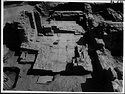
| Well in Room 7 of Roman House H, partially covered by caldarium of added bath complex (Room 6). Stone well-head; 0.85m in diameter. Stpped because of danger of collapse. Cut through bedrock, water from ... 6th c. A.D. |
| Pyre in Room 8 of Roman House H. Concentration of artifacts, bone, and flecks of carbon in stratum, no pit discerned. the pyre lay within a red fill apparently contemporary with it, but with some later ... 300-290 B.C. |
Greek House J, under room 8 of Roman House H.
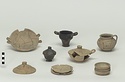
Typical though very fragmentary pyre pottery lay dispersed in a stratum over bedrock with pottery ranging from the 5th to the mid-3rd c.
In same general area ... Early 4th c. B.C.? ... Greek House J, under room 8 of Roman House H.
... In same general area as pyre Q 20:4, it must come from a different, earlier pyre. If the early date is correct, it falls within the first phase of the house but cannot be related to a construction event. |
|
|