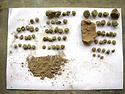
[Agora Deposit] K 6:1: Well East of Roman Building

Diameter of top of well 0.80m. An early well east of Roman Building, north of Temple of Ares and thus in the region of the Mycenaean cemetery. Sherds almost entirely Mycenaean with nothing later and a ... Mycenaean ... An early well east of Roman Building, north of Temple of Ares and thus in the region of the Mycenaean cemetery.

[Agora Deposit] M 11:2: Well at Southeast Corner of Court of Late Roman Building

Well at SE corner of Court of Late Roman Building (Trench C). Estimated Grid ... 12th c. A.D ... Well at SE corner of Court of Late Roman Building (Trench C).

[Agora Deposit] F 5:4: Figurine Deposit

Figurine Deposit in Roman Building 4, Room 20, strosis 1. Coins: 13 April 1937 #1 ... To 4th c. A.D ... Figurine Deposit in Roman Building 4, Room 20, strosis 1.

[Agora Deposit] O 19:5: Well at 56/ΚΖ

Well at 56/ΚΖ, just south of the south wall of the northern Late Roman Building ... Second half of 2nd c. - early 3rd c. A.D ... Well at 56/ΚΖ, just south of the south wall of the northern Late Roman Building

[Agora Deposit] P 7:7: Wall and Below Floor of Late Roman Building

Late Roman Building to W of N end of Stoa (from its wall and below floor) Coins: July 12 1950 #1-#4 ... 11-12 July 1950 ... Wall and Below Floor of Late Roman Building

[Agora Deposit] T 18:4: North of Eleusinion: Loose fill in pit outside Roman Building

North of Eleusinion: Loose fill in pit outside Roman Building. 14 inventoried items, 22 objects, 325 sherds. Objects : terracottas; handmade object; large figurine; lamps. Early ware : Gray Minyan; Mycenaean; ... 6th c. B.C. and earlier ... North of Eleusinion: Loose fill in pit outside Roman Building

[Agora Deposit] T 18:3: Fill in Room 3 of Roman Building North of Eleusinion

North of Eleusinion: Fill in Room 3 of Roman Building. 614 sherds (6 miniature shapes, 20 intrusive sherds). Objects : terracottas; loom weights; spindle whorls; disks; handmade tray; lamps. Early ware ... First half of 6th c. B.C.-Mixed Fill to ca. 480 B.C ... Fill in Room 3 of Roman Building North of Eleusinion

icon

[Agora Deposit] J 2:21: Coin Hoard

Marcie Handler ... Fill within the drain from the basin on the west side of Roman Room B through Wall A. After we removed the fill within the basin on the west side of Roman Room B (BZ XXVII p. 5325), we began excavating ... Late Roman ... Excavations | 2003 | Trenches | Handler | Roman Building East of the North-South Road | Roman Room B | Coin Hoard J 2:21

[Agora Deposit] P 8:1: Circular Building Fills

Building Fill NE of Circular Building 13-17/ΚΓ-ΚΣΤ (Roman Group H) and Connecting Cut NE of Circular Bldg ... First half 2nd c. A.D ... Building Fill NE of Circular Building 13-17/ΚΓ-ΚΣΤ (Roman Group H) and Connecting Cut NE of Circular Bldg.

[Agora Deposit] L 18:2: Well on Lower Slopes of Areopagus

Well on lower slopes of Areopagus. Diameter ca. 1.50m. Dumped filling of 8th c. at the top. Fill mostly Geometric but containing bits of later (even Roman) pottery. Perhaps cleaned out and refilled with ... 730-700 B.C ... Fill mostly Geometric but containing bits of later (even Roman) pottery. Perhaps cleaned out and refilled with its own contents at the time of building of Roman house over it.

[Agora Deposit] F 5:1: Cistern

Evidence of stratification into five layers, although joins between the layers. Layer VI added when the construction of the Roman building above required it. No subdivisions assigned. Flask-shaped cistern ... Early 3rd-late 2nd c. B.C ... May reflect the cutting of wall trenches and leveling operations preparatory to laying the foundations for Hellenistic Building ... Layer VI: Supplemental filling prior to construction of Roman house

[Agora Deposit] O-P 20-21

Late Roman Fills: SE Building, Conglomerate Wall. (see O-Q 18-19)Deposit list under O-Q 18-19 Coins 21 May 1938 #14 23 May 1938 #1-#2 24 May 1938 #2, #3-#4 25 May 1938 #3 Asterisk: O-P 20-21* ... Late Roman Fills: SE Building, Conglomerate Wall.

[Agora Deposit] U 22:2: Well East of Circular Building

Well East of Circular Building, at 25/ΙΗ. Well dug originally in 5th c. B.C. and probably had POU fill. In 2nd c. A.D. the shaft was intersected by a horizontal vaulted brick tunnel belonging to the Brick ... 5th c. B.C.(?) ... Well East of Circular Building, at 25/ΙΗ. Well dug originally in 5th c. ... After construction of tunnel the old well shaft was filled up again, this time with a Roman dumped filling of second half of 2nd c.

[Agora Deposit] C 17:5: Pit or Well Under Building A, Room 2

Pit (Well?) under Building A, Room 2. Coins: 9 May 1949 #1-#2 11 May 1949 #4 12 May 1949 #3 (not a coin, bronze fragment in lotted metal tins ΠΠ 295). Estimated Grid Remains of coloring matter found with ... Hellenistic-Early Roman

[Agora Deposit] L-M 11-12:1: "Coroplasts' Dump"

Filling between tongue walls to north of main apse in Late Roman complex, equals "Coroplasts' Dump" overlying Odeion south side. Containers Ο 17-Ο 20 are from "debris of burnt building" [i.e. Odeion ... 267-ca. 350 A.D ... Filling between tongue walls to north of main apse in Late Roman complex, equals "Coroplasts' Dump" overlying Odeion south side. Containers Ο 17-Ο 20 are from "debris of burnt building" [i.e. Odeion destruction debris] and should go with deposit L-M 9-12 ... These finds include only those from "Late Roman fill between tongue walls" (the "brownish earth" indicated on nbp. 252 plan),and not from "debris of burnt building" which should fall under Destruction Debris of Odeion deposit L-M 9-12.

icon

[Agora Deposit] J-K 2:2: Chamber Tomb Below Floor of Room 2 of Classical Building II

David Scahill ... Below packed clay floors in Room 2 of Classical Building II; bordered on east and south sides by polygonal cross wall and back wall extension for Classical Building. Late Roman wall and drain installation ... LHIII A:1 ... Below packed clay floors in Room 2 of Classical Building II; bordered on east and south sides by polygonal cross wall and back wall extension for Classical Building. Late Roman wall and drain installation above west side. ... Upper part of tomb cut away by leveling for floors of Classical Building. Loose fill of stones and earth with large number of Geometric sherds ranging from Protogeometric to late Geometric in date, from top of cutting extending down into layer of tomb contents.

[Agora Deposit] P 19:1: Well at 52/ΛΣΤ

Tile well at 52/ΛΣΤ, in the northern late Roman building in the room with the apse. The top was covered by a large stone, and the well had never been filled after the last period of use. water stood to ... Late 1st (?) cent.-early 3rd to 6th cent ... Tile well at 52/ΛΣΤ, in the northern late Roman building in the room with the apse.

icon

[Agora Deposit] J 5:2: Crossroads Enclosure

Enclosure within Roman Circular Building. The finds apparently reflect the entire area inside the enclosure. Pottery lot ΒΓ 515 identifies the deposit as layer 10 and coin #895 from layer 11 says "layer ... 12-18 August 1971 9-10 May 1972 ... Enclosure within Roman Circular Building.

icon

[Agora Deposit] T 22:3: Well

Well cut into bedrock, associated with late Roman building G in ΕΛ 1.2m in diameter, narrows to 0.5m at bottom. Disturbed by later pits at top. Excavated from 85.77-79.25m (6.52m), but bedrock at 85.91m ... Late 4th/early 5th AD ... Well cut into bedrock, associated with late Roman building G in ΕΛ 1.2m in diameter, narrows to 0.5m at bottom.

[Agora Deposit] B 14:4: Well

POU = 10.00-11.30m. "The well is important because it gives us a terminus post quem for Building D." (nbp. 3346) Shallow well, producing little water or trouble, but a great quantity of coarse late Roman ... Ca. A.D. 300-370 and Ca. A.D. 400 ... "The well is important because it gives us a terminus post quem for Building D." (nbp. 3346) Shallow well, producing little water or trouble, but a great quantity of coarse late Roman pottery, with Type XXVIII lamps.

icon

[Agora Deposit] J 2:18: Well in the South Section of Room E in the Byzantine Building East of the North-South Road

Marcie Handler ... Located in the south section of Room E in the Byzantine Building east of the North-South Road. The uppermost 1.5 meters of well lining was built of well-coursed stones (some reused marble blocks) and tiles ... 12th c. A.D ... Located in the south section of Room E in the Byzantine Building east of the North-South Road. ... The later phase of the well, a Byzantine well-lining and well-head, was excavated during the 2001 season (BZ XXV p. 4953, Lot BZ 1217) and the Roman catchment basin and well-lining down to the level of the terracotta lining were excavated during the 2002 season (BZ XXVII pp. 5279 & 5285 for the catchment basin; BZ XXVII p. 5293 for the Roman well-lining).

[Agora Deposit] R 13:8: Debris From Room I of Street Stoa

Debris, Room I of Street Stoa (R/16,20-13/10,15). The lack of any rooftiles and similar architectural debris suggests that perhaps it was brought in from an adjacent area and dumped in the room. This is ... 6-8 May 1975 ... Another possible explanation is that the room was quarried for clean bedrock fill (perhaps by the builders of the Late Roman Building to the east), with the resultant filling of the room with destruction debris from Alaric's attack on the city, perhaps taken from the same area where the bedrock fill was to be used (cf. east, in Room 1 and the south half of Room 2.

icon

[Agora Deposit] U 21:1: Well

Well cut into bedrock under late Roman building in ΕΛ. 1.2m in diameter with small cutting of unclear function at south edge about 0.2m wide. Walls cut straight down, tapering near bottom to 0.8m. Footholds ... Late Archaic ... Well cut into bedrock under late Roman building in ΕΛ. 1.2m in diameter with small cutting of unclear function at south edge about 0.2m wide. ... There were 14 layers of fill from two periods-the Roman resurfacing of the area using Hellenistic fill (possibly associated with Deposit T-U 21:1, but not kept as such since floors were damaged in area directly above) and dumped fill from the late 6th/early 5th c. ... Layers: Hellenistic fill under Roman floors I.(86.34-85.93m) rubble II.(85.93-85.58m) dark brown rubble III.(85.57-85.30m) more stony rubble IV.(85.30-84.80m) very rocky, almost sterile, increase of clay and sand V.(84.80-84.03m) less rocks, almost sterile, increase of clay and sand Late 6th/early 5th B.C dumped fills VI.(84.03-82.64m) mix of clay and sand deposits, dog skulls VII.(82.64-81.79m) mostly sand VIII.(81.79-81.39m) light brownish-grey clay, almost sterile IX.(80.39-80.99m) mix of grey clay, brown clay and sand, much ceramic X.(80.99-80.24m) sandy, more ceramic XI.(80.19-77.74m) sandy, enormous stones (some 100kg+).

icon

[Agora Deposit] J 2:27: Pyre J 2:27

Marcie Handler ... It was situated in the NW corner of Room 3 in the Classical Commercial Building, just S of Wall 11, the cross-wall that divides Room 3 from Room 4 to the north. The pyre pots were found surrounded by ... Late 4th c. B.C ... It was situated in the NW corner of Room 3 in the Classical Commercial Building, just S of Wall 11, the cross-wall that divides Room 3 from Room 4 to the north. ... The pyre deposit continued up to the north face of late Roman Wall C, suggesting that these lower courses of Wall C were packed into a narrow trench instead of built up within a wider foundation trench.

[Agora Deposit] G 13:4: Well

Tiled well, ca. 30m south of the Tholos. Associated with Building D. Hellenistic Group A with Late Roman fill in upper 3.00m. Objects A 245 and P 4597 are from fill on floor around well-head, contemporary ... 325-260 B.C ... Associated with Building D. Hellenistic Group A with Late Roman fill in upper 3.00m.

[Agora Deposit] T-U 21:1: Hellenistic Fill Beneath Floors

Two pebble floors of Roman date, broken into at the SE and north, covered a 6x5m trench in ΕΛ, bounded by the unexcavated east trench and a wall from Byzantine Building D (Wall A). Under these pebble floors ... 220 - 150 B.C ... Two pebble floors of Roman date, broken into at the SE and north, covered a 6x5m trench in ΕΛ, bounded by the unexcavated east trench and a wall from Byzantine Building D (Wall A).

[Agora Deposit] B 19:4: Geometric Grave, RSY Grave A

RSY Grave A. Under the Roman House with three rooms floored with mosaic near the southwest side of the area. The burial consisted of a pot laid on its side over the bedrock, presumably containing a child ... 7 August 1947 ... Under the Roman House with three rooms floored with mosaic near the southwest side of the area. ... The grave had been disturbed in early times by the building of a wall (6th or 5th century B.C.) which in part overlay it; only the part of the pot immediately over the stereo was preserved. it was an amphora with banded body and conventional ornaments on the reserved neck, probably late 8th century.

[Agora Deposit] D 4:1: West Chamber

Cistern-chamber on the northwest side of Kolonos Agoraios, 10 to 12m west of the end of the Hellenistic Building. Dimensions at bottom 2.50m x 2.75m. The west chamber of a cistern system composed of two ... Use filling early 1st-2nd c. B.C ... Cistern-chamber on the northwest side of Kolonos Agoraios, 10 to 12m west of the end of the Hellenistic Building. Dimensions at bottom 2.50m x 2.75m. ... North of the Hephaisteion. (Roman Group G).

[Agora Deposit] T 21:1: Hellenistic Fill Beneath Floors

Laura Gawlinski ... Pebble floors of Roman date covered the northern half of a 6x6m square trench in ΕΛ, bounded to the west by the post-Herulian Wall and to the east by a wall from Byzantine Building D (Wall A) to the east ... Hellenistic/ 220-150 B.C ... Pebble floors of Roman date covered the northern half of a 6x6m square trench in ΕΛ, bounded to the west by the post-Herulian Wall and to the east by a wall from Byzantine Building D (Wall A) to the east.

[Agora Deposit] T 19:3: Well

Well at 15/ΙΕ = Pocket in side of Turkish Pit at 15/ΙΔ. Shallow well on the lower slopes of the Acropolis, east of the Panathenaic Way, in the area later occupied by the Archaic Building. Located 3.5m ... 700-675 B.C. with intrusions ... Shallow well on the lower slopes of the Acropolis, east of the Panathenaic Way, in the area later occupied by the Archaic Building. Located 3.5m north of the Archaic peribolos wall, in a spot later covered by the Temple of Triptolemos. ... Intrusions: Archaic ware; terra cotta figurine; blac figure; black glaze; lamp; Roman ware; Late wares: green glaze; yellow glaze; orange/brown glaze; green/white ware; grooved ware, white slip; incised wavy ware; white slip ware, amphora; globular jug; lamp; jug; unglazed plate; micaceous coarse ware; other coarse ware.

icon

[Agora Deposit] U 13:1: Well in Room 6 of Street Stoa U/2,U/3-13/15

Well in Room 6 of Street Stoa U/2,U/3-13/15. Associated with the building lying under the Roman Street Stoa. Its fills divided into 5 separate layers, with the bulk of finds belonging to Layer 1, the ... 14 June-21 August 1973 ... Associated with the building lying under the Roman Street Stoa.