|
|
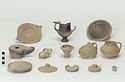
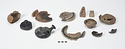
Classical commercial building, room 3, against south wall. Small fragments of pottery dispersed in fill overlying two floor levels (at 51.897 and 51.941 masl). Five objects of pyre type: ribbon-handled ... 4th c. B.C ... Five objects of pyre type: ribbon-handled plate, plate with concave rim (P 36558), and uninventoried fragments of a ribbon-handled plate and three small pyre saucers. |
Pocket on the line of the early (Archaic) peribolos wall at entrance on the south side. Uncatalogued material: 215 sherds, 186 + frags. plemochoai and 4 objects.
Classical Ware : black glaze; mug; rilled-rim ... 3rd quarter 4th c. B.C ... Classical Ware : black glaze; mug; rilled-rim plate; lekythos; miniatures. |
| Pyre against north face of polygonal wall, Room 2, Classical Building II. No floor preserved above, but the pyre is below floor level 51.820masl, preserved just to the east and above patchy floor with ... Ca. 275-260 B.C ... Includes 2 chytra, small saucer and rilled rim plates. |
Well at 15/ΜΓ (Well E: PG, ELS). Supplementary filling around its top Small partly glazed one handler
Fragment of black figured kylix
Small protogemetric cup
Fragment of skyphos
Rim fragment of Large Open ... Protogeometric-6th - 5th c. B.C ... Small partly glazed one handler
Fragment of black figured kylix
Small protogemetric cup
Fragment of skyphos
Rim fragment of Large Open Vase
Protogeometric Oinochoe
Handmade wide-mouthed amphora
Fragmentary oinochoe
Hnadmade pitcher x3
Vertibrae strung on rib bone
Conical foot
Amphora (?) |
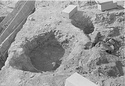
| Sacrificial Pyre = Pit in floor (identified as pyre by SIR); with the characteristic small plates and saucers. "Saucer Grave" at 12/ΚΑ.
Dimensions: 2m (length)x 0.70 (width).
North of north wall of building ... First half 4th c. B.C ... Both the large size of the cutting and the presence of a kernos are unusual, but the rilled-rim plate and the saucers suggest that this is a pyre. |
| Disturbed pyre dispersed in fill of Room 5, House D.
Pyre pots in very fragmentary condition were noticed by Barbara Tsakirgis in later analysis of pottery that had been excavated in 1938; no mention of ... 14 June 1938 ... It is likely that more than one pyre is involved: the two rilled-rim plates do not match and there are three lekanis lids (rarely does a pyre contain more than two lekanides). |
| Marcie Handler ... This pyre was found in the fill under Pyre J 2:23. Unfortunately, no floor surface was found between the two pyres. There were no complete vessels in this pyre. The sherds of the pyre vessels were mixed ... 275-250 B.C ... The catalogued pots included fragments of two lopadia, one lopadion lid, fragments of five pyre saucers and two ribbon-handled plate and one rilled-rim plate. In addition to the catalogued pottery, fragments of between five and seven additional pyre saucers, one ribbon-handled plate, and one chytridion were left in the pottery bag. |
| Rodney S. Young ... Grave 7 in notebook (E.L. Smithson: Grave XXI: PG). Bones discarded. Disturbed and damaged cremation (originally trench-and-hole), the east end cut away, probably contained the burial urn.
JP
It consisted ... Late Protogeometric ... The east end where the cinerary urn would have originally been located in an urn-hole, was almost completely cut away by the Hellenistic water channel that skirted the tomb to the south. evidence of heavy burning, in the form of reddened earth, was noted on the ground around the mouth, rim, floor and three sides of the trench. |
Well (diameter 0.91m, water level -7m) in House H, Room 10 (and pit over). Plain shaft cut in stereo; pit at mouth of well,reused as drainage pit at start of tile drain running west.
Scanty use filling ... Ca. 425-400 B.C ... P 18400, although found in the drain channel, appears to be a good 5th c. collar rim type,and was perhaps dislodged in this same disturbance. |
| Dorothy Burr Thompson ... Grave 1. Urn cremation (trench-and-hole), adult female 30-40 years old).
Mentioned as Grave XVII in Deposit list.
Consisted of a roughly circular pit, approximately 0.30-0.40m in diameter, cut into ... Late Protogeometric ... Virtually nothing of the pyre trench survived, but it's presence was indicated by hard red-colored burned earth packed tightly against the rim of the amphora along the northwest side. |
| John Travlos ... (Grave XXXII: EG) Urn cremation (trench-and-hole). Published as cremation burial of a warrior.
The tomb was probably originally oriented north-south, with the urn-hole at the south end. The north side ... Transitional Early Geometric II-Middle Geometric I ... The north side of the urn-hole, most of the neck and rim of the cinerary urn, and the entire pyre trench had been cut away by a Turkish pit that was cleared in 1938.
|
Well in Coletti Garden.
Diameter 1m. There were no traces of hand holes in its walls. At 5.2m depth below datum on the S-E side of the shaft, a small underground stream emptied into the well. The stratigraphy ... Ca. 425-400 B.C ... Fine ware:quantities similar to black glaze catalogued pieces; panathenaic amphorae, two lower body fragments; lekanis, one fragment with..pattern on exterior of rim; black glaze oinochoe fragments; fragments of a black glaze psykter; fragments of striped lekanai. |
Accumulated fillings in a system of underground drains at west end of section ΔΔ with northward continuation into and across Section Υ.
The filling in the "underground passages" in section ΔΔ appears to ... 3rd c. B.C.
2nd c A.D ... Section Υ: pit at 31-32/ΜΘ-Ν, 31-32/ΜΣΤ-ΜΖ, 36-38/ΞΔ, 33/ΝΒ, 31-32/ΜΓ-ΜΣΤ, 31/ΜΑ-ΜΓ
two fragments of semi-glazed bowls with everted rim (late 2nd c.?) |
| Marcie Handler ... Cist grave for two infants. The grave was cut into a sterile rocky layer on its southern and western sides, and a sterile fill layer on its northern and eastern sides. No obvious grave marker was present, ... Early Iron Age ... A piece of the handle of the cup was found 30 cm higher in the grave filling than the cup itself, and parts of the rim and neck of the amphoriskos were never recovered (even though water sieving), providing further proof that the grave was at least partially disturbed. |
| Extract from notebook ΠΘ XIX, pp. 3644-3646. Well at 105/ΝΗ (report on sorting of pottery, July 19, 1951 - H.S. Robinson).
"Not a useful well" HSR.
Well dug to 1.50m., vi/9/36; dug from 1.50m. to bottom ... Early Roman; use fillings of 2nd. c. B.C. and 1st. and 4th. c. A.D.; dumped filling of late 4th. c. (HSR)
Fill I: 2nd. c. B.C.
Fill II-V: to second half of 4th. c. A.D.
Fill VI: mixed to Byzantine ... P 11878) and of another with heavy rim such as those that occasionally have Latin stamps; BHWJ's. |
| James Artz Pirisino Daniele Kylindreas Miltiades ... Excavation in Room 3 of ΒΘ West revealed 5 ceramic vessels in a row against the eastern face of Wall 12. 3 complete vessels (ΒΘ 122, 124, and 125) were catalogued, along with the base of a plain glazed ... 9th-11th c. A.D ... Plain glaze ware; Constantinople white ware; monochrome glaze; green and brown painted ware; combed ware; ridged ware; gouged ware; amphora toe; incised coarse ware; Roman lamp fragment and red wares; classical red and black glaze (including geometric, archaic, and classical); coarse base with strange shape, handle and neck close to base; coarse handles, bases, rims, and body sherds; micaceous body; cooking ware, including joining lid fragments; painted and unpainted plaster; roof and floor tile fragments; pithos lid, rim and body fragments; worked stone; stone revetment; bone; metal; glass |
|
|