|
|
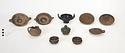
| Sacrificial pyre in Poros Building, NW Room (RSY= Pyre 1).
Against east wall of room 5 west. artifacts, bone, carbon and ash in pit in floor sequence. the pyre lay below a floor covered with marble dust, ... Middle of 4th c. B.C ... Sacrificial pyre in Poros Building, NW Room (RSY= Pyre 1).
Against east wall of room 5 west. artifacts, bone, carbon and ash in pit in floor sequence. the pyre lay below a floor covered with marble dust, the lowest floor that can be associated with the north wall of the room. ... The pyre thus postdates the arrival of the marbleworkers, and may be associated with the 4th century reconstruction of the building. It contained scattered carbon and there was a heavy ash deposit in the chytridion. some of the pottery is burnt; there were also fragments of burnt mudbrick or clay. |
Channel J (in ΗΗ)
Cutting that probably originally held a drain. Packed with amphoras and other coarse pottery. It tapped the poros aqueduct wall just East of our explanatory trench at the East end of ... 1st c. B.C. - early 1st. A.D ... It tapped the poros aqueduct wall just East of our explanatory trench at the East end of ΗΗ. Then it swung sharply NW and N as though to avoid some building and moved down at great depth (1.62m)as though along a street. |
Rectangular pit at 54/ΛΓ.
The pit's plan is irregular; its measurements approximately 2.00x1.10x1.15m. The wall foundations run a little over a meter deep at 53/ΛΓ-ΛΕ, consist of irregularly shaped and ... Ca. 450-425 B.C ... On top of these rest two good sized poros blocks which once supported the first blocks of the house wall. The south wall of the pit is built of slightly smaller stones and clay (no poros blocks), and bonds with the west wall. The east wall is one large (2.00x1.14x0.22m) poros slab. |
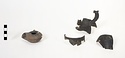
| Disturbed Pyre at 59/ΚΗ (ΚΖ), in the area of the Poros Building west of the Areopagus.
Against east wall of room 5 west. concentration of artifacts, ash, carbon and a few bones in stratum, no pit discerned ... 3rd c. B.C ... Disturbed Pyre at 59/ΚΗ (ΚΖ), in the area of the Poros Building west of the Areopagus.
Against east wall of room 5 west. concentration of artifacts, ash, carbon and a few bones in stratum, no pit discerned. |
Well 12: Archaic.
It lies on a rocky ledge about thirty meters north of the Klepsydra, just east of the Panathenaic street. In spite of its depth, it produced little pottery and its contents were of slight ... 6th c. B.C.? ... It lies on a rocky ledge about thirty meters north of the Klepsydra, just east of the Panathenaic street. ... In the well were not merely the usual quantities of domestic wares, pithoi, tubs and the like, of broken up terracotta rooftiles and crude brick; there was also a number of building stones: three large blocks of poros from some archaic structure, and many small carefully dressed blocks of Acropolis limestone from a polygonal wall or walls. |
|
|