|
|
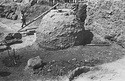
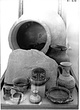
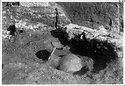
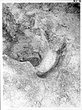
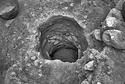
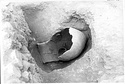
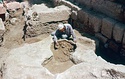
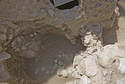
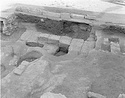
Anne McCabe ... Pithos D, adjacent to Pithos A at the NE, is built of stone and broken tile, beehive-shaped, unlined, with no floor. The wall of Pithos D appears to have been cut by the construction of the mortar wall ... 4-6 July 2007
31 July 2007 ... Pithos D, adjacent to Pithos A at the NE, is built of stone and broken tile, beehive-shaped, unlined, with no floor. The wall of Pithos D appears to have been cut by the construction of the mortar wall of Pithos A, and both vessels were damaged by the modern basement. ... At 53.764m. was found a segment of a bronze toothed blade (BH 228). |
| "From the phot. and description, p. 555, this appears to be a built pithos, rather than a cistern." [deposit nb] Grid 30/ΙΔ also mentioned ... 28 July-3 August 1931 ... "From the phot. and description, p. 555, this appears to be a built pithos, rather than a cistern." |
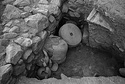
| Grave 2 in notebook. Child of about two (or 10?) months, body placed in plain pithos, which rested on its side at the bottom of a pit; the mouth closed with a stone slab.
The burial forms a group with ... 750-725 B.C ... months, body placed in plain pithos, which rested on its side at the bottom of a pit; the mouth closed with a stone slab.
The burial forms a group with two other graves (D 16:2, D 16:4) set in angle formed by intersecting roads. |
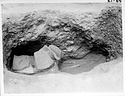
| Rodney S. Young ... Grave 13 in notebook.
Two skeletons of small children lay in a pithos which had been put on its side; its mouth was stopped by a stone slab.
Most offerings were inside the pithos, but two kantharoi and ... Late Geometric ... Two skeletons of small children lay in a pithos which had been put on its side; its mouth was stopped by a stone slab.
... An animal bone was found under a coarse pitcher left outside the pithos at its mouth; carbonized matter, perhaps from a food offering, was found in one of the kantharoi.
No evidence of re-opening, hence this was probably a double funeral. |
Original bottom of pithos was damaged (probably by ground water) and a second, higher bottom consisting of squarish terracotta tiles laid. Fill above second, higher floor was unusually rich in pottery ... Byzantine ... Original bottom of pithos was damaged (probably by ground water) and a second, higher bottom consisting of squarish terracotta tiles laid. Fill above second, higher floor was unusually rich in pottery and was thus given a deposit number. |
| Grave 3 in notebook. Outside Archaic cemetery, inhumation burial. Deposit list says black glaze pithos (P 8922) containing the bones of a child and four small vases. The pithos lay on its side with the ... Last quarter of 6th century B.C ... Deposit list says black glaze pithos (P 8922) containing the bones of a child and four small vases. The pithos lay on its side with the open mouth to northeast. The bottom had been cut by a late fifth century well and the upper side was caved in. |
| "Room D" is the triangular area at L/15,16-2/10,12, NW of Wall 1, in E corner of basement of No.3. Hastings Street, bounded by the NE and SE walls of basement).
Bell-shaped vessel built of horizontally-laid ... 10th-11th c. A.D. |
Well 2: archaic. Diameter, top ca. 1.00; bottom ca. 0.90m.
Water level:ca -7.00m In the use filling, along with the plain water pots was a black-figured neck amphora assigned to the Edinburgh painter ... Last quarter of the 6th c. B.C ... In the use filling, along with the plain water pots was a black-figured neck amphora assigned to the Edinburgh painter.
Dumped filling consisting largely of mudbrick, broken rooftiles and other debris, along with a pithos-top well head.
An upper filling was not a dump, but a washed-in filling, containing a scattering of figured fragments. |
| RSY Grave 51.
The grave lay on the slope of the Areopagus in Roman house O, just east of the line where the hillside is scarped for the foundation of the west wall of the house.
Cutting:the pit cut in ... Archaic period/6th or 7th c ... The burial urn, a pithos, was laid in the pit on its side, the mouth toward the south. A foundation wall of the Roman house passed close to the mouth of the pithos, for which we found no cover; one may have been removed when the foundation was laid. ... Skeleton: On the bottom of the pithos were found the skull and some of the leg-bones of a small child who had seemingly been buried in a doubled-up position with the head toward the mouth of the pithos (south). |
| Circular pit and irregular cutting north of it. Diam. of pit ca. 0.80m; Dimension of irregular cutting ca. 1.00x1.20m. The pit was dug into bedrock and filled with red earth which was packed with undisturbed ... Second half of 7th c. B.C ... At the bottom was a filling of earth and small stones. The pit was well-cut, perhaps as a bedding for a pithos. The irregular cutting contained a similar filling but the pots were stacked, not dumped. |
| Johanna Hobratschk ... South end of Byzantine Room J, adjacent to Pithos B and under St. Philip's st scarp. Built lining at the E and N side, roughly constructed of some large square blocks and slabs, smaller field stones of ... 21 July-3 August 2006
2011
28 June 2012-16 July 2012 ... South end of Byzantine Room J, adjacent to Pithos B and under St. ... At the W side, there is an area which does not seem to have a built lining. The shape is irregular, with a diameter of ca. 0.8m. |
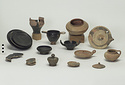
| Sacrificial Pyre I, Classical Building II.
The pyre was set through the original floor level of the northern room of the Classical Building and apparently is the remainder of a ritual conducted when the ... Ca. 375-350 B.C ... The pyre was set through the original floor level of the northern room of the Classical Building and apparently is the remainder of a ritual conducted when the old floor was raised. The pyre was preserved in a thin strip of undisturbed fill between Pithos III and a Byzantine pit. ... "In 1989 we dug in adjacent area and found a black-glazed skyphos, Attic type ΒΕ 755= P 31817, which appears to belong to this deposit, cf. pp. 4289-4291. |
| Well South of Soft Yellow Poros Foundation. Dumped filling of a collapsed well, that, due to hazardous conditions, could not be cleared below- 2.50m. The well was partly cut on the east side by a Byzantine ... Protogeometric-Early Geometric II, ca. 850 B.C ... Dumped filling of a collapsed well, that, due to hazardous conditions, could not be cleared below- 2.50m. The well was partly cut on the east side by a Byzantine storage pithos, and on the south side it was disturbed by another, tile-lined, well of the Roman period (U 19:4), which had been used for water and then as a cesspool inn the early 20th century.
... At -1.50m a complete and ordered skeleton (man of 45-50 years old), doubled up so that its thighbones were parallel to and to the backbone, lay on a rough stone slab. |
| James Artz Pirisino Daniele Kylindreas Miltiades ... Excavation in Room 3 of ΒΘ West revealed 5 ceramic vessels in a row against the eastern face of Wall 12. 3 complete vessels (ΒΘ 122, 124, and 125) were catalogued, along with the base of a plain glazed ... 9th-11th c. A.D ... Other joining fragments include significant portions of course water jars and amphorae, and a large pithos lid with decorative grooves (west:2012:f:42).
... The fragmentary remains of a ceramic pithos (ΒΘ 178) were revealed after the removal of a reused threshold block above the pithos. Many fragments of a deep bowl with poorly preserved glaze (ΒΘ 171) were wedged between the wall of the pithos and the southern face of Wall 23. |
| Eugene Vanderpool ... Grave (E.L. Smithson: Grave II: SM).
Unlined trench, roughly the size of the deceased, cut into bedrock to a depth of just over 1.50m. Oriented north-south, the tomb pit measured 1.69m in length (length ... Late Mycenaean/Submycenaean-Earliest Protogeometric ... Unlined trench, roughly the size of the deceased, cut into bedrock to a depth of just over 1.50m. Oriented north-south, the tomb pit measured 1.69m in length (length of the skeleton in situ, 1.65m), and had a width, as excavated, of 0.40-0.58m. the west side was slightly undercut, and a small part of the east side was cut buy the cellar wall of a modern house, but only the very edge of the tomb at an upper level was touched, whereas the contents of the grave were untouched. Ledges, maximum width 0.20m, ran along the full length of the sides. A roughly rectangular stone slab rested on the ledges above the head of the deceased, while fragments of a pithos (or pithoi), also resting on the ledges, covered the deceased down to the thighs. |
Mycenaean Well at Q/8-9;23/2-3.
Small pieces, few joins. From the lowest levels a few somewhat larger pieces, from jars suited to drawing and transporting water, but no characteristic POU fill.
Proportion ... LH IIIC ... From the lowest levels a few somewhat larger pieces, from jars suited to drawing and transporting water, but no characteristic POU fill.
... Proportionately more coarse ware in upper levels; pithos fragments, cooking and pantry wares; four pieces (two cooking) are handmade, one burnished.
|
Well at 15/ΙΕ = Pocket in side of Turkish Pit at 15/ΙΔ.
Shallow well on the lower slopes of the Acropolis, east of the Panathenaic Way, in the area later occupied by the Archaic Building.
Located 3.5m ... 700-675 B.C. with intrusions ... Located 3.5m north of the Archaic peribolos wall, in a spot later covered by the Temple of Triptolemos. The pit was disturbed by two Ottoman pits on the east and north sides and by the wall of a modern cellar sunk through part of it ... No evidence for a period of use; a single dumped filling including a number of votive terracottas. |
|
|