|
|
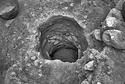
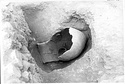
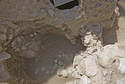
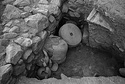
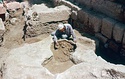
Modern Pithos containing coins ... 23 March 1937 ... Modern Pithos containing coins. |
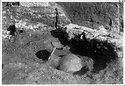
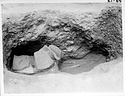
Turkish Pithos at 4/ΙΖ ... Turkish ... Pithos |
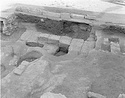
Pithos in NW corner (room) of Poros Building. Marble chips ... Mid-4th c.? ... Pithos in NW corner (room) of Poros Building. |
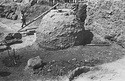
| Pithos ay the bottom of the north slope of the Areopagus with single fill; Part of Hellenistic Group D.
One stamped amphora handle dates slightly after 146. Latest coin dates in first two decades of 2nd ... 160-130 B.C ... Pithos |
16 March 1957 pottery discarded nb.p. 122 ... 20-21 June 1947 ... Pithos |
P.H. 1.98m; greatest diameter 1.70; wall thickness 0.20. The walls are of rubble set in clay, and the bottom is flat. Pottery was coarse Byzantine sherds but discarded except for one graffito ... 25 May 1956 ... Pithos |
Pithos at NE corner of Byzantine Building. Coins:
20 May 1938 #1, #3 ... Late 11th-Early 12th c. A.D ... Pithos at NE corner of Byzantine Building. |
Anne McCabe ... Pithos D, adjacent to Pithos A at the NE, is built of stone and broken tile, beehive-shaped, unlined, with no floor. The wall of Pithos D appears to have been cut by the construction of the mortar wall ... 4-6 July 2007
31 July 2007 ... Pithos |
Tile lined bothros with field stone collar. Coins:
19 June 1992 #818-#819 ... 12th-13th c. A.D ... Pithos #2 |
Joins occur between this pit and the cistern in section ΛΛ (87/ΛΕ)
(E 5:3). Coins:
16 May 1936 #6 ... Byzantine ... Pithos K |
Pithos in Turkish Pathway Coins
26 May 1937 #2-#7 ... Byzantine ... Pithos |
Mudbrick Pithos at N/8-6/3.
Constructed in conical shape of mudbricks, including the floor. Top cut by modern basement wall. Diameter at floor 1.45m Coin
30 May 1930 #113 ... Byzantine ... Mudbrick Pithos at N/8-6/3.
Constructed in conical shape of mudbricks, including the floor. |
Original bottom of pithos was damaged (probably by ground water) and a second, higher bottom consisting of squarish terracotta tiles laid. Fill above second, higher floor was unusually rich in pottery ... Byzantine ... Pithos |
Pithos at 38/ΚΣΤ Coins:
9 February 1938 #6 (disintegrated) ... 9-16 February 1938 ... Pithos at 38/ΚΣΤ |
Pithos at 19/ΜΔ Coins:
10 February 1936 #1-#2 ... 8-10 February 1936 ... Pithos at 19/ΜΔ |
| Grave 2 in notebook. Child of about two (or 10?) months, body placed in plain pithos, which rested on its side at the bottom of a pit; the mouth closed with a stone slab.
The burial forms a group with ... 750-725 B.C ... Pithos Child Burial |
Located in front of west end of Stepped Retaining Wall, Heliaia. Filled in and covered in last stages of grading of area after construction of Middle Stoa.
Pottery from settling basin nondescript. Single ... 175-150 B.C ... Pithos Settling Basin |
| Contents of Pithos Y; probably belonging to sacrificial pyre III.
In northern corner of courtyard. Characteristic pyre pottery in fill of one of two pithoi set into the floor of the courtyard as part ... 400-350 B.C ... Contents of Pithos Y; probably belonging to sacrificial pyre III.
... Perhaps the pyre material was unearthed in the course of later activities and thrown into the pithos, which had gone out of use.
|
| Roman Pithos at 38/ΛΔ. Cf. also Ψ734 (P 14037) from late pit at 41/ΛΓ ... Early to Middle Roman ... Roman Pithos at 38/ΛΔ. |
Pithos at 15-17/ΠΕ-ΠΣΤ. Coins:
9 March 1937 #6-#8
16 March 1937 #15-#17 ... 8-16 March 1937 ... Pithos at 15-17/ΠΕ-ΠΣΤ. |
Rubble and mortar pithos built over and into line of zig-zag drain. Excavated upside-down. Loose fill. No coins ... 18 A.D with mostly 16 A.D. c ... Rubble and mortar pithos built over and into line of zig-zag drain. |
| "Room D" is the triangular area at L/15,16-2/10,12, NW of Wall 1, in E corner of basement of No.3. Hastings Street, bounded by the NE and SE walls of basement).
Bell-shaped vessel built of horizontally-laid ... 10th-11th c. A.D ... Pithos |
Top slightly broken by 19th century disturbance. Built of soft mortar and stones, lined with stucco. Diameter at bottom (inside) 1.05m; at (maximum) center 1.18m.
Fill soft and green with consistency of ... 16th-17th century A.D ... Pithos |
| Rodney S. Young ... Grave 13 in notebook.
Two skeletons of small children lay in a pithos which had been put on its side; its mouth was stopped by a stone slab.
Most offerings were inside the pithos, but two kantharoi and ... Late Geometric ... Two skeletons of small children lay in a pithos which had been put on its side; its mouth was stopped by a stone slab.
Most offerings were inside the pithos, but two kantharoi and two oinochoai were placed outside.
An animal bone was found under a coarse pitcher left outside the pithos at its mouth; carbonized matter, perhaps from a food offering, was found in one of the kantharoi.
|
| Grave 3 in notebook. Outside Archaic cemetery, inhumation burial. Deposit list says black glaze pithos (P 8922) containing the bones of a child and four small vases. The pithos lay on its side with the ... Last quarter of 6th century B.C ... Deposit list says black glaze pithos (P 8922) containing the bones of a child and four small vases. The pithos lay on its side with the open mouth to northeast. |
| "From the phot. and description, p. 555, this appears to be a built pithos, rather than a cistern." [deposit nb] Grid 30/ΙΔ also mentioned ... 28 July-3 August 1931 ... "From the phot. and description, p. 555, this appears to be a built pithos, rather than a cistern." |
| RSY Grave 51.
The grave lay on the slope of the Areopagus in Roman house O, just east of the line where the hillside is scarped for the foundation of the west wall of the house.
Cutting:the pit cut in ... Archaic period/6th or 7th c ... The burial urn, a pithos, was laid in the pit on its side, the mouth toward the south. ... Skeleton: On the bottom of the pithos were found the skull and some of the leg-bones of a small child who had seemingly been buried in a doubled-up position with the head toward the mouth of the pithos (south). ... No finds listed from "fill in grave cutting" around the pithos, e.g. T 2894, container Lot ΝΝ 773. |
Upper part collapsed (diameter 1.25m). Uniform fill with water jars. Sorted June 1956. 4 tins thrown out. Joins from all boxes, but pithos fragments and water jars mostly from boxes 6-16 ... 750-700 B.C ... Joins from all boxes, but pithos fragments and water jars mostly from boxes 6-16. |
Unlined Pit at N/9-6/3,4 partially cut into wall of Mudbrick Pithos (N 6:1). Dimensions 1.20x 2.m.
Soft green-gray with wet sandust consistency. Large number of sea shells, fish and animal bones. No pottery, ... Turkish ... Unlined Pit at N/9-6/3,4 partially cut into wall of Mudbrick Pithos (N 6:1). Dimensions 1.20x 2.m.
|
Pocket on the line of the early (Archaic) peribolos wall at entrance on the south side. Uncatalogued material: 215 sherds, 186 + frags. plemochoai and 4 objects.
Classical Ware : black glaze; mug; rilled-rim ... 3rd quarter 4th c. B.C ... Household : pithos; coarse ware |
Well 2: archaic. Diameter, top ca. 1.00; bottom ca. 0.90m.
Water level:ca -7.00m In the use filling, along with the plain water pots was a black-figured neck amphora assigned to the Edinburgh painter ... Last quarter of the 6th c. B.C ... Dumped filling consisting largely of mudbrick, broken rooftiles and other debris, along with a pithos-top well head.
|
| Johanna Hobratschk ... South end of Byzantine Room J, adjacent to Pithos B and under St. Philip's st scarp. Built lining at the E and N side, roughly constructed of some large square blocks and slabs, smaller field stones of ... 21 July-3 August 2006
2011
28 June 2012-16 July 2012 ... South end of Byzantine Room J, adjacent to Pithos B and under St. |
| James Artz Pirisino Daniele Kylindreas Miltiades ... Excavation in Room 3 of ΒΘ West revealed 5 ceramic vessels in a row against the eastern face of Wall 12. 3 complete vessels (ΒΘ 122, 124, and 125) were catalogued, along with the base of a plain glazed ... 9th-11th c. A.D ... The fragmentary remains of a ceramic pithos (ΒΘ 178) were revealed after the removal of a reused threshold block above the pithos. ... An illegible coin (ΒΘ-239) was found in the fill within the pithos (ΒΘ 178).
The fill within the pithos was removed separately (ΒΘ Lot 528), and after consultation with Dr. Joanita Vroom and the Agora staff, all fill from the pithos was saved, but not given an Agora Sample number. |
Mycenaean Well at Q/8-9;23/2-3.
Small pieces, few joins. From the lowest levels a few somewhat larger pieces, from jars suited to drawing and transporting water, but no characteristic POU fill.
Proportion ... LH IIIC ... Proportionately more coarse ware in upper levels; pithos fragments, cooking and pantry wares; four pieces (two cooking) are handmade, one burnished.
|
| Sacrificial Pyre I, Classical Building II.
The pyre was set through the original floor level of the northern room of the Classical Building and apparently is the remainder of a ritual conducted when the ... Ca. 375-350 B.C ... The pyre was preserved in a thin strip of undisturbed fill between Pithos III and a Byzantine pit. |
| Circular pit and irregular cutting north of it. Diam. of pit ca. 0.80m; Dimension of irregular cutting ca. 1.00x1.20m. The pit was dug into bedrock and filled with red earth which was packed with undisturbed ... Second half of 7th c. B.C ... The pit was well-cut, perhaps as a bedding for a pithos. The irregular cutting contained a similar filling but the pots were stacked, not dumped. |
| Well South of Soft Yellow Poros Foundation. Dumped filling of a collapsed well, that, due to hazardous conditions, could not be cleared below- 2.50m. The well was partly cut on the east side by a Byzantine ... Protogeometric-Early Geometric II, ca. 850 B.C ... The well was partly cut on the east side by a Byzantine storage pithos, and on the south side it was disturbed by another, tile-lined, well of the Roman period (U 19:4), which had been used for water and then as a cesspool inn the early 20th century.
|
Early Roman pit at P/3-6/6,7
Layer 4a in Room 6 of Greek House δ, area P/2,3-6/6,8.
Pit in NW corner of Room 6 bounded by walls of Room to North and West, cut into preexisting layers to east, cutoff by ... 17 May 1971 ... Pit in NW corner of Room 6 bounded by walls of Room to North and West, cut into preexisting layers to east, cutoff by Byzantine pithos to South. Covered by hard mortar strosis.
|
Well ΑΒ located on the lower terrace to the north of the sanctuary(diameter 1.10m). Foot-holes were cut into the shaft at intervals of ca. 0.40m. The fill consisted mostly of small stones, dug bedrock, ... Second quarter of the 6th century B.C ... Coarse ware-plain ware : amphora; lekane; pithos; cooking wares; unglazed; mottled black/brown-glazed ware; mottled red/brown-glazed ware; coarse ware. |
| Eugene Vanderpool ... Grave (E.L. Smithson: Grave II: SM).
Unlined trench, roughly the size of the deceased, cut into bedrock to a depth of just over 1.50m. Oriented north-south, the tomb pit measured 1.69m in length (length ... Late Mycenaean/Submycenaean-Earliest Protogeometric ... A roughly rectangular stone slab rested on the ledges above the head of the deceased, while fragments of a pithos (or pithoi), also resting on the ledges, covered the deceased down to the thighs. |
Well at 15/ΙΕ = Pocket in side of Turkish Pit at 15/ΙΔ.
Shallow well on the lower slopes of the Acropolis, east of the Panathenaic Way, in the area later occupied by the Archaic Building.
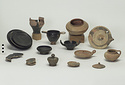
Located 3.5m ... 700-675 B.C. with intrusions ... Household: Unglazed; double-yoked handle for large amphora ("cow's head handle"); amphora; utility amphoras; storage amphoras; kados; spouted kados; cooking ware; cooking jug; cooking stand; brazier; cooking ware basin; oinochoe; hydriai; bowl, deep spouted; lekane; large basin; coarse ware basin; pithos; incised coarse ware.
|
|
|