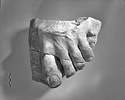
Eleven pieces comprising two non-joining fragments. To Young's publication of six pieces are now added five more, two of which help to complete to inscription.
Part of the side wall with reserved panel ... 600 B.C ... Letters incised deeply but not too carefully with a blunt point.
Line 1: Ανδρογ[---] ho Δ[..]ιες
Line 2: τοι Δι τ΄άναχτι hισ-
Line 3: έδρασεν
Line 1 contains a proper name, Androg ... , followed by a patronymic or an ethnic. ... Hemberg shows that Apollo receives the title Anax in Homer and Classical literature far more often than any other deity, and since, like Zeus, Apollo was worshipped on Mount Hymettos (Pausanias, I, 32,2), it is possible that the inscription is a dedication to both deities.
... To the right of the end of line 1 is a lone four-barred sigma, larger and more deeply cut than the letters of the inscription.