|
|
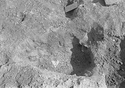
Gravel above early road some 5m wide. The bedrock was heavily scored by traffic, and the accumulation of gravel, ca. 0.30m, thick produced Middle Helladic Pottery. This early thoroughfare ran in a northwest-southeast ... Middle Helladic ... This early thoroughfare ran in a northwest-southeast direction, apparently making for the saddle between the Acropolis and the Areopagus. |
| An area about 10m2. on the lower northwest slopes of the Areopagus, southeast of the archaic fountain house. A dumped fill to the end of the 3rd quarter of the 7th c. B.C., containing many votives, overlying ... 7th c. - 625 B.C ... on the lower northwest slopes of the Areopagus, southeast of the archaic fountain house. |
R. Ross Holloway ... Protogeometric Grave in Koletti Garden. Male inhumation.
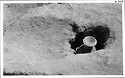
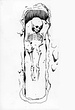
Tomb first encountered and partially damaged by workmen who were digging a cess pit for the restored Koletti House on Polygnotos street. The tomb ... "Submycenaean"/Early Protogeometric ... The tomb was located just southeast of the house, between the paved terrace and the annex to the east. It consisted of an unlined rectangular pit, oriented southeast-northwest, cut into bedrock to a depth of about 0.25m, below the level of the surrounding bedrock, and measuring approximately 1.45m long and averaging 0.60m wide. Within the pit, the skeleton of a man aged 18-21 years at death, and described as somewhat decayed, was laid out on his back in a fully extended position, head to the southeast. the fill of the tomb appeared to consist of sterile redeposited bedrock and it was hastily dug by the workmen prior to the arrival of a trained excavator. the floor of the tomb was encountered at 1.95m below the level of the court in the area of the cess pit, ca. 1.15m below the level of the tiled pavement along the east side of the Kolletti House |
| Rodney S. Young ... Grave 6 in notebook (E.L. Smithson: Grave XXII: PG). Bones discarded. Urn cremation (trench-and-hole).
JP
Roughly rectangular trench cut through hard earth into bedrock to a depth of about 0.35m, approximately ... Late Protogeometric ... Trench oriented southeast-northwest, with the urn-hole adjoining the southeast corner. |
| Grave 16 in notebook.
Length of shaft 1.81m; width 0.64m; depth from cover 0.54m.
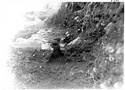
Skeleton of a woman , head at northwest end. Most of pots piled over feet and legs of skeleton at southeast end.
An iron ... 750 B.C ... Skeleton of a woman , head at northwest end. Most of pots piled over feet and legs of skeleton at southeast end.
|
| Homer A. Thompson ... (Grave XXX: EG)
Rectangular cutting with burned bones of a female 40-45 years old, and both burned and unburned pottery fragments.
Rectangular trench, measuring approximately 0.80m long, 0.40m wide, with ... Middle Geometric I ... Rectangular trench, measuring approximately 0.80m long, 0.40m wide, with a preserved depth of 0.20m, cut through earth, partly into irregular outcroppings of bedrock, oriented northwest-southeast. |
| Rodney S. Young ... Grave 19 (In some records as Grave VIII). No remains, no burned matter or traces of burning.
JP
A small cutting with a single offering. The pit may have been for a simple child/infant inhumation, with ... Early Protogeometric ... A further cutting, just to the south, roughly rectangular, oriented east-southeast to west-northwest, measured 0.95m in length, 0.53m wide, and 0.47m deep. |
| James H. Oliver ... (E.L. Smithson: Grave IX: PG). Two children's skeletons one on top of the other. Cf. PD 329 for PD 430 for second skeleton, same deposit.
PG grave about 25m. SW of Cistern A at 46/ΜΔ.
[In some records, ... Developed Protogeometric ... Oriented southeast-northwest, the tomb measured 1.40m long and 0.65m wide at the top, narrowing with depth. The bedrock forming the edges of the tomb pit was stepped in to provide an irregular ledge, running round all four sizes. maximum width of the pit at the bottom was about 0.30m. a partial lining of fieldstones was bedded on the ledges; the uppermost stones were interrupted at the southeast corner by an irregular recessed pocket containing two lekythoi.
Skeletons fully extended, heads to the southeast. Lower skeleton was described as a "six-year-old girl" with arms bent over the body. |
|
|