|
|
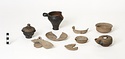
Lower fill may be original. Part of North side cut away by modern bothros wall. Fragments of Pilgrim Jug of Grey Ware, related to Turkish Grey Ware? ... 12th or 13th c. A.D ... Lower fill may be original. Part of North side cut away by modern bothros wall ... Fragments of Pilgrim Jug of Grey Ware, related to Turkish Grey Ware? |
| Marcie Handler ... The Pyre was revealed in a layer of 4th c. fill in the north end of Room 6, just south of Wall 8. Room 6 is defined by the street wall (Wall A) on the west, Wall 7 on the east, Wall 9 on the south (preserved ... 4th c. B.C ... The Pyre was revealed in a layer of 4th c. fill in the north end of Room 6, just south of Wall 8. Room 6 is defined by the street wall (Wall A) on the west, Wall 7 on the east, Wall 9 on the south (preserved only as a stub on the east side of the area), and possibly Wall 8 or Wall 6 on the north.
2.5 meters SW of the pyre, a patch of floor surface at J/10-1/20 at 52.188 masl. was found. ... This pyre is the northernmost pyre found in Section ΒΖ North, and its location suggests that the Classical Commercial Building continues this far north. |
Hellenistic fill, north of Temple of Ares, on either side of wall running east-west over 50/ΙΓ. Mostly coarse pottery including many stamped amphora handles.
Cf. also nb. P XII, pp. 2297-2298. Coins:
13 ... 275-200 B.C ... Hellenistic fill, north of Temple of Ares, on either side of wall running east-west over 50/ΙΓ. |
| David Scahill ... Protogeometric/Early Geometric well under floors in Room 1, Classical Building II, on north side of south ashlar wall. See J 3:9 for the burial within this well.
Cf. Hesperia Suppl. 50 (2018), p. 106, ... 27 June 2001
17 July 2002 ... Protogeometric/Early Geometric well under floors in Room 1, Classical Building II, on north side of south ashlar wall. |
| David Scahill ... At northeast corner of Classical Building II; on south side of dromos of Tomb K 2:5, and separated from it by ca. 0.6m of bedrock. Chamber cut through bedrock. The northeast corner of chamber defined ... LHIII A:1 ... At northeast corner of Classical Building II; on south side of dromos of Tomb K 2:5, and separated from it by ca. 0.6m of bedrock. ... Rest of tomb runs under later wall foundations to the south and west.
... Partially articulated skeleton laid out against the north wall of the tomb, with feet to the east. |
| David Scahill ... Below packed clay floors in Room 2 of Classical Building II; bordered on east and south sides by polygonal cross wall and back wall extension for Classical Building. Late Roman wall and drain installation ... LHIII A:1 ... Below packed clay floors in Room 2 of Classical Building II; bordered on east and south sides by polygonal cross wall and back wall extension for Classical Building. Late Roman wall and drain installation above west side. ... At floor of tomb, concentration of bone fragments and pots, mostly broken in situ, concentrated against the north side of the tomb, with some bone fragments across the middle, and on the south side with more pots. |
| Marcie Handler ... Fill within the drain from the basin on the west side of Roman Room B through Wall A.
After we removed the fill within the basin on the west side of Roman Room B (BZ XXVII p. 5325), we began excavating ... Late Roman ... Fill within the drain from the basin on the west side of Roman Room B through Wall A.
After we removed the fill within the basin on the west side of Roman Room B (BZ XXVII p. 5325), we began excavating in the cutting on the east face of a conglomerate block that is part of Wall A. ... The cutting is probably a drain that carried water from the basin through Wall A and onto the North-South Road. |
Trial trench IV. A thin strip of undisturbed fill excavated on the north side of the upper terrace, just inside the line of the Archaic peribolos wall.
Probably this small patch of clay represents part ... Protoattic ... A thin strip of undisturbed fill excavated on the north side of the upper terrace, just inside the line of the Archaic peribolos wall.
Probably this small patch of clay represents part of the ground surface of the sanctuary in the 7th century, pressed into the high bedrock.
|
| An extensive cistern system on the lower north slope of the Areopagus, south chamber with blind tunnel extending further south (south tunnel); north chamber; drawshaft further north, extends to north tunnel ... Ca. 320-240 B.C ... An extensive cistern system on the lower north slope of the Areopagus, south chamber with blind tunnel extending further south (south tunnel); north chamber; drawshaft further north, extends to north tunnel. ... Later, the entire tunnel was blocked off by a similar wall set in the side of shaft. About the same time,the southern chamber was dispensed with and the mouth of the passage leading to the north chamber was carefully walled, the one plastered face of the wall looking toward the northern chamber. |
| Initially uncovered with a diameter of c. 1.05m. Its south side extends under the south wall of the Classical structure and so clearly predates it. The highest preserved portion of the well shaft (at the ... 22 July-9 August 1994
26 June 1995
3-7 July 1995 ... Initially uncovered with a diameter of c. 1.05m. Its south side extends under the south wall of the Classical structure and so clearly predates it. ... The well is cut through a compact stratum of fill at the top of its the north side; elsewhere it is cut into the gray bedrock. ... Because the south side of the well shaft projects beneath the E-W Classical Wall at J/6,7-2/20, we attempted to leave undug the portion of the well fill that underlies that wall. |
| Laura Gawlinski ... Coin hoard of Athenian tetradrachms. Dug into fill under floor (floor level not preserved) on east side of Strategeion near the NE corner of room formed by the eastern poros block wall and an east-west ... Second half of 4th c. B.C ... Coin hoard of Athenian tetradrachms. Dug into fill under floor (floor level not preserved) on east side of Strategeion near the NE corner of room formed by the eastern poros block wall and an east-west polygonal crosswall. ... Dug into two layers of fill, Lots S 295 (ca. 475 B.C) and S 296 (last quarter of 6th c. |
| Handler ... Found in an area of disturbed fill north of a floor surface in Room 4 of the Classical Commercial Building. The floor surface (n. 3 on the west side of Room 4) was preserved at 52.503-52.544 masl., and ... 2nd half 4th c. B.C ... Found in an area of disturbed fill north of a floor surface in Room 4 of the Classical Commercial Building. The floor surface (n. 3 on the west side of Room 4) was preserved at 52.503-52.544 masl., and was excavated in Lot ΒΖ 1758 (2nd half of the 4th c. ... The pyre was located in a shallow channel adjacent to the south face of Wall 4, where the floor surface was not preserved. |
| Mycenaean Chamber Tomb under north side of Temple of Ares, towards its west end.(1951).
The tomb had a hasty and unfinished appearance oddly at variance with its long history and the quality of the pottery ... 1st: Myc IIB-IIA:1-2, 2nd: Myc. IIIC:1 (1450-1200 B.C.) ... Mycenaean Chamber Tomb under north side of Temple of Ares, towards its west end.(1951).
... The original dromos ran from west to east and entered the chamber toward the south end of the long west wall. ... A small niche, 0.50m square and raised 0.25m above the chamber floor, was set in the wall at the southwest corner of the room.
|
| Marcie Handler ... Continued from 2000 season, 10-12 July 2000; BZ XXIII p. 4472.
The hoard was originally excavated during the 2000 season (Lot BZ 1049, 5th-6th centuries AD), from a higher elevation through a gap in the ... 10-12 July 2000
21-22 July 2003 |
| Mycenaean Chamber Tomb occupies a considerable part of the western half of section ΕΕ; lies about half way up the north slope of the Areopagus towards its eastern end, just below the highest point of the ... Myc. III A:1 ... The tomb consists of a roughly rectangular chamber approached from the north by a long dromos. it is entirely hewn out of the rock of the hill and except for the wall of rough stones that blocked the doorway, there is no masonry. ... Its roof has entirely caved in, except for a small bit projecting at the north end of the west side; probably was not flat but slightly concave (all along the north side it seems that it rises from the sides toward the center).
... Group of objects:
a) on the east bench, a little north of its center (BI 511, P 15234-15239)
b) on the floor in the northeast corner of the chamber just to the left of the door (B 704, P 15358-15359)
c) on the floor of the chamber, about 0.40m from the south wall, near its mid-point (B 705, BI 513, BI 514, BI 530
d) on the floor in the northwest part of the chamber, at the foot of the bench about midway between the grave and the north wall of the chamber (J 64, J 65, J 68) |
| Brian Martens ... Mycenaean Chamber Tomb J 1:11, located in the area north of Wall K, was partially excavated during the 2014 season. At this point the full western extent of the chamber has not been located because of ... LHIIIA ... Mycenaean Chamber Tomb J 1:11, located in the area north of Wall K, was partially excavated during the 2014 season. ... Only a small portion of the northern edge, cutting into the rocky red virgin fill, could be revealed; the remainder is presently concealed under the scarp of still-standing Wall P. the stomion and its intact blocking wall were found behind a thin layer of fill centered at the western side of the chamber. ... At the end of season, a strip of fill remained atop the blocking wall.
|
| RSY Grave 51.
The grave lay on the slope of the Areopagus in Roman house O, just east of the line where the hillside is scarped for the foundation of the west wall of the house.
Cutting:the pit cut in ... Archaic period/6th or 7th c ... The grave lay on the slope of the Areopagus in Roman house O, just east of the line where the hillside is scarped for the foundation of the west wall of the house.
... A foundation wall of the Roman house passed close to the mouth of the pithos, for which we found no cover; one may have been removed when the foundation was laid. The side of the pithos which lay upward had been crushed in by pressure from above, but all the fragments were found inside where they had fallen, and there was no evidence that any hole had been made for the insertion of the body.
|
| C.G. Thomas ... Geometric grave. Bones discarded.
Tomb located about 2m west/west-southwest of the EG1 child inhumation, beneath the restored line of a hypothetical wall connecting the western "apse' and the south wall ... Middle Geometric II ... Tomb located about 2m west/west-southwest of the EG1 child inhumation, beneath the restored line of a hypothetical wall connecting the western "apse' and the south wall of the Geometric House. ... Oriented more or less to the points of the compass, the trench measured about 0.80m (east-west) by about 0.70m (north-south). ... Remnants of a stone packing over the trench survived on the west side and for a short distance along the north.
|
| Eugene Vanderpool ... Grave (E.L. Smithson: Grave II: SM).
Unlined trench, roughly the size of the deceased, cut into bedrock to a depth of just over 1.50m. Oriented north-south, the tomb pit measured 1.69m in length (length ... Late Mycenaean/Submycenaean-Earliest Protogeometric ... Unlined trench, roughly the size of the deceased, cut into bedrock to a depth of just over 1.50m. Oriented north-south, the tomb pit measured 1.69m in length (length of the skeleton in situ, 1.65m), and had a width, as excavated, of 0.40-0.58m. the west side was slightly undercut, and a small part of the east side was cut buy the cellar wall of a modern house, but only the very edge of the tomb at an upper level was touched, whereas the contents of the grave were untouched. ... The left arm of the deceased was at her side, the right arm was slightly bent, with the hand over the pelvis |
| John Camp ... Protogeometric grave (female inhumation) located about 0.60m northwest of T 15:1. It consisted of a roughly rectangular pit, with the corners slightly rounded, oriented approximately north-south. The pit ... "Submycenaean"/Early Protogeometric ... Protogeometric grave (female inhumation) located about 0.60m northwest of T 15:1. It consisted of a roughly rectangular pit, with the corners slightly rounded, oriented approximately north-south. The pit was cut to a depth of at least 0.45m at the south end and 0.25m at the north on account of the sloping bedrock. ... The tomb pit measured 1.65-1.70m long by about 0.63m wide; the floor of the tomb was at 68.30-68.40 masl., 1.65-1.70m long by about 0.63m wide; the floor of the tomb was at 68.30-68.40 masl.
|
|
|