|
|
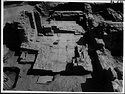
Cistern C (pit) in West Room of late Roman House.
Mixed dump of material, with a little Classical, much Roman dating at least as late as 3rd century A.D., and large amount of late Hellenistic. Coins:
1 ... Late Hellenistic and Roman ... Cistern C (pit) in West Room of late Roman House.
Mixed dump of material, with a little Classical, much Roman dating at least as late as 3rd century A.D., and large amount of late Hellenistic. |
Pocket of soft fill in bedrock at corner of Late Roman house, with a hoard of lead tokens. No pottery catalogued.
Herulian debris: cf. D 10:1, D 11:7 Coins:
25 May 1935 #8 Estimated Grid
No pottery catalogued ... 25 May 1935 ... Pocket of soft fill in bedrock at corner of Late Roman house, with a hoard of lead tokens. |
Pit in floor of cellar of House 634/19. Contents mixed to late Roman. Pottery 4th c. B.C. to 4th c. A.D. discarded ... 25 April 1958 ... Pit in floor of cellar of House 634/19. Contents mixed to late Roman. |
| Well in Room 7 of Roman House H, partially covered by caldarium of added bath complex (Room 6). Stone well-head; 0.85m in diameter. Stpped because of danger of collapse. Cut through bedrock, water from ... 6th c. A.D ... Well in Room 7 of Roman House H, partially covered by caldarium of added bath complex (Room 6). ... Nondescript Late Roman. |
| Well in East Colonnade of Roman House H. Diameter 0.80m, lined with field stones set in mortar. used as a cistern as well.
No useful pottery dates. Capital from colonnade A 3866 and part of shaft found ... 29 July 1970 ... Well in East Colonnade of Roman House H. Diameter 0.80m, lined with field stones set in mortar. used as a cistern as well.
... Capital from colonnade A 3866 and part of shaft found at 2.50m-3.00m, indicating destruction of house (late 6th, 580's by Slavs). ... See also Q 21:4 from same house. Marble heads (S 2354-2356) deliberately discarded before house went out of use. |
Upper fill early Roman. Lower fill latest Hellenistic.
No house walls clearly associated with it, and apparently no attempt made to assign it to any particular house. Subdivisions:
.1=Upper fill
.2=Lower ... Late Hellenistic-Early Roman |
Well south of the apse of Room 3, Roman House H. Cut through bedrock, diameter ca. 1.15m, stopped at ca. -10.80m because of danger of collapse. Water at very top, up to bottom of parapet between well and ... 2nd-4th c. A.D ... Well south of the apse of Room 3, Roman House H. Cut through bedrock, diameter ca. 1.15m, stopped at ca. -10.80m because of danger of collapse. ... A.D, indicating period of use of Room 3A as a fountain-house before incorporation into Roman House H sometime around the middle of the 4th c. ... The well apparently went out of use as such with the construction of Roman House H. |
"Oinophorus Well".Tiled well in House H (diameter 0.80m, water level -4.70m). Height of tiles 0.64m Heavy well deposit; lamps,, type XXVII; many basket-handled water jars; oinophoros with labors of Herakles ... Use filling of early 2nd-mid.-3rd c. A.D ... "Oinophorus Well".Tiled well in House H (diameter 0.80m, water level -4.70m). ... Subdivisions:
.1=top-2.95m. Late Roman dump.
.2=2.95-7.00m. |
Well at 63/ΙΒ (in House H, Room 15). Upper fill mixed Hellenistic to 2nd c. or later. Probably thrown in in Early Roman times when House H was built. Contained many figurines; probably part of Koukla factory ... 12 August 1947 ... Well at 63/ΙΒ (in House H, Room 15). ... Probably thrown in in Early Roman times when House H was built. ... Lower fill with much 4th c. and as late as upper fill into 2nd c. |
Diameter 0.95m; water level -9.10m.
Plais shaft cut in stereo from bottom of slender flask-shaped cistern. Scanty fill from house destruction in 5th c. A.D.; Christian lamps; unfinished statuette of Castor ... Late Roman |
Connected with G 14:3.
There was a layer of Late Roman fill. It rested over a layer of 2nd c. B.C Hellenistic and then another of 4th c. B.C Hellenistic; the passage between the two cisterns contained ... Late Hellenistic ... There was a layer of Late Roman fill. It rested over a layer of 2nd c. ... Therefore, it appears that this cistern had several periods of use: Hellenistic (at least one phase contemporary with the 2nd century B.C, phase of House E to the north), Late Roman (probably associated with the amphora and perhaps also maybe the platform and the drain), and finally Byzantine.
|
Plaster dump at Q/2,5-6/7,9.
Layer 5 in "Wall Painted Room" of Roman House ε. Layer resting on bedrock and covered partially by good strosis (55.26m.). Fill was red with mudbricks, tiles, much plaster ... Late 1st-early 2nd c. A.D. |
| Pyre in House D, Room 4 (RSY=Pyre 4) in the industrial area west of the Areopagus.
Notebook refers to House N.
Pottery belongs late in third quarter of the 4th. c. BC. Pyre burned near beginning of last ... 350-300 B.C ... Pyre in House D, Room 4 (RSY=Pyre 4) in the industrial area west of the Areopagus.
Notebook refers to House N.
Pottery belongs late in third quarter of the 4th. c. ... Hence the pyre may postdate the abandonment of the house considerably. |
No period of use. Below the upper (Early Roman) dump extending down to ca. 6.10m. was a dumped fill of broken pottery in great quantity, including a high proportion of red-figured fragments. Masses of ... Ca. 430-400 B.C.
Late 1st c. B.C.-mid 1st c. A.D ... Below the upper (Early Roman) dump extending down to ca. 6.10m. was a dumped fill of broken pottery in great quantity, including a high proportion of red-figured fragments. ... Subdivisions
.1=Upper fill. Late 1st cent. B.C. to mid 1st cent. after Christ.
.2=Lower fill. Late 5th cent. B.C. |
Evidence of stratification into five layers, although joins between the layers. Layer VI added when the construction of the Roman building above required it. No subdivisions assigned.
Flask-shaped cistern ... Early 3rd-late 2nd c. B.C. |
RSY Grave A.
Under the Roman House with three rooms floored with mosaic near the southwest side of the area. The burial consisted of a pot laid on its side over the bedrock, presumably containing a child ... 7 August 1947 ... Under the Roman House with three rooms floored with mosaic near the southwest side of the area. ... The grave had been disturbed in early times by the building of a wall (6th or 5th century B.C.) which in part overlay it; only the part of the pot immediately over the stereo was preserved. it was an amphora with banded body and conventional ornaments on the reserved neck, probably late 8th century. |
| Mycenaean Chamber Tomb occupies a considerable part of the western half of section ΕΕ; lies about half way up the north slope of the Areopagus towards its eastern end, just below the highest point of the ... Myc. III A:1 ... It was originally several meters longer but its northern end was cut off by a late Roman retaining wall. ... High above the chamber to the south, about five meters above its floor, is the remains of a wall of a late Roman house, part of which passed over the southwest corner of the chamber and had to be removed. About a meter below this, and again over the southwest quarter of the chamber, was a corner of light rubble wall of late hellenistic times. |
|
|