|
|
| Sections Ε, Ν, Η 1952 ... Homer A. Thompson ... Mycenaean graves were excavated in section Ε.
Section Ν was disturbed by late pits, bothroi and walls. Excavation was carried out through Roman levels. The area seemed to have been leveled out and raised ... 4 Mar-31 May 1952 ... Section Ν was disturbed by late pits, bothroi and walls. ... Earlier fills were found only in wells and pits cut down into bedrock. ... Work in section Η was confined to cleaning in and around the large late Roman building covering most of the section. |
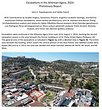
| Excavations in the Athenian Agora, 2024: Preliminary Report ... John K. Papadopoulos Debby Sneed ... A summary of the second excavation season in Section ΒΚ, in the area beneath the former building at 14 St. Philip Street.
The area was divided into three trenches and yielded mixed material from the Modern ... 10 Jun-2 Aug 2024 ... The area was divided into three trenches and yielded mixed material from the Modern to Late Roman periods. Notable features from this season were walls in ΒΚ North from the Middle Byzantine period and pits from both ΒΚ West and South, the purpose and dating of which is still under investigation. |
| Preliminary Report on the 2008 Excavation Season ... John McK. Camp II ... Excavations took place in three sections, two north of Hadrian Street (ΒΗ and ΒΘ) and one in the old area south of the Tholos (Γ).
In Section ΒΗ, layers in, over and behind the building identified as the ... 10 Jun-1 Aug 2008 ... A rubble wall may represent a late blocking of the interior colonnade, relatively common in the late Roman period.
... Mostly late fills were dug but the top of Byzantine walls came to sight in some places, as was large worked blocks that may have come from one or several Classical buildings.
... Elsewhere various floor levels and pits were dug, most of them dating to the 4th century B.C. |
| Section Υ: 1958 Excavation Report ... Dorothy Burr Thompson ... Two areas at the north foot of the Areopagus were uncovered. The first area did not yield much of interest due to modern disturbances. Excavations of a well, three pits and a water channel produced however ... 3 Mar-3 May 1958 ... Excavations of a well, three pits and a water channel produced however ancients material.
... Little evidence remain from late Hellenistic to late Roman period but habitation continued in the area until Byzantine times. |
| Section ΛΛ 193
Excavation Summary ... Dorothy Burr Thompson ... Excavations in Section ΛΛ revealed that the original contour of Kolonos Agoraios had been much sharper than in modern times. No traces of early graves were found in the area; first sign of habitation is ... 1 Feb-23 Jun 1937 ... No traces of early graves were found in the area; first sign of habitation is pottery from the last half of the 5th century B.C. found in metal working pits in connection with a drain and a road. ... In the late 4th century A.D. the area suffered much damage.
|
| Preliminary Report on the 2009 Excavation Season ... John McK. Camp II ... Excavations were conducted in four sections: Γ, ΒΘ, ΒΗ and ΒΖ.
In Section Γ, the investigation of the Classical buildings south of the Tholos continued with the aim to find out if they were civil, commercial ... 8 Jun-31 Jul 2009 ... Various other features were found, such as pithoi and pits.
In section ΒΗ, most of the 10th century A.D. house walls were removed and more remains of the back wall and two interior columns of the Stoa Poikile were exposed. ... The building went out use in the late 6th century. Behind the back wall, two terracotta pipelines were uncovered. |
|
|