icon

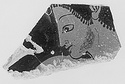
[Agora Object] P 22208: Red Figure Calyx Krater Fragment

Small piece from wall. Head and shoulder of youth, left. Relief contours; dilute glaze details, including sideburns, forelock incised. Cf. Kleophrades Painter, Beazley (1933), Kleoph.Maler, pl. 14(3) ... 30 April 1952 ... Cf. Kleophrades Painter, Beazley (1933), Kleoph.Maler, pl. 14(3) and pl. 28(1).

[Agora Object] Agora XXX, no. 1676

Wall fragment. Glaze streaky reddish brown and dull black on inside. Max. dim. 0.062. A. Ashmead, Hesperia 35, 1966, pl. 8:6. Man or youth (lower legs, right foot frontal, left in profile). Preliminary ... Ca. 480 B.C ... The shin bone continuing to the inside contour of the leg occurs on a few late works by the Kleophrades Painter: Copenhagen 149, the youth leaning on the stele (ARV2 184, 27; Paralip. 340, 27); London, B.M. ... The Kleophrades Painter (ARV2 191, 99; Paralip. 341, 99).

icon

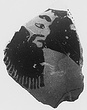
[Agora Object] P 1412: Red Figure Column Krater Fragment

From the shoulder of a large vase, glazed inside with thin black. No relief contours; the outline of the eye and the breast muscle drawn with relief lines. The eye full face, the angles slightly open; ... 16 February 1933 ... Circle of the Kleophrades painter? Cf.

[Agora Object] Agora XXX, no. 1650

Shoulder and wall fragment. Traces of burning on inside. Max. dim. 0.116. A. Ashmead, Hesperia 35, 1966, pl. 7. Herakles (head, upper torso, left arm with club, start of right arm outstretched) reclining ... Ca. 500 B.C ... The Kleophrades Painter (ARV2 one 125, 59; ARV2 189, 79; Paralip. 341, 79).

icon

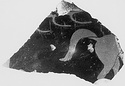
[Agora Object] P 24052: Red Figure Bell Krater Fragment

Broken all around. Rear part of Centaur moving right; with branch over his shoulder; trace of another figure at left. (The Centaurs of the Kleophrades painter are not far off. Note also that the scale ... 29 May 1954 ... (The Centaurs of the Kleophrades painter are not far off.

[Agora Object] Agora XXX, no. 255

Wall fragment from near rim. Glaze slightly dull on outside. Max. dim. 0.052. H. A. Thompson, Hesperia 16, 1947, pl. 47:2; A. Ashmead, Hesperia 35, 1966, pl. 8:2. Man (most of filleted head) to right ... Ca. 490 B.C ... The Kleophrades Painter (ARV2 186, 41; Paralip. 340, 41).

[Agora Object] Agora XXX, no. 254

Two non-joining wall fragments. Max. dim. a) 0.055, b) 0.077. A. Ashmead, Hesperia 35, 1966, pl. 8. Fragment a preserves most of the filleted head of an old man (Phoinix) to left, holding a spear or staff ... Ca. 490 B.C ... Döhle (Klio 49, 1967 [ pp. 63--143], p. 105) thinks that 254 may come from a representation of the Mission to Achilleus, based in part by the presence of Phoinix in the same scene by the Kleophrades Painter on his hydria in Munich, inv. 8770 (Paralip. 341, 73 bis; Addenda 189). ... The Kleophrades Painter (ARV2 185, 38; Paralip. 340, 38).

[Agora Object] Agora XXX, no. 252

Three non-joining fragments: P 22490 of rim and start of wall; P 30996 of rim; P 13366 of wall and cul with stub of handle. Reserved line at top of rim on inside. Max. dim. P 13366: 0.105, P 22490: 0.083, ... Ca. 500-490 B.C ... For black glazed palmettes on the rims of red-figured calyx-kraters, see the following: two by the Kleophrades Painter decorated early in his career: Louvre G 48 + New York, M.M.A. 1978.429.1:a--v: there one-half of the rim has horizontal black-glazed palmettes, the other half, upright palmettes in reserve (ARV2 185, 33; Paralip. 340, 33; Addenda 187) and Tarquinia RC 4196, up-and-down palmettes (ARV2 185, 35; Paralip. 340, 35; Addenda 187); two by the Eucharides Painter, both drawn horizontally and also early in his career: Louvre G 47 (ARV2 227, 11; Addenda 199) and Louvre G 163 (ARV2 227, 12; Paralip. 347, 12; Addenda 199). 252 is closest to Louvre G 48. Black palmettes do not seem occur elsewhere on the culs of red-figured calyx-kraters, but they are known from two black-figured examples, both related to the Antimenes Painter: Syracuse, where a single palmette at each handle frames the figured composition (ABV 281, 18) and Louvre F 316 (ABV 281, 19). For the net pattern on the cul, though not reduced to a dot band as on 252, see Copenhagen, N.M. inv. 13365 by the Kleophrades Painter (ARV2 185,32; Paralip. 340, 32; Addenda 187) and Louvre G 47 by the Eucharides Painter; also Louvre CA 5950 (above, sub 249).

[Agora Object] Agora XXX, no. 1653

Wall fragment. Max. dim. 0.037. Uncertain subject. What remains is the head and neck of a pantherskin overlapping something decorated with toothed stripes. At the bottom of the fragment is part of an ... Probably late first quarter of the 5th century B.C ... The toothed stripes also resemble Oriental costume, for example, that of the Amazon on Würzburg HA 120 = 507 by the Kleophrades Painter (ARV2 181, 1; Paralip. 340, 1; Addenda 186).

[Agora Object] Agora XXX, no. 1424

Bowl fragment. Max. dim. 0.035. LIMC IV, 1988, p. 232, no. 337, s.v. Gigantes. A, Hephaistos(?): in the Gigantomachy(?). The fragment preserves the face of a man with a very long beard, to right, with ... Ca. 490-480 B.C ... A good example, contemporary with 1424, is Hephaistos in the big Gigantomachy on Berlin 2293 by the Brygos Painter (ARV2 370, 10; Paralip. 365, 10 and 367, 10; Addenda 224). ... Méd. 385 by the Kleophrades Painter (ARV2 186, 50; Addenda 188).

[Agora Object] Agora XXX, no. 257

Wall fragment. Glaze mottled on outside. Max. dim. 0.063. A. Ashmead, Hesperia 35, 1966, pl. 10:o (mispoised); A. Bélis, BCH 110, 1986, p. 213, fig. 12 (mispoised). Trumpeter (most of face, a little of ... Ca. 480 B.C ... Paul Getty Museum 77.AE 11 by the Kleophrades Painter (ARV2 186, 51; Addenda 188) has short hair, at least to judge by what protrudes from the edge of her leather cap. ... The Kleophrades Painter (ARV1 124, 39; ARV2 186, 46; Paralip. 340, 46; Addenda 187).

[Agora Object] Agora XXX, no. 203

Wall fragment from turn of shoulder. Glaze thin and dull on inside. Max. dim. 0.055. Satyr (part of face, beard, ear, and hair) to right, wearing a spotted feline skin. Overlapping the locks of hair at ... Ca. 490 B.C ... Cf., e.g., the maenad with the fawn skin over her chiton who holds both a thyrsos and a snake on Munich 8732 = 2344 by the Kleophrades Painter (ARV2 182, 6; Paralip. 340, 6; Addenda 186); also the huge serpent held by Dionysos on Louvre Cp 10748, where the god attacks a falling giant (ARV2 187, 55; Addenda 188).

[Agora Object] Agora XXX, no. 177

Four non-joining fragments of neck and shoulder. P.H. a) 0.125; max. dim. b) 0.16, c) 0.11, d) 0.99. E. Laufer, Kaineus: Studien zur Ikonographie [Rivista di archeologia Suppl. 1], Rome 1985, pl. 12:35 ... Ca. 470-460 B.C ... Cohen, "Paragone: Sculpture versus Painting, Kaineus and the Kleophrades Painter," Ancient Greek Art and Iconography, Warren Moon, ed., Madison, Wisc., 1983, pp. 171--192; E. ... From what remains of the Kaineus scene on Side A of 177, taken together with the curve of the krater's shoulder, it is likely that the composition was a symmetrical one, with the warrior flanked to left and right by a single centaur, similar to the one by the Pig Painter himself, once in the Lucerne Market, now in a Swiss private collection (ARV2 563, 7; Addenda 260). Earlier Mannerists, i: Manner of the Pig Painter (ARV2 566, 1; Addenda 261).

[Agora Object] Agora XXX, no. 249

Wall fragment with a little of projecting rim. Glaze misfired reddish brown in places on outside; a bit greenish on inside. Max. dim. 0.074. Fight(?). The fragment preserves the raised, bent right arm ... Ca. 510-500 B.C ... For ivy on the rim, the closest parallels appear on the rims of these four calyx-kraters: Villa Giulia, no no. by Epiktetos (ARV2 77, 90; Addenda 169); Copenhagen, N.M. 126 by the Troilos Painter (ARV2 297, 11; Addenda 211); Louvre CA 5950, which may be by Psiax (p. 27, note 2 and p. 88, note 6 above); and Lecce, inv. 610 (CVA, Lecce 1 [Italia 4] pl. 10 [161]:1, 2). ... For an encircled palmette-and-lotus configuration at the handle, see Louvre G 48 + New York, M.M.A. 1978.429.1:a--v by the Kleophrades Painter (ARV2 185, 33; Paralip. 340, 33; Addenda 187) and Basel, Cahn H.C. 537 by the Berlin Painter (Paralip. 344, 116 bis; Addenda 193); Louvre CA 5950; London Market (Cat.

[Agora Object] Agora XXX, no. 589

Five non-joining wall fragments, a with start of keel. Glaze much pitted on underside of bowl. P.H. a) 0.18; max. dim. a) 0.25, b) 0.174, c) 0.087, d) 0.107, f) 0.062; est. circumference at ground line ... Ca. 500 B.C ... The position of this acontist may have been very similar to one on the psykter in a Swiss private collection, attributed to a painter of the Pezzino Group (ARV2 1621, 3 bis; Addenda 157; NumAntClass 16, 1987, pl. 5:7), only reversed. ... Perhaps it is just a javelin stuck in the ground (cf. the two on the skyphos by the Brygos Painter, Boston 10.176 [ ARV2 381, 173; Paralip. 368, 173; Addenda 227]). Manner of the Kleophrades Painter (ARV1 129, 5); near the Kleophrades Painter (ARV2 193, 1; Paralip. 341, ---, 1).

[Agora Object] Agora XXX, no. 1411

Profile complete. Mended with the missing pieces restored in plaster and painted, notably most of one side of the bowl, about half of the other, both handles. H. 0.077; rest. diam. at rim 0.185; diam ... Ca. 500 B.C ... Robertson (Στη'λη , pp. 125--129) suggested that 1411 is an early work by the Kleophrades Painter, an attribution he has since withdrawn orally. The face of the woman shares some similarities with the work of the Nikoxenos Painter, especially the shape of the nose and the slightly downturned mouth, but the rest of the drawing is too rough to be his.

[Agora Object] Agora XXX, no. 173

Six non-joining fragments, a of rim, neck, shoulder, and start of one handle column, b + d of shoulder with swelling for handle root and part of wall, c, f, and g of wall. Glaze dull in places on outside; ... Ca. 480 B.C ... There are not very many red-figured examples of satyrs making wine, and 173 seems to be one of the earliest, preceded slightly by the scene on a bell-krater in Basel, Antikenmuseum und Sammlung Ludwig, BS 482, attributed to the Kleophrades Painter (ARV2 1632, 49 bis; Addenda 188; CVA, Basel 3 [Schweiz 7], pl. 11 [323]:2, 4); 173 seems to be the only example in which there are four satyrs by themselves. Usually, Dionysos is present, as in the scene by the Cleveland Painter in New York (M.M.A. 41.162.10: ARV2 516, 4; Paralip. 382, 4; Addenda 253) or there may be three satyrs by themselves (e.g., Lecce 602 by the Leningrad Painter: ARV2 569, 39; Paralip. 390, 39; Addenda 261). 173 presents a number of problems concerning interpretation of details. ... The Flying Angel Painter (ARV 1 184, 25; ARV2 281, 30).

[Agora Object] Agora XXX, no. 256

Fifteen non-joining fragments of wall, P 18278 b--c and P 19582 a--d of torus rim with zone of ornament below. Glaze mottled here and there; has a greenish cast in places; abraded in part on rim. Max ... Ca. 480 B.C ... What comes to mind immediately, of course, is the Achaeans' mission to Achilleus described by Homer in Book IX of the Iliad and illustrated by the Kleophrades Painter on his hydria in Munich, inv. 8770 (Paralip. 341, 73 bis; Addenda 189). ... If the scene on 256 represents the Second Arming of Achilles, it would be the earliest known red-figured example, and it would show once again the ability of the Kleophrades Painter to depict a Trojan theme imaginatively and powerfully. ... The Kleophrades Painter (ARV2 185, 39; Paralip. 340, 39).