|
|
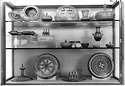
Deposit of jewelry in hypocaust area (92/ΙΗ) of Bath to East of Poros Building. Coins:
8 April 1948 #12-#47 ... 2nd-3rd c A.D ... Jewelry and Coins |
| Grave 16 in notebook.
Length of shaft 1.81m; width 0.64m; depth from cover 0.54m.
Skeleton of a woman , head at northwest end. Most of pots piled over feet and legs of skeleton at southeast end.
An iron ... 750 B.C ... An iron fibula and a bronze pin lay to the right of the skull, other metal jewelry was among the pots at the feet.
|
| Rodney S. Young ... Destroyed urn cremation. No remains. Originally assigned as part of Tomb C 9:14 (Grave 7)
JP
"Large fragments of an urn were found in the packing of a Hellenistic water channel which cut through a LPG ... Final Mycenaean/Submycenaean ... P 6723, although surely an urn, rust-stained inside from the iron jewelry and within a meter of Grave C 9:14, is much earlier than the offerings in that grave and must have come from still another burial trench in the line of the water channel; a narrow burned strip along the edge of the channel opposite the fragments may be part of that trench.
|
| Rodney S. Young ... Grave 3 in notebook (E.L. Smithson: Grave XIII: PG). Urn cremation (trench-and-hole), adult female.
JP
Rectangular trench, measuring approximately 1.10x0.45m, but which may have been larger, cut through ... Late Protogeometric ... Young " The burial seems to have been quite normal-cremation on the spot, the bones and jewelry gathered up and placed in the amphora, and the whole buried in a pit. |
| Margaret Crosby ... Grave 1 (Grave XXVI: EG) Urn cremation (trench-and-hole), adult male?
[JP]
Boots or Booties Grave. Near the west branch of the Great Drain, about 100m to the southwest of the Agora horos inscription ... Early Geometric I ... After cremation the remains of the bones, together with the jewelry which had probably served to fasten the clothed, were gathered up and placed in an amphora. |
|
|