|
|
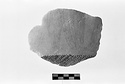
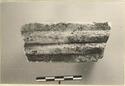
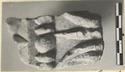
| Egg and dart fragments of large capital: a) parts of four eggs, b) parts of three eggs, c) parts of three eggs.
From Stoa of Attalos.
Pentelic marble.
May 1954: The fragment A 2073 b), and many others ... 13 August 1952 ... Capital Fragments: Ionic |
| a) A fragment from the lower edge of the echinus, broken both sides and behind. The underside was finished with a toothed chisel. The egg and dart ornament was incised and painted. Of the paint only the ... 1931 ... Capital Fragments: Ionic: Painted |
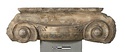
| Two non-joining fragments from volute.
Both fragments are symmetrical showing volutes on both sides. Traces of burning.
Northeast Stoa series.
Pentelic marble. Destruction debris associated with Northeast ... July 1950 |
| Two joining fragments.
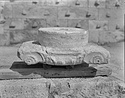
Abacus, fillets, and top of volutes recut to make base for interior support of fourth period of church. Lower part of volutes cut off.
Developed fifth century type egg and dart ... 18 February 1936 |
| The builders of the Late Roman Fortification Wall had knocked off chips, especially from the volutes; most are missing. Empolion cutting on underside 0.06m square. Egg and dart not carved but painted; ... July 1959 |
| Four joining fragments from a volute. Similar in design to A 1669 (ΣΑ 1375), but there is a marked difference of the edge of the volute and there are no drill holes in the astragal. Traces of burning ... July 1950 |
| Chips had been knocked off by the builders of the Late Roman Fortification Wall but most were recoverable. Empolion cutting on underside 0.06m square.
Ornament painted except for palmettes which are carved ... July 1959 |
| Fragment of echinus of Ionic capital, with painted egg and dart on the convex surface of the molding. Preserved, the lower part of a dart and parts of the eggs adjacent. The resting surface dressed with ... 1 March 1934 ... Fragment of echinus of Ionic capital, with painted egg and dart on the convex surface of the molding. ... Cf. ceiling beam fragments with similar painted pattern, A 400 (Z 992).
|
| Fragment preserves part of two adjacent sides. Acanthus and scales on bolsters; egg, dart and lateral half palmettes on spiral end. Two pour channels in top, one dowel hole in bottom.
From Stoa of Attalos ... 13 August 1952 |
| Three non-joining fragments from drum below capital. Fragments a) and b) from the top, c) from the bottom. The drum was decorated with a band of palmette and honeysuckle in low relief, resting on a plain ... July 1950 |
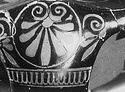
| Most of body and foot missing, handle and neck practically complete. Partly restored in plaster. Round-bodied oinochoe; band handle; brown wash inside. At top of handle, a palmette between two half-palmettes; ... 2-19 May 1939 |
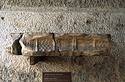
| Comprised of four drums. Square empolion cuttings for all joints except that between shaft and base. Drums neatly lettered from top down Ζ - Κ.
With this shaft goes capital A 2973 and base A 2891-A 2892 ... July 1959 |
| Comprised of four drums. Square empolion cuttings for all joints including top and bottom. Drums neatly lettered from top down Α - Ε. Twenty flutings. Dipinto in flute of second drum. Deep slots in second ... July 1959 |
Three non-joining wall fragments, a with turn of shoulder and start of handle. Max. dim. a) 0.128, b) 0.097, c) 0.046.
Wedding procession. Fragment a (illustrated) preserves the heads of two trace horses ... Ca. 410-400 B.C ... Three non-joining wall fragments, a with turn of shoulder and start of handle. ... On the right-hand side of the team are the shaft and capital of an Ionic column. ... There is something Meidian about the style of drawing on 107, and these fragments very likely belong somewhere within the group, although probably not by the painter himself. |
|
|