|
|
| North of House G (RSY=Pyre 13).
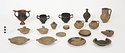
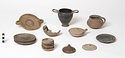
Concentration of artifacts, small pieces of bone, and burnt material in stratum, no pit discerned. The pyre is cut by the trench of a wall of a Roman house to north. It ... 290-250 B.C ... North of House G (RSY=Pyre 13).
... The pyre is cut by the trench of a wall of a Roman house to north. It was found in digging "Hellenistic" fill; no further information about the stratigraphy or about the pottery from that fill is available. although the pyre was apparently not burnt in situ, the objects lay in a compact mass, not much disturbed, and they are mostly complete. |
House A destruction debris over floors. All floors (rooms 1-7) dug in 1939. Re-examination of House A in 1967 (nbpp. 648 ff.). Coins:
27 February 1939 #5-#9
7 March 1939: #1
9 March 1939 #4-#6
11 March ... First half 3rd. c. A.D. |
Wells at 24/ΙΓ at 26/ΙΑ near the SW corner of the market square, about 10m west of the Southwest Fountain House (the party wall between them broken through in antiquity).
Use filling middle to third quarter ... Ca. 550-525 B.C. |
Wells at 24/ΙΓ at 26/ΙΑ near the SW corner of the market square, about 10m west of the Southwest Fountain House (the party wall between them broken through in antiquity). ... Ca. 500 B.C ... Wells at 24/ΙΓ at 26/ΙΑ near the SW corner of the market square, about 10m west of the Southwest Fountain House (the party wall between them broken through in antiquity). ... Coins:
20 July 1932 #1
P 16811 and P 16812 may be assigned either to G 15:1 or to G 15:2. |
Connected with G 14:3.
There was a layer of Late Roman fill. It rested over a layer of 2nd c. B.C Hellenistic and then another of 4th c. B.C Hellenistic; the passage between the two cisterns contained ... Late Hellenistic ... Connected with G 14:3.
There was a layer of Late Roman fill. ... Therefore, it appears that this cistern had several periods of use: Hellenistic (at least one phase contemporary with the 2nd century B.C, phase of House E to the north), Late Roman (probably associated with the amphora and perhaps also maybe the platform and the drain), and finally Byzantine.
|
Tiled well near the SW corner of the market square between the Southwest Fountain House and the Great Drain, three fills noted: lower fill of earth and stones with a few fragments only of coarse pottery ... 4th-2nd c. B.C.
100-70 B.C. |
Cistern at 53/ΝΕ, bottle-shaped, stucco-lined, in the east aisle of the peristyle of Roman House H (courtyard of Greek House G, just west of andron).
Lower diameter 2.73m.
Homogenous fill all apparently ... Into early 2nd century B.C ... Cistern at 53/ΝΕ, bottle-shaped, stucco-lined, in the east aisle of the peristyle of Roman House H (courtyard of Greek House G, just west of andron).
|
Well in Room 5 of Roman House H.
Under cement border of andron of Greek House G. Diameter 1.10m, cut through bedrock. water at ca. 3.55m. Hand or foot holes along one side.
0-7.25m crushed bedrock fill ... 5th c. B.C ... Well in Room 5 of Roman House H.
Under cement border of andron of Greek House G. |
Archaic house with Distyle Porch (= Building J) in southeast of section: packing beneath floors (Layers a and b of Tholos Trench S.Layer b=Beneath original floor dated to ca. 500 B.C.
Layer a=Between original ... 6th-early 5th c. B.C. |
| Pyre in Room 1, area west of street (RSY=Pyre 11).
Early in the third quarter of the 4th. c. B.C.
In courtyard. Artifacts, bone, and cinders in irregular pit in floor sequence. The pit had been dug into ... 350-330 B.C ... It may be associated with the abandonment of the house, since the marble-and limestone-chip layer was laid down during the structure's last phase. ... Publication says: House G, Court. |
Stroses I, II, III, IV in Court J (below marble chip layer), House of Greek Mosaic.
No independently datable objects. Estimated Grid ... Early 3rd c. B.C. |
| Stephen G. Miller ... Irregular circular tomb (Diam. 2.20-2.60) with blocked dromos to northwest. Top of tomb lost in Archaic grading of area, center disturbed by Byzantine pit, overbuilt by northern-eastern walls of Room 3 ... LH III |
| Dorothy Burr Thompson ... Child's Grave (E.L. Smithson: Grave XXVIII: G).
Cf. Container Lot ΣΤ 165 (fill over geometric grave).
Neat, rectangular, unlined trench, cut into bedrock to a preserved depth of 0.20m,below the level ... Early Geometric I ... Smithson: Grave XXVIII: G).
Cf. Container Lot ΣΤ 165 (fill over geometric grave).
Neat, rectangular, unlined trench, cut into bedrock to a preserved depth of 0.20m,below the level of the floor of the so-called Geometric House. The tomb was located in the area between pits A and D, and was just over 2m to the east of the preserved west wall of the Geometric House. ... Two other empty trenches were found within the area of the Geometric House, ,thought to be rifled tomb pits. |
Evidence of stratification into five layers, although joins between the layers. Layer VI added when the construction of the Roman building above required it. No subdivisions assigned.
Flask-shaped cistern ... Early 3rd-late 2nd c. B.C. |
|
|