|
|
House C, Room 4 (Pottery dump of stamnos wall and fill below floor). Coins:
1 July 1947 #13
2 July 1947 #1
Coins from House IV:
14 May 1947 #1-#2
19 May 1947 #6-#7
20 May 1947 #32 ... First half 3rd c. B.C ... House C, Room 4 (Pottery dump of stamnos wall and fill below floor) ... Coins:
1 July 1947 #13
2 July 1947 #1
Coins from House IV:
14 May 1947 #1-#2
19 May 1947 #6-#7
20 May 1947 #32 |
House C, Room 5, small hoard. Deposit created by A.W. and first appears in his thesis (Biblio. below).
"Another small hoard or purse of Herulian date", A.Walker (1980), p. 127. Coins:
23 June 1947 #7-#13 ... Ca. 267 A.D. |
| Pyre in House N, room 4 (RSY=Pyre 7), in the industrial area west of the Areopagus.
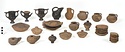
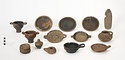
Pottery, mall pieces of calcined bone, log, wood cinders, and charcoal in diamond-shaped pit in floor sequence. The pyre ... Late 4th-early 3rd c. B.C. |
A well in House T, Room 2W (Publ. House D), industrial area west of the Areopagus. Lower filling of dug bedrock including a small amount of pottery of the Geometric period. Gravelly filling in collapsed ... 3rd. quarter of 8th. c. B.C. |
| Pyre in House C, Room 8 (RSY=Pyre 6).
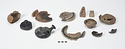
Near east corner of room 8. Artifacts, burnt bone, burnt sticks, and large cinders in a shallow pit dug into surface of layer 3, and covered by layer 2. Some cinders ... 350-325 B.C.-end of 4th c. B.C ... Pyre in House C, Room 8 (RSY=Pyre 6).
Near east corner of room 8. Artifacts, burnt bone, burnt sticks, and large cinders in a shallow pit dug into surface of layer 3, and covered by layer 2. ... These strata lay above the first floor of the third phase of the house. The hard baked floor of the pit indicated burning in situ, with charred sticks 0.06 and 0.10m in diameter preserved; some of the pottery is burnt. |
| Disturbed pyre dispersed in fill of Room 5, House D.
Pyre pots in very fragmentary condition were noticed by Barbara Tsakirgis in later analysis of pottery that had been excavated in 1938; no mention of ... 14 June 1938 |
Greek House J, under room 8 of Roman House H.
Typical though very fragmentary pyre pottery lay dispersed in a stratum over bedrock with pottery ranging from the 5th to the mid-3rd c.
In same general area ... Early 4th c. B.C.? |
House N, Room 4, Pit through layers 5-6. Debris filling, mixed context. Estimated Grid ... Late 4th. c. B.C. into early 3rd c. B.C. |
|
|