|
|
Part of three horses, left: back and neck of far red horse; forequarters of centre white horse; and one foreleg of near red horse.
Drawing on the red horse, and the outline of the near hoof, in fine black ... 21 January 1931 ... Part of three horses, left: back and neck of far red horse; forequarters of centre white horse; and one foreleg of near red horse.
Drawing on the red horse, and the outline of the near hoof, in fine black. Dilute glaze for all details, and harness, of the white horse.
Compare oinochoe by the Meidias painter: Athens 10, 424; Att.V. no.462; Phot. |
Horse's legs and man's; grape decoration; hindquarters of horse on piece b.
ADDENDA: Near the Caylus Painter, "Early 5th c. B.C."
Roebuck, no. 162
ABV. Carl Roebuck, Nb. No. 6.
Well A. 91 ... 6 April 1938 ... Horse's legs and man's; grape decoration; hindquarters of horse on piece b.
ADDENDA: Near the Caylus Painter, "Early 5th c. |
Wall fragment. Max. dim. 0.06.
Horse (top of neck and mane, ear, forelock, a bit of forehead and cheek), probably a mount, to right. Preliminary sketch. Relief contour. Dilute glaze: muscles. White: studs ... Ca. 440-430 B.C ... Max. dim. 0.06.
Horse (top of neck and mane, ear, forelock, a bit of forehead and cheek), probably a mount, to right. ... If this is a chariot horse, it has to be the right-hand pole horse; if it were a trace horse, one would expect to see the neck and head of the pole horse where there is black glaze. See the team on Ferrara 1685 = T.308 by the Painter of Bologna 228 (ARV2 511, 5; Paralip. 382, 5; Addenda 252). |
Bowl fragment. Max. dim. 0.075; est. outer diam. of tondo 0.12.
I, border of tondo: stopped-maeander pattern. A (illustrated), man or youth (lower part of himation, toes of right foot) to right, leaning ... Ca. 450 B.C ... In front of him are the hind legs and tail of a horse to right and the end of a spear held by its rider. ... The composition was probably similar to those on these two cups by the Penthesilea Painter, except that the horse is unmounted, and the position of the spear overlapping the right hind leg on 1440 makes clear that the horse on 1440 had a rider: Philadelphia, APS on loan to the University Museum L. 637.1a (ARV2 880, 3; Paralip. 522, 3; Addenda 301) and Göttingen J. 34 (ARV2 881, 25; Addenda 301).
The Penthesilea Painter (ARV2 881, 24). |
Wall fragment. Glaze fired greenish in places. Max. dim. 0.106. H. A. Thompson, Hesperia 18, 1949, pl. 45:5; P. E. Corbett, JHS 85, 1965, pl. 1; Langridge, "Eucharides Painter," p. 345, cat. no. E 6.
... Ca. 500-490 B.C ... Corbett, JHS 85, 1965, pl. 1; Langridge, "Eucharides Painter," p. 345, cat. no. ... For a boy, not a youth or a man, leading a horse, see Vienna, Univ. 501 by Onesimos (ARV2 324, 64; Addenda 215) and side B of Florence PD 56 by the Dokimasia Painter (ARV2 412, 6; CVA, Firenze 4 [Italia 38], pl. 126 [1698]:1).
The Eucharides Painter (ARV2 227, 17; Paralip. 347, 17). |
Floor fragment with start of stem on underside. Max. dim. 0.11; est. diam. of tondo 0.11.
I, youth (all but lower parts) to right, wrapped in a himation with the garment pulled up over the back of his ... Ca. 450 B.C ... In front of him is a horse (croup and start of tail), the body and foreparts cut off by the narrow reserved line, one of two for tondo border.
For a similar composition, see Göttingen J.34 by the Penthesilea Painter (ARV2 881, 25; Addenda 301).
The Painter of Agora P 5192 (ARV2 one 611, 4; ARV2 936, 7: not a Stemless as here). |
Wall fragment. Max. dim. 0.188.
Chariot team (legs of horses), a triga to right. Below, maeander pattern. Preliminary sketch. Dilute glaze: muscles.
For a triga, only to left, see the one driven by Nike ... Ca. 450 B.C ... For a triga, only to left, see the one driven by Nike on Ferrara 2892 = T.300 in the manner of the Peleus Painter (ARV2 1041, 6; Paralip. 443, 6; Addenda 319; Matheson, Polygnotos, p. 443, cat. no. ... On 39, the rightmost forelegs belong to the trace horse; the others to the pole horses. The first pair of hind legs are those of the trace horse; the other, one of the pole horses. |
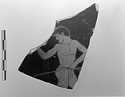
| Fragment from the wall of a calyx krater. Nude youth, right, looking back left. In his left hand he holds leading reins and a slender staff or goad. His right arm is outstretched to left; the hand, missing, ... 23 April 1948 |
|
|