|
|
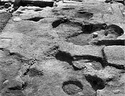
| Hole in bedrock; dumped filling used in leveling.
Probably a natural water line, tending to wash out, has been cut back for various purposes, and finally all filled in to make level bedding for 4th c., ... Ca. 350-270 B.C ... Hole in bedrock; dumped filling used in leveling.
|
Scanty filling over bedrock ... Latest 6th c. B.C ... Hole |
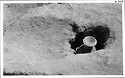
Irregular depression in bedrock (ca. 7x5m), ca. 2m deep; area south of E-W Late Roman wall. Dumped filling apparently intended to level off the area. Coins:
11 March 1952 #10
12 March 1952 #1-#5
13 March ... Ca. 400-325 B.C ... Fourth Century Hole |
Pocket of soft fill in bedrock at corner of Late Roman house, with a hoard of lead tokens. No pottery catalogued.
Herulian debris: cf. D 10:1, D 11:7 Coins:
25 May 1935 #8 Estimated Grid
No pottery catalogued ... 25 May 1935 ... Hole ("Cistern") B |
Upper fill (top to around 4.50m.) was in a pit of large dimensions above the preserved well shaft. From the bottom and shaft proper no catalogued pottery. No tiling in place in well but fragments of tiles ... 3rd-4th c. A.D ... Late Roman Hole |
Hole at 65/ΚΔ; small cutting in bedrock with scanty pottery ... 450-400 B.C ... Hole at 65/ΚΔ |
Great Hole at 33/Ζ = Area of early wells Some of the objects may have come from N 18:7 or from a neighboring 7th c, well, not separately cleared, but no definite association is possible ... 7th-5th c. B.C ... Great Hole at 33/Z |
In Southeast House, Room E. The inventoried material consisted entirely of loomweights, all of the 4th c. B.C ... 5th-4th c. B.C ... Hole in Southeast House, Room E |
Refuse pit in rock by heavy wall on West Street ... Ca. 500-480 B.C ... Hole by Heavy Wall on West Street |
Hole in bedrock; small amount of debris filling ... Last quarter 5th c. B.C ... Hole in bedrock; small amount of debris filling. |
Well (Hole) at 19/Ι(ΙΑ). Collapsed well creating a hole above; mixed fill in hole, early Byzantine in well proper. Coins:
26 April 1934 #12
27 April 1934 #28
28 April 1934 #38
1 May 1934 #3 ... Early Byz ... Well (Hole) at 19/Ι(ΙΑ). Collapsed well creating a hole above; mixed fill in hole, early Byzantine in well proper. |
Containers 1-ca. 139. The well shaft broken out into a large hole so that no sequence could be observed ... Mixed post-Herulian ... The well shaft broken out into a large hole so that no sequence could be observed. |
| Rodney S. Young ... Grave 2 in notebook (E.L. Smithson: Grave XV: PG). Urn cremation (trench-and-hole), adult female.
JP
It consists of a roughly rectangular pit or trench cut into bedrock to a depth of 0.35m., measuring ... Late Protogeometric ... Urn cremation (trench-and-hole), adult female.
... The trench was oriented east-west, urn-hole to the east. The fill of what remained of the pyre trench contained much burned debris, especially in the western part of the tomb. The urn-hole, cut to a depth of 0.62m., measured roughly 0.40m in diameter. the urn-hole itself, but not the rectangular trench of the tomb, was sealed by a large, flat stone, broken in situ. |
Cistern System #1a: Shaft (Manhole) at 10/ΞΗ (10-11/ΞΖ-ΞΗ). Filling consistently late Hellenistic in hole and in passage; probably 1st c.
B.C. Coins:
26 May 1936 #1 ... 110-75 B.C ... Filling consistently late Hellenistic in hole and in passage; probably 1st c.
|
| Gerald V. Lalonde ... Urn cremation (trench-and-hole), adult female with fetus/neonate. One box with burnt animal bones is stored with the skeleton AA 302 in drawer 97.
Objects also recorded frm Section ΣΤ. PD 1692, PD 1807 ... Early Geometric II, 850 B.C ... Urn cremation (trench-and-hole), adult female with fetus/neonate. |
| Rodney S. Young ... Grave 3 in notebook (E.L. Smithson: Grave XIII: PG). Urn cremation (trench-and-hole), adult female.
JP
Rectangular trench, measuring approximately 1.10x0.45m, but which may have been larger, cut through ... Late Protogeometric ... Urn cremation (trench-and-hole), adult female.
... The roughly circular urn-hole was located to the east; the bedrock dipped sharply along the west side of the grave. Much of the trench and the upper part of the urn-hole were destroyed by Classical and Hellenistic builders. |
| John Travlos ... (Grave XXXII: EG) Urn cremation (trench-and-hole). Published as cremation burial of a warrior.
The tomb was probably originally oriented north-south, with the urn-hole at the south end. The north side ... Transitional Early Geometric II-Middle Geometric I ... (Grave XXXII: EG) Urn cremation (trench-and-hole). Published as cremation burial of a warrior.
The tomb was probably originally oriented north-south, with the urn-hole at the south end. ... The original dimensions of the tomb are lost, but the urn-hole had a diameter of approximately 0.70m and a preserved depth of at least 0.63m.
|
| Grave 1 in notebook (E.L. Smithson: Grave XXV: PG). No remains. Probable trench-and-hole.
JP
Roughly circular pit measuring 0.39m in diameter cut into bedrock to a depth of 0.72m. Pyre refuse-described ... Late PG/EG I ... Probable trench-and-hole.
JP
Roughly circular pit measuring 0.39m in diameter cut into bedrock to a depth of 0.72m. Pyre refuse-described as "ashes and cinders etc"- was encountered throughout the tomb pit, below, around and above the urn. although there is no specific mention of a trench, Young's description of the tomb suggests that a rectangular trench, with a maximum length of about 0.80m and a preserved width of ca. 0.60m, was cut through earth into bedrock. consequently, the tomb appears to be a classic example of an Athenian trench-and-hole, oriented east-west,with the urn-hole at the east. |
| Hole (Well) and adjoining water channel with 4th c. pottery, probably a dumped fill.
At a depth of about -5.70m we started yielding some very crude potsherds, clearly not made on the wheel (maybe Prehistoric) ... Prehistoric-Roman ... Hole (Well) and adjoining water channel with 4th c. pottery, probably a dumped fill.
|
| Rodney S. Young ... Grave 6 in notebook (E.L. Smithson: Grave XXII: PG). Bones discarded. Urn cremation (trench-and-hole).
JP
Roughly rectangular trench cut through hard earth into bedrock to a depth of about 0.35m, approximately ... Late Protogeometric ... Urn cremation (trench-and-hole).
JP
Roughly rectangular trench cut through hard earth into bedrock to a depth of about 0.35m, approximately 1m long and 0.50m wide. Trench oriented southeast-northwest, with the urn-hole adjoining the southeast corner. ... The urn-hole (diameter ca. 0.34m and about 0.35m deep- was evidently cut after the fire had subsided, not quite deep enough to conceal the full height of the cinerary urn below the floor of the trench. |
|
|