|
|
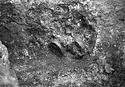
Beneath layer 11. "Despite its extreme irregularity this pit may be an early well, for it would seem definitely to be an artificial cutting and sherds were found in its lowest part," (Nbp. 2095).
Contemporary ... SubMycenaean |
Well associated with the Tholos, with scanty use fill but primarily dumped filling. Coins:
5 April 1934 #1-#4
10 April 1934 #1-#2
11 April 1934 #1
12 April 1934 #1
18 April 1934 #1-#2
19 April 1934 #1-#5 ... Ca. 350-294 B.C. |
Irregular depression in bedrock (ca. 7x5m), ca. 2m deep; area south of E-W Late Roman wall. Dumped filling apparently intended to level off the area. Coins:
11 March 1952 #10
12 March 1952 #1-#5
13 March ... Ca. 400-325 B.C. |
| Rodney S. Young ... Grave 10 in notebook. No remains. Probably grave of a woman.
Only a small portion of the inhumation pit was preserved at the northeast edge of pit A, a large oval cutting of modern date dug for the construction ... Middle Geometric II |
Well near southwest corner of market square; successive use fillings, and dumped filling.
Lower use filling, second half of 4th century B.C.
Main use filling, second quarter of 2nd century B.C. to shortly ... 10 April-31 May 1935 |
| In area West of the Areopagus. Fills with many figurines and molds, possibly from a terracotta factory.
Twelve stamped amphora handles; no long-petal bowls; Type 54 A lamp Coins:
31 May 1939 #11
1 June ... Mostly 200-150 B.C. |
| Marcie Handler ... The Pyre was revealed in a layer of 4th c. fill in the north end of Room 6, just south of Wall 8. Room 6 is defined by the street wall (Wall A) on the west, Wall 7 on the east, Wall 9 on the south (preserved ... 4th c. B.C. |
Middle Stoa Building Fill (with filling to S) (See also Κ: H-I-J 14-15 and Λ: K-M 13-14)
This deposit is not definitive and must be considered with the above deposits before details are entered into database; ... To ca. 180 B.C. |
At 67/ΙΗ, at the northeast slope of the Areopagus.
Cistern with drawshaft, 4.60m deep. The drawshaft had been cleared to bottom in the eighteenth or nineteenth century, and some of the fill in the main ... Most second half of 3rd c. B.C. |
Cistern-shaft at the southeast foot of Kolonos Agoraios.
Nbp. 2369: Two chamber cisterns, 88/ΛΔ and 100/ΚΘ, united by a long straight passage running almost due N-S. A draw shaft at 95/ΚΘ is set just ... Upper fill, Late Roman with some Hellenistic.
Middle fill, Sullan debris to last quarter of 1st c. B.C.
Lower fill, 4th-3rd c. B.C.=POU and abandonment |
Cistern at 9/Β (10/Β on plan), at the NW foot of the Areopagus, some 200m to the west of the Coroplast's Dump. It had evidently belonged to one of the small houses in that thickly populated residential ... Second half 4th c. B.C. |
Cistern System #3: West Chamber at 69/ΛΣΤ, joined by a crooked passage to 69/Λ. Under the southwest corner of the Hellenistic Building to the north of the Temple of Hephaistos. Upper fill of early 1st ... 175-125 B.C. |
Cistern at the southeast foot of Kolonos Agoraios.
Nbp. 2369: Two chamber cisterns, 88/ΛΔ and 100/ΚΘ, united by a long straight passage running almost due N-S. A draw shaft at 95/ΚΘ is set just off the ... Use filling of late 4th-early 3rd c. B.C.
Accumulative fillings of late 3rd-early 2nd and late 1st c. B.C.
Upper dumped filling of 3rd c. A.D. |
|
|