|
|
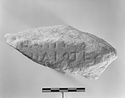
| Inscribed fragment.
Inscribed face only preserved, much weathered.
Two lines of the inscription preserved.
Pentelic marble.
Taken to the Epigraphical Museum on 18th. December 1954 with IG I2, no. 58; ... 5th. century B.C ... Hesperia 44 (1975), p. 380, pl. 85. |
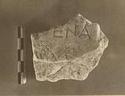
| Inscribed fragment.
Inscribed face only preserved.
One line of the inscription preserved, with four letters.
Pentelic marble. Found in late road packing, west of the Klepsydra. Leica ... 5th. century B.C ... Hesperia 44 (1975), pp. 380-381, pl. 85. |
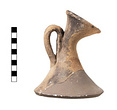
| Restored. Lower part of base missing. Twisted funnel with broad base sloping sharply inward to point two-thirds the height of object, then flaring out slightly and to side to upper rim composed of flat ... 21 August 1973 |
Mended from many fragments, with missing pieces restored in plaster and painted, notable among them the left horizontal handle and part of the wall below it. Glaze fired greenish around left handle; abraded ... Ca. 430 B.C ... Amyx, Hesperia 27, 1958, pl. 48:b; Matheson, Polygnotos, p. 427, cat. no. ... Trendall, The Red-Figured Vases of Apulia, Oxford 1978, p. 21, no. 94); also 836; P 30054 (Hesperia Suppl. XXV, p. 84, cat. no. 80, pl. 30); and the figure of Leto in the Naples painting on marble of knucklebone players (H. ... Perhaps one should also mention Brunswick 220, which is near the Hector Painter, on which a woman holds the end of a fillet in her mouth while she ties the rest of it around her head (ARV2 1037, 3; Matheson, p. 380, cat. no. CURM 2: manner of the Curti Painter).
|
|
|