|
|
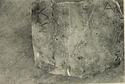
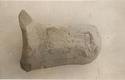
Broad, nearly level. Thickened at junction with neck. Broken at curve.
Coarse red clay.
Impression nearly obliterated. Traces of boukranion and part of a letter. [Χρύσιππος vac]
boukranion
(retr, Σ ... 29 February 1932 |
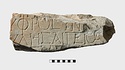
Fragment from left side of inscribed grave stele.
Broken all round save left side and inscribed surface.
Left edge, with anathyrosis, meets inscribed face at a little less than a right angle.
Inscribed, ... Late 4th. century A.D. |
| Inscribed fragment.
Parts of two lines of the inscription, with traces of two others, above and below, preserved.
Pentelic marble. Pre-excavation. Finished Found in the modern wall of the house 631/9, ... 1933 ... Hesperia 3 (1934), p. 112, no. 177 ... Agora XVII, no. 107, p. 47, pl. 11. |
Shape like Knidian.
Rather coarse pinkish-buff clay; cream slip.
Impression incomplete below; damaged. Ἐπὶ Φιλομβρ
οτίδα Κνί(διον) [Χ]
αρμοκρά
τ[ευς double axe l. in outline]
(Σ lunate) Leica ... 17 March 1932 |
Broad, widens to neck; start of right angle curve. Part of rim preserved.
Comparatively fine clay; red, grey core; buff surface with thin traces of slip.
Impression with slightly incomplete right end; ... Hellenistic ... Hesperia Suppl. 10 (1956), p. 152, no. 116 ... Hesperia 3 (1934), p. 262, no. 177. |
Fragment from left side of inscribed block.
Broken above, below and to right. Back uneven but probably original surface. Front much hacked but there remain legible a few carelessly inscribed letters.
Pentelic ... 14 March 1932 |
Rising; broadening to neck.
Very coarse clay; full of bits; reddish, grey at core; remains of light slip.
Impression broken away at right end; much worn. Msc: prob from jar of =EPIFANHS=? (insect?) dated ... 12 February 1932 |
Level, broad; broken before curve.
Coarse brick red clay, yellowing to surface, greying to core; cream slip.
Impression incomplete in both sides; much worn. Ἐπὶ Δαμοκρίτου Δαμο
κράτευς
boukranion ... 4 July 1931 ... Hesperia Suppl. 10 (1956), p. 149, no. 177 ... Hesperia 3 (1934), no. 202. |
B road, thick, ribbed, right angle curve.
Coarse clay; red, with grey core; traces of light slip.
Impression shallow set with deeply cut boukranion. Study: Die 1* Δ̣α̣μ̣οκράτευ̣ς [τοῦ Ἀ]ρ̣ισ[τ]ο̣κ̣λ̣[εῦς] ... 1 March 1932 ... Hesperia Suppl. 10 (1956), p. 162, no. 177 ... Hesperia 3 (1934), p. 271, no. 204. |
Broad, ribbed, slightly arched.
Coarse clay; red, grey core; cream slip.
Impression set so shallow as to be incomplete top and bottom. Study: Die 4* Δαμοκρά[τευς] τ̣οῦ Ἀριστ̣[οκλεῦς]
boukranion ... 1 March 1932 ... Hesperia Suppl. 10 (1956), p. 162, no. 177 ... Hesperia 3 (1934), p. 271, no. 205. |
| Broad curving shape, like Knidian.
Medium coarse red clay; buff slip.
Relief lines used to frame stamp and attribute; much worn. Rdg: sec impression at start of hdl; poss: circ w/ cross(VG)*
Study: Die ... 15 July 1931 ... Hesperia Suppl. 10 (1956), no. 177, pl. 62 ... Hesperia 3 (1934), p. 272, no. 206. |
Typical curved; broad.
Coarse red clay; grey at core; slip almost or entirely absent.
So badly stamped and so nearly effaced as to be nearly illegible. Msc: cf SS 00153, not same die(VG)*
Study: Die ... 17 June 1931 |
| Mended from many pieces; the profile complete; most of the rim missing; also one handle and large fragments from the body. Restored in plaster. Heavy moulded conical foot; shallow wheel-run grooves on ... 3 March 1934 ... Museum Guide (2014), p. 177 ... Guide (1962), p. 177 ... Hesperia 3 (1934), no. |
| Fragment from an inscribed stele.
Edges broken; back, rough picked, preserved, worked smooth to within ca. 0.10m. of the present bottom of the stone, where a boss-like mass, rough picked, projects.
Seventeen ... Late 3rd. or early 2nd. centuries B.C. |
|
|