|
|
| Thick, similar to Rhodian; broken at curve.
Clay similar to Knidian, with thick light slip; inside of neck appears to be slipped.
Impression begins close to neck; long, shallow except at ends. Deposit ... Hellenistic ... Hesperia 3 (1934), no. 64. |
| From a thin, straight-walled vessel. Decoration of conventionalized branch with leaves of thin clay and white paint alternating.
Metallic black glaze inside and out. Cistern. Leica, 4-338 ... 3-12 March 1934 ... Hesperia 3 (1934), no. E 64. |
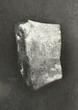
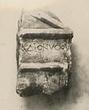
| Broken at bottom and left side; preserved surfaces all rough picked, save for a recessed, more finely picked band, on which is the inscription.
Perhaps sanctuary of Herakles Alexikakos.
Pentelic marble ... Mid. 5th. century B.C ... Hesperia 3 (1934), p. 64, no. 56. |
| Typical curve.
Fairly coarse red clay, to greyish at core; traces of mica; slight traces of pinkish cream slip.
Askew and incomplete impression; worn. Cxt: see cxt notes of 7.vii.75 made for SRotroff ... 23 July 1931 |
| Lip fragment with wavy groove on flat rim.
Brown glaze inside; coarse pink clay, cream slip. Cistern. Leica, 96-3-6(5) PD 350 ... 1932 ... Hesperia 3 (1934), no. C 64. |
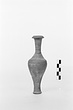
| Fusiform shape. The neck broken off but repaired. Rather fat body with definitely profiled shoulder below which is a trace of a white band.
Orange red clay, entirely covered with a thin, streaky dark ... 4 April 1933 ... Hesperia 3 (1934), no. A 64, p. 326. |
| Red clay, light slip.
Cf. Hesperia 3 (1934), nos. 131 ff. Par: Grace 1934, nrs 131 ff* In late Roman fill. Ἐπὶ {επ} Ἱππάρ̣χ̣ο̣υ̣
Διονυσίου Κ̣ν̣ί̣
διον Διονύσιος
(Α broken-barred) Leica ... 14 February 1935 |
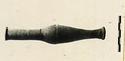
| Complete, mended from two pieces. Fusiform, slender shape. Two lines of white paint on body and two on neck. Crudely made.
Ash-gray clay.
Cf. Hesperia 3 (1934), p. 392, no. D 78. Cistern. 2421 Leica ... 30 May 1970 ... Hesperia 3 (1934), p. 392, no. ... Agora XXXIII, no. 468, fig. 64. |
| It has an elongated concave conical shape. Unpainted.
The clay buff, but the surface bluish gray in part. S.W. passage of cistern.
Hellenistic group B. Leica, 4-321, XXXIX-64 ... 19 April 1932 |
| Shape similar to Knidian; broken at curve close to neck.
Clay similar to Knidian.
Large impression, set close to neck; incomplete to the right, below the boukranion; indistinct. From bedrock. [ Ἐπὶ ... 21 April 1932 |
| Broad, widening at the neck; very small fragment preserving only start of handle.
Red clay, medium coarse; traces of light slip.
Only left end of the impression preserved, incomplete above, set close ... 28 April 1932 |
| Broad; rising, start of arched curve.
Fairly fine clay with many small particles of mica. Red with grey core. Traces of light slip.
Large, shallow set, boukranion clear but most of circumference worn ... 10 March 1932 |
| Fragmentary handle; probably typical curve.
Coarse red clay; grey at core; remains of buff slip.
Impression broken away at left; incomplete(?) at top. Msc: prob from jar dated in the term of =ARISTOBOULOS= ... 25 July 1931 |
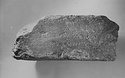
| Inscribed fragment.
Broken back, left side and right corner.
Top finished with toothed chisel; bottom rough picked.
Right side damaged but part of rough picked surface preserved.
Dedication of Archonship ... 100 B.C ... Hesperia 3 (1934), p. 69, no. 64. |
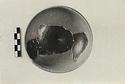
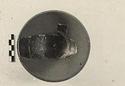
| Much of side wall missing; restored in plaster. Low base ring; side wall rising in an unbroken curve to a plain lip; the floor is drawn to a low cone both above and below; around the floor a double circle ... 3-12 March 1934 ... Hesperia 3 (1934), no. ... Agora XXIX, no. 1041, fig. 64. |
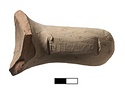
| Broad, widening to neck; broken before curve.
Coarse reddish-buff clay; greyish at core; light slip; slightly micaceous.
Two-thirds of the impression broken away; only traces of emblem in centre. Drain ... 23 February 1932 |
| Curve fragment.
Much worn impression, an edge partly broken away; garlanded boukranion.
Cf. Dumont (1872), p. 184, no. 254 (incomplete). Par: Dumont 1871, p184 nr 254 (incomplete)* Byzantine building, ... 8 April 1933 |
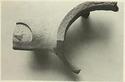
| Rather thick handle.
Impression incomplete above, broken away to left; worn. Ivy leaf. Middle Stoa Building Field; Trench Z. Ἐπ[ὶ Φιλίππου]
Δ̣ιονυσί̣ο̣υ̣
Κνίδι(ο)ν ivy leaf Leica ... 30 March 1933 |
| Knidian type, slightly descending, broken before curve.
Coarse, dark red clay, greyish at core. Traces of light slip.
Impression with framed rectangle with thick letters; worn but clear. Modern cellar ... Modern |
| Rather arched; part of rim preserved.
Coarse clay fired dark grey save for surface layer about 0.001m. thick of russet with traces of light slip.
Large circular impression of a fairly sharp die set shallow ... Hellenistic |
| Arched handle with short upper part; 0.14m. of lower part preserved.
Slip thicker on top but peeled there.
Shallow, slightly overlapping circular impression, with twisted boukranion in centre. Retrograde ... 7 March 1933 |
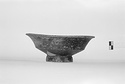
| Broken and lacking most of the side wall. Restored in plaster. High flaring base ring. Hemispherical bowl. Lip flat on top and sloping inward. On the floor a double circle of light rouletting.
Thin fabric; ... 3-12 March 1934 ... Hesperia 3 (1934), no. ... Agora XXIX, no. 1043, fig. 64, pl. 78. |
| Typical handle; part of rim preserved.
Circular impression of which one-third of the circumference is broken away, another lost in the incompleteness of setting, the rtest neat and fresh; retrograde; ... 1st century B.C. |
Mended with the missing pieces restored in plaster and painted, notably much of the rim, neck, and a bit of the body on Side A. Much of the glaze fired red, otherwise dull. Surface pitted in places. H ... Third quarter of the 4th century B.C. |
| Broken and lacking a little of its side wall. Restored in plaster. High base ring; gently concave floor; high out-curving upper wall.
Covered with flaky glaze, mottled black and brown. Cistern. Group ... 3-12 March 1934 |
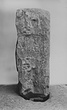
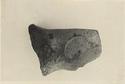
| Inscribed fragment of small columnar grave monument.
A little of top surface preserved, and toward the bottom a little more than half the circumference.
Below fragment of convex band, inscribed.
Hymettian ... 4 February 1932 ... Hesperia 3 (1934), p. 100, no. 141 ... Agora XVII, no. 787, p. 146, pl. 64. |
| Upper right corner of pediment top grave stele.
Corner akroterion broken off.
Inscribed in a single line below pediment.
Pentelic marble. Pre-excavation. Found in the modern wall of the house 646/6, over ... 1933 ... Hesperia 3 (1934), p. 112, no. 175 ... Agora XVII, no. 780, p. 145, pl. 64. |
| Mended from five fragments; complete. Bottom flat, unfinished; concave sides.
Pink to buff clay. Unglazed. Pithos. Leica, 4-333, color slide PD 1231-3 ... 22 April 1932 ... Hesperia 3 (1934), p. 389, no. D 64, fig. 76. |
| Typical shape; curves rather close to neck.
Coarse, greyish-red clay; yellowish near surface; thick slip.
Impression sharp, but incomplete from shallow setting; apparently doubled. Msc: prob from jar ... 6 May 1932 |
| Typical shape. Preserved from upper attachment nearly to lower attachment.
Coarse red clay; traces of light slip.
Impression incomplete round three-quarters of circumference. Msc: prob from jar dated ... 9 May 1932 |
| Mended from several pieces; lip chipped; handle broken away and several pieces missing from body. Restored in plaster. Ring base; slender neck; flaring flat-topped rim; handle ridge.
Pinkish-buff clay ... 22 April 1932 |
| Rather broad; small fragment not preserving junction with neck.
Coarse, pinkish-buff clay; grey core.
Impression set obliquely; incomplete upper right and lower left. South chamber of Cistern, lowest ... 22 April 1932 |
| Broad, flat; typical curve.
Coarse yellow-red clay; slightly greyish at core.
Shallow impression; much worn. Dte: prob after 188 (MSP)* Cave below lintel, south chamber, upper fill. Δοξαίου double
Κνίδιον ... 24 July 1931 |
| Fragmentary: about half of one side, with one handle, preserved; mended from many fragments. Small foot; flaring sides; high straight rim. Nearly identical with P 602: slightly larger.
Clay fine gray ... 22 April 1932 |
| Rather broad, ribbed; broken at curve.
Clay similar to typical Knidian, slip much worn, pitted.
Impression shallow set so as to be incomplete left side and above boukranion. Parts of a few letters on ... 11 March 1932 |
| Mended from several fragments; about half of the rim and a small part of the side missing. Moulded ring foot; rounding sides.
Stamped in center inside with hatched band enclosing four careless palmettes ... 22 April 1932 ... Hesperia 3 (1934), p. 370, no. ... Agora XXIX, no. 1039, fig. 64, pls. 78, 146. |
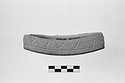
| Fragment from upper part of inscribed stele with moulded band at top.
Broken at sides, back and bottom.
Border consists of taenia above flattened ovolo.
On the taenia, which is finished with toothed chisel, ... 302/1 B.C. |
| Somewhat twisted handle with slightly arched upper part; worn bit of rim preserved.
Clay bright colored; core only slightly greyish; thin slip(?).
The die from which the boukranion is clear seems to ... 2 May 1933 |
| Whole jar put together of large fragments, part of side restored.
Cap. (Lang 1954) 21.710.
Red clay.
Stamped on neck; sphinx. Grf: =PIIC= (according to M.L.)*
Prof: PD 1454--64* Well; uniform Greek fill ... 4 April 1933 |
| Mended from many fragments; about one-third of the rim, with one handle, missing; restored in plaster. Small ring foot; flaring sides; high straight rim, sloping inward slightly from the sharp angle which ... 22 April 1932 |
|
|