|
|
| Agora 008, no. 600. Hesperia 17 (1948), pl. 65, 2-3. Jug Fragments: Blister Ware. Well. Black Glaze Lid Fragment: West Slope. Black Glaze Spout ... Φ-9 1693, 1694 P 31872 P 31873 P 31874 Φ 1117 Lot Φ 188 Lot Φ 262 M 18:10 P 31872 P 31873 P 31874 ... 7th B.C ... Hesperia 17 (1948), pl. 65, 2-3 |
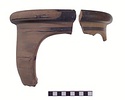
| Two non-joining fragments preserve parts of rim and upper bowl. Slightly bulging wall; heavy rolled rim; oval cutout in wall for baby's legs. Glazed are: rim inside and out; a band below rim, a band at ... 1937 ... Hesperia 17 (1948), pl. 65:2-3 ... Hesperia 75 (2006), pp. 27-28, figs. 20-21. |
| A well in the industrial area of the Areopagus, about 7.00m. west of the West Bath, to a depth of 14.60m. This well was the direct successor to A 17:1, replacing it when it collapsed. The use filling at ... Second quarter 6th. c. |
| A well on the lower slope of the Hill of the Nymphs, (diam. 1.20m -water level -7m), to 7.90m. The scanty use filling at the bottom contained water jars and pitchers as well as the inventoried objects; ... Second quarter of 6th. c. B.C ... Hesperia Suppl. 46 (2011), p. 375 ... Hesperia 17 (1948), p. 184, pl. 65, 2-3. |
| Well. Hesperia, XVII, 1948, p. 184, pl. 65, 2-3. Burial. Howland, Greek Lamps, p. 234. Hesperia, XX, 1951, pp. 83-85, pls. 35, e, 36. Pit. Hesperia, XVII, 1948, p. 159, and note 15. Fill. Hesperia, XVIII, ... Agora 8 125 P 20087 P 15838 A 17:1 B 21:23 B 14:5 J 18:4 C 12:2 C 14:5 B 15:1 D 11:5 B 18:6 B 20:5 D 12:3 B 21:2 D 16:3 B 21:10 D 16:2 D 16:4 ... 6th B.C. |
| Homer A. Thompson ... (Grave XXX: EG)
Rectangular cutting with burned bones of a female 40-45 years old, and both burned and unburned pottery fragments.
Rectangular trench, measuring approximately 0.80m long, 0.40m wide, with ... Middle Geometric I |
Foot missing.
Offset neck and echinoid mouth; raised ridge at junction of neck and wall; round handles. Neck reserved. Added red: band at level of lower attachment of handles.
For a later version, see ... 575-550 B.C ... For a later version, see P 1358 G 6:3-U Hesperia, XV, 1946, pl. 66, 268, with an ivy wreath round the neck. A patterned example from the Agora forms a link between the plain and the figured; it has black-figured lotuses on the neck and a stout echinus foot; P 18348 A 17:2 Hesperia, XVII, 1948, pl. 65, 1; Archaeology, I, 1948, pp. 13-20. |
| Pnyx, p. 107, under no. 120, pl. 50:C. Hausmann, p. 94, pl. 62:2. Watzinger, p. 65, no. 2. Cistern. Pnyx, pp. 89-90, 107, under no. 120. Hausmann, p. 94. Nordiske Fortidsminder II, iii, Copenhagen 1923, ... Agora 22 67 P 20273 P 20997 P 10877 P 30435 P 28544 P 18657 P 25986 P 18640 M 21:1 L 19:2 D 11:4 ... 225-175 B.C ... Hausmann, p. 94, pl. 62:2 ... Watzinger, p. 65, no. 2 ... Hesperia 17, 1948, pp. 160-161 |
| Fill. A. Furumark, The Mycenaean Pottery, Stockholm, 1941, figs. 48-49, pp. 303ff. Hesperia, XVII, 1948, pls. LXXIII-LXXIV. Brock, Fortetsa, passim. Brann N 9. Πρακτικά, 1911, p. 120, fig. 15. Fragment ... Agora 8 100 P 8136 P 1736 P 5199 P 6580 P 25646 P 1657 P 1660 P 26294 P 5417 B-C 9-10:1 H 17:4 E-F 12-14 F-G 12:2 J 14:5 Q 13-14:1 F 12:5 ... 7th B.C. |
| B.D. Meritt, Hesperia 21, 1952, p. 374, no. 25, photograph pl. 96. Agora 3, p. 29, no. 39. Agora 14, p. 96 and note 78. SEG XII, 64. B.D. Meritt, Hesperia 8, 1939, p. 48, no. 14, photograph p. 48. B.D ... Agora 19 23 I 7012 I 298 I 5910 I 2483 I 1454 ... 19 november 1934 ... Meritt, Hesperia 21, 1952, p. 374, no. 25, photograph pl. 96 ... Agora 3, p. 65, no. 151 ... Meritt, Hesperia 17, 1948, p. 35, no. 18, photograph pl. 9 |
| Index of Deposits. Well. Hesperia, XVII, 1948, p. 184 and pl. 65. Type 23 A; Flat Rims; Broad Open Bodies. Type 24 A; Grooved or Ridged Rims; Broad Open Bodies. Type 41; Sanctuary Lamps. Type 2 B; Lamps ... Agora 4 234 A 17:1 B 13:6 B 13:7 A 18:1 A 18-19:1 B 13:8 B 14:3 A 20:3 B 14:5 B 12:1 B 12:5 B 15:1 ... Late 5th-Early 4th B.C. |
| Drain. ARV¹ 699, 73. ARV² 1057, 101. H.A. Thompson, Hesperia 17, 1948, pl. 67:4. Matheson, Polygnotos, p. 354, cat. no. P 37. Matheson, Polygnotos, p. 465, cat. no. PGU 95. E.R. Young, The Slaying of the ... Agora 30 180 P 18279 P 22811 P 7282 P 1855 P 25918 P 92 B 19:12 B 12:3 R 13:4 ... 440 B.C ... Thompson, Hesperia 17, 1948, pl. 67:4 ... ABV 163, 2 ... Philippaki, Stamnos, pl. 48:3, side A |
| Inscribed fragments.
Confiscated property of Alcibiades.
"POLETAI" record.
Fragment ΣΤ 604 from upper right corner of inscribed block.
Full thickness of block preserved, but large flakes broken from surface ... (ΣΤ 604) 11 May 1932
a) (Κ 1350) 16 July 1947
b) (Κ 22) 22 January 1934
c) (ΘΘ 5) 18 December 1936
c) (ΙΙ 242b) March 1938
d) (ΘΘ 30) 30 December 1936
d) (ΘΘ 44) 17 January 1937
d) )ΙΙ 133) 7-8 March 1938 ... |
Wall fragment. Glaze dull and misfired reddish here and there on inside and outside; slightly abraded. Max. dim. 0.107. H. A. Thompson, Hesperia 17, 1948, pl. 67:4; Matheson, Polygnotos, p. 354, cat. no ... Ca. 440 B.C ... Thompson, Hesperia 17, 1948, pl. 67:4; Matheson, Polygnotos, p. 354, cat. no. ... Cristofani, Materiali per servire alla storia del vaso François [Bollettino d'Arte, Serie Speciale 1], Rome, 1980, fig. 65: the figure of Theseus) and in the slaying of the Minotaur on the cup in Munich by Archikles and Glaukytes, 2243 (ABV 163, 2; Paralip. 68, 2; Addenda 47), also on a late-6th-century cup in Taranto by the Edinburgh Painter (ABV 476, 3): there the lyre is hanging up. On Bologna 177, a stamnos by the Agrigento Painter (ARV2 577, 53; Philippaki, Stamnos, pl. 48:3, side A only), Theseus and the Minotaur appear on the obverse, and a man offering a lyre to a youth, accompanied by a male, appears on the reverse, but it is far from certain that the two scenes are connected (Beazley separates his description with a period, not a semicolon, indicating that he considered the two unrelated; see ARV2 p. xlvi). |
|
|