|
|
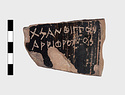
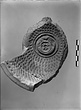
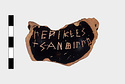
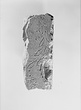
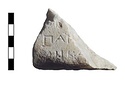
| From rim of large heavy black glazed amphora with squared rim. The top of the rim reserved.
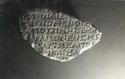
Incised inside: Όστρακο οστρακοφορίας Ξανθίππου. Προέρχεται από το χείλος μεγάλου μελαμβαφούς αμφορέως. Finished ... 18 June 1935 ... Robinson (1951), p. 178 ... Hesperia 10 (1941), p. 3, fig. 3 ... Agora XIV, p. 51, pl. 38. |
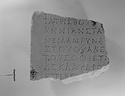
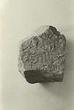
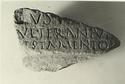
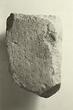
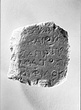
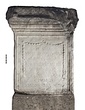
| Inscribed fragment.
Parts of top, both sides and back preserved; bottom broken off.
Boundary stone of the Nymphaeum.
Three lines of the inscription preserved.
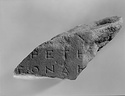
Poros. Found in modern or late Turkish wall ... First half of 5th. century B.C ... Hesperia 10 (1941), p. 38, no. 3 ... Agora XIX, no. H 3, p. 22. |
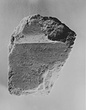
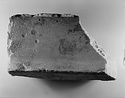
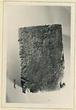
| Inscribed fragment.
Left side, picked fine, preserved; otherwise broken.
Eight lines of the inscription preserved.
Pentelic marble.
ADDENDA I 53 may belongs.
Join with IG II2, no. 4007.
Permanently transferred ... 3rd. century A.D. |
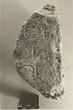
| Inscribed fragment.
Top and right side preserved.
Traces of color in letters of line 3 (?).
Pentelic marble.
ADDENDA I 2989 belongs. Found in the wall of the modern house 636α/1 [636/1 on Vrysaki map], ... 2nd. century A.D. |
| Fragments of marble with letters of Marcus Aurelius and Commodus.
Broken all around.
Fragment T 48, part of left side preserved.
Ten lines of the inscription preserved.
Pentelic marble.
ADDENDA Same ... 177-180 A.D. |
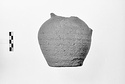
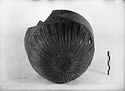
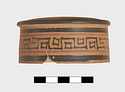
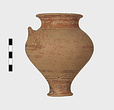
| Body preserved intact but handle missing and neck broken off at base. Flat bottom, globular, ribbed body. One strap handle attached below shoulder. Three incised grooves at base of slightly flaring neck ... 8-9 March 1939 |
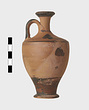
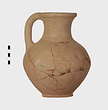
| Mended from several pieces; a few small fragments of wall missing. Slender type; high conical foot, moulded in two degrees. Spurred handles, from the lip.
Dull black to red glaze, somewhat peeled; a ... 1 August 1947 |
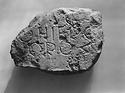
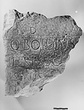
| From a coarse unglazed pot.
Incised outside:
Very micaceous pinkish clay. Well, Roman context. Leica PD 764 ... 4 April 1936 ... Hesperia 21 (1952), p. 3, no. 7, fig. 2 ... Hesperia 10 (1941), p. 2. |
| Intact except for small chip from lip. Outside unglazed except for rim. Rim inside and omphalos glazed; fringe of short strokes around omphalos. On body inside, four grapevines with tendrils and white ... 25 April 1940 |
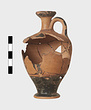
| Mended from many pieces; fragments of body and shoulder missing. Similar in shape, size and decoration to P 16587 (ΝΝ 1713). Purple: ground line, band at base of neck, two bands on lip.
Good black glaze, ... 25 April 1940 ... Hesperia 20 (1951), pl. 42 a-3 (Grave 12) ... Hesperia 10 (1941), p. 2, fig. 1 ... ABV, p. 461, no. 18. |
| Inscribed fragment.
Rough picked left face and lower portion of back may be original; otherwise inscribed face only preserved.
Sepulchral monument; Latin.
Pentelic marble. Found in modern context, east ... 23 February 1935 |
| Mended from many pieces; only about one-quarter of sides preserved.
Base medallion: rosette. Sides decorated with flutes alternating with vertical rows of raised rings. Above fluting, double groove, surmounted ... 22 April 1932 ... Hesperia Suppl. 10 (1956), p. 105, under no. 108 ... AJA 45 (1941), p. 218, n. 69 ... Hesperia 3 (1934), no. |
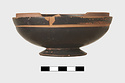
| Intact, save for chip from rim. High flaring ring foot and rounded body; reserved groove outside below rim; upstanding inner rim to hold lid. Black glaze all over except: bottom of bowl inside foot, resting ... 25 April 1940 |
| Inscribed fragment.
Broken all round; carefully cut.
Pentelic marble.
ADDENDA Joined I 1789. Found in a marble pile, in the northwestern part of the Market Square. Leica, XXV-56 ... 17 February 1933 |
| Fragment inscribed in both Greek and Latin.
Left side perhaps preserved; elsewhere broken.
Part of four lines of the inscription preserved.
Pentelic marble. Found in the wall of the modern house 636α/14 ... Ca. 50 A.D. |
| Fragment of inscribed stele.
Broken to right and below; smooth left edge, not at right angles to face; broken behind. Along the top a wide convex moulding.
Seems to be a Thiasos decree in praise of an ... Ca. 300 B.C. |
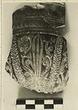
| A fragment from one side; restored in plaster. From the medallion springs a succession of lanceolate petals, tendrils and tall spikes. The petals are probably a stylized version of the nymphaea lotus, ... 1932 ... Hesperia Suppl. 10 (1956), p. 100, under no. 67 ... AJA 45 (1941), p. 221, n. 78 ... Hesperia 3 (1934), no. |
| Inscribed fragment.
Broken all around.
Fragment with imperial letters.
Pentelic marble.
ADDENDA Same inscription with I 10, I 60, I 64, I 815. Finished Found at a late Roman level, above the foundation ... 177-180 A.D. |
| Mended from two pieces; the profile complete. In the center, a gorgoneion; on the sides, leaf pattern.
Pinkish buff clay.
ADDENDA Medallion from same stamp as p 3089.
Cf. Hesperia Suppl. 10 (1956), p ... 2 March 1934 ... Hesperia Suppl. 10 (1956), p. 84, n. 4 ... AJA 45 (1941), p. 220, no. 1 (noted) ... Hesperia 3 (1934), p. 453, fig. 119. |
| Small fragments are missing from side wall. In the medallion, a rosette of 11 petals, from the medallion spring elongated petals with pointed tips, alternating with jewelled lines which terminate above ... 3-12 March 1934 ... Hesperia Suppl. 10 (1956), p. 105, under no. 108 ... AJA 45 (1941), p. 218, n. 69 ... Hesperia 3 (1934), no. |
| Inscribed fragment.
Inscribed face and left side, tooth dressed preserved.
Seventeen lines of the inscription preserved.
Hymettian marble.
Cf. Hesperia 26 (1957), p. 37. Found in the wall of the modern ... 121/0 B.C. |
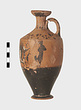
| Intact. Surface much worn and peeled. Shoulder lekythos with low foot and flaring mouth. Foot and lower body glazed; purple ground line. On body, crude nude figure, left, draped figure facing center to ... 25 April 1940 |
| Fragment from grave monument.
The inscription in Latin.
The inscription on a projecting fascia, of which the bottom is preserved. The monument is broken away on all sides.
Three lines of the inscription ... 5 March 1934 |
| Lid intact save for chip at edge. Straight wall and very slightly convex top, projecting a little beyond the wall and grooved near the edge. On top, a bird with spread wings, no incision; black glaze on ... 25 April 1940 |
| a) Broken behind and at the right end. Traces of painted palmette on concave face.
b) The right end.
Pentelic marble.
From the Temple of Hephaistos (earlier assigned to the Temple of Ares).
a) Marble ... 31 January 1935
17 March 1952 |
| Inscribed fragment.
Inscribed face only preserved.
Surface worn.
Remains of at least sixteen lines of the inscription preserved.
Pentelic marble.
Cf. Hesperia 26 (1957), p. 94. Found in modern Greek retaining ... 184/3 B.C. |
| A deeply concave mold for making the face and the side of the head (including ears) of a bearded male, about life size.
Right half broken away; original surface preserved at top, left edge and back.
The ... 25 April 1940 |
| Inscribed fragment.
Broken all around.
Grant of citizenship.
Eleven lines of the inscription preserved; stoichedon.
Pentelic marble. Found in a modern wall, south of the central part of the Middle Stoa ... 307-301 B.C. |
| About one-third of a black-glaze skyphos base with reserved band on exterior above foot. Flaring ring foot; space inside foot reserved. Excellent glaze, slightly worn on the resting surface.
Incised on ... 24 May 1940 ... Museum Guide (2014), p. 134, fig. 75 ... AntW 37 (2006), p. 51, fig. 10. (Camp) ... Hesperia 10 (1941), p. 3, fig. 2. |
| Inscribed fragment.
Top, sides and bottom (?) are preserved.
Back has been re-worked.
Dedication to Hadrian.
Six lines of the inscription preserved.
Hymettian marble. Found in wall of the modern house ... 28 October 1938 |
| Inscribed fragment.
Inscribed face and part of original back only preserved.
Dedication to Hadrian.
Three lines of the inscription preserved.
Hymettian marble. Found in late Byzantine context, at the north ... 129-138 A.D. |
| Inscribed fragment.
Inscribed on two adjacent faces; inscribed faces only preserved.
Contains list of officers.
On face A, nine lines of the inscription preserved, and a wreath below; on face B, three ... 324/3 B.C. |
| Complete save for chip from handle and many flakes from surface. Shoulder lekythos with low spreading foot and echinus mouth. Top of foot and lower body glazed, also mouth and handle. On front of body, ... 25 April 1940 |
| Mended from many fragments: large part of side missing. Central base medallion, frontal face surrounded by plain and dotted ring, scraped groove between, thin double (imbricated) wreath with pin-wheels ... 17 March 1932 ... Hesperia Suppl. 10 (1956), p. 97, under no. 32 ... AJA 45 (1941), pp. 203:4, no. 3 (noted); 205:10, no. 2 (noted) ... Hesperia 3 (1934), p. 356, no. |
| Inscribed fragment.
Inscribed face only preserved.
Five lines of the inscription preserved.
Pentelic marble. Found in mixed late Roman to Byzantine context, north of the Odeion north wall. Leica, VII-38, ... 20 June 1935 ... Hesperia Suppl. 9 (1951), p. 28, no. 3 ... Hesperia 10 (1941), p. 52, no. 14 ... Agora XIX, no. H 77, p. 39, pl. 6. |
| Inscribed fragment.
Inscribed face, right side (smooth picked) and rough picked back preserved.
Sixteen lines of the inscription preserved; stoichedon.
Pentelic marble.
ADDENDA Joined to I 6804. Found ... Mid. of 4th. century B.C ... AM-BH 13 (1989), no. A 159, p. 310 ... Hesperia 29 (1960), pp. 2-3, no. 3 ... Hesperia 10 (1941), p. 42, no. 10. |
| Mended from many pieces. Large parts still missing. Central medallion, rosette separated from moulded ring by groove colored with miltos. Multiple radiating wreath, rosettes between the tips. Figured band ... 17 March 1932 ... Hesperia Suppl. 10 (1956), p. 96, under no. 25 ... Hesperia 29 (1960), p. 283 ... Hesperia 3 (1934), p. 357, no. |
| Inscribed fragments.
Record of sacrifices.
Fragment Ζ 777 a), broken all round.
Parts of four lines of the inscription preserved, with a space to the left.
Pentelic marble.
ADDENDA With I 251, I 590, ... a) (Ζ 777a) 26 June 1933
b) (Ζ 777b) 7 May 1937 |
| Piece from top of inscribed stele.
Pediment top.
Left side and a trace of back preserved; broken away at right and below.
Preamble of decree; Archon Alexander.
Hymettian marble.
Cf. Hesperia 16 (1947), ... 174/3 B.C. |
| Inscribed fragments.
Monument to heroes of Phyle.
Top and right side preserved; other sides broken.
Fragment Ε 476, consists of five lines of the inscription.
Pentelic marble.
ADDENDA Belongs with I ... Early 4th. century B.C ... Hesperia 71 (2002), pp. 377-397, figs. 1-3 ... Hesperia 3 (1934), p. 287, no. 78 ... Hesperia 2 (1933), p. 151, no. 3. |
| Small inscribed fragment from bottom of block.
Bottom surface picked fine; other edges broken.
Record of sacrifices.
Parts of three lines of the inscription preserved; non-stoichedon.
Pentelic marble ... 20 March 1933 |
| Fragment of inscribed stele.
Part of a pediment preserved, broken off at the right and behind; rough picked on the top. Close to the apex, part of an acroterion.
Inscribed below the pediment, the inscribed ... 122/1 B.C. |
| Large inscribed base of grave monument.
Dimensions preserved complete, though at the bottom the projecting base-moulding has been broken away, and the under surface is preserved only near the middle of ... 113-136 A.D. |
| Inscribed fragments.
List of names by tribes and demes.
Fragments ΘΘ 104 and ΘΘ 124 (a) four joining fragments.
Inscribed face only preserved; parts of two columns.
Fragments ΘΘ 121a, ΘΘ 121b, ΘΘ 124b, ... 4th. century B.C ... Hesperia Suppl. 14 (1975), p. 79 ... Hesperia 37 (1968), pp. 1 ff., pls. 1-3 ... Hesperia 10 (1941), p. 46. |
| Inscribed fragments.
Decree honoring Ulpius Eubiotus.
Fragment Β 300 a), broken on all sides.
Seven lines of the inscription preserved.
Fragment ΒΒ 286 b), inscribed face only preserved.
Nine lines of ... Ca. 220-250 A.D. |
| Nearly complete. Missing one handle; badly chipped at rim and body; paint flaking.
Piriform body, low neck, wide mouth with flaring rim. Two small horizontal handles on shoulder; break for attachment ... Mycenaean LHIIIA2 |
| Complete. Mended from numerous fragments; largely chipped along breaks from impact on belly; patches of incrustations on one side, one on belly and one at rim.
Globular body. Tall, wide neck with rounded ... Mycenaean LHIIIB |
| Inscribed fragments.
Year of Hegesios.
ΚΚ 788 (a) inscribed face only preserved; much broken.
Seven lines of the inscription preserved; stoichedon.
Spacing (five lines including) 0.079m.
ΚΚ 1182a (b) ... 324/3 B.C. |
| Broken on right end and along inner edge.
At the left end there remains a trace of a cutting for a half-housing joint.
Cyma reversa type crowned with an ovolo molding. On the front a band of palmettes ... 1932 |
| Mended from many pieces; the profile complete; most of the rim missing; also one handle and large fragments from the body. Restored in plaster. Heavy moulded conical foot; shallow wheel-run grooves on ... 3 March 1934 |
| Completely preserved except for phallus. The top of the head is flat and rough-picked, and was probably originally finished with stucco.
Realistic portrait of an elderly man, the lines and folds of flesh ... Period of Hadrian |
|
|