|
|
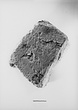
| Inscribed fragment.
Remains of an inscription in two columns, that to the right being a list of names. Parts of fifteen lines of the inscription preserved.
Pentelic marble. Pre-excavation. Found in the ... 1st. century B.C. (?) ... Hesperia 3 (1934), p. 57, no. 45. |
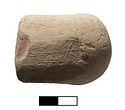
| Angular shape like Rhodian; only small fragment around curve preserved.
Similar clay to typical Rhodian.
Left end of impression broken away; incomplete above; much worn. Finished Floor of Drain. [ Βαδρο]μ̣ίου ... 9 March 1932 ... Hesperia 3 (1934), no. 57. |
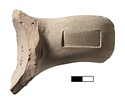
| Less angular shape than typical Rhodian.
Fine clay, yellowish, with small light red core; cream slip.
Letters in very slight relief. Par: Nilsson 1909 nr 263* Finished Ἐπὶ Καλλικράτευς
Ἀγριανίου 463 ... 20 July 1931 |
Fragment of lip and many from the body missing; restored in plaster. Large round mouth; broad vertical handle; no neck; nearly round bottom, blackened from fire.
Rather coarse brick red clay.
Cf. Agora ... 21 March 1933 ... Hesperia 3 (1934), no. A 57. |
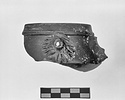
Vertical band handle and the left side of the body are broken away.
Watch-shaped body, flattened on top, with radiating ribs covering the upper part, from a small raised ring round the filling hole.
On ... 22 April 1932 ... Hesperia 3 (1934), p. 388, no. D 57, fig. 76. |
| Lip offset; vertical ring handle broken off. Lion spout. Well, in north cistern arm. Group E. Leica, 90-35-4, 4-335 ... 5 March 1934 ... Hesperia 3 (1934), no. E 57. |
Fragment of inscribed stele.
Part of smooth picked top and rough back preserved.
Other edges broken. Above the inscription a horizontal groove.
Remains of six lines of the inscription.
Pentelic marble ... Ca. 210 A.D ... Hesperia 3 (1934), p. 57, no. 44. |
Fragment from rim and wall. Two shallow grooves around the body, one below the rim.
Between the grooves, scratched in the dry clay, the letters:
Attic clay. Dull mottled glaze, with band fired red around ... 22 April 1932 ... Hesperia 3 (1934), p. 372, no. D 15, figs. 56-57. |
|
|