|
|
| Heavy ring, round in section; somewhat rusted.
Probably used as hitching ring, to which animals could be tied. Found attached to marble block. 2082-2083 Leica ... 2 July 1951 ... Hesperia 28 (1959), pp. 7-8 ... Hesperia 21 (1952), p. 96, pl 21 d. |
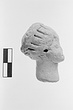
| Head with long neck; hair drawn straight back from forehead in melon waves to a crown of braids on back of head.
Broken at base of neck; the features almost completely obliterated.
A few flecks of white ... 19 July 1949 ... Hesperia 21 (1952), p. 138, no. 96, pl. 36. |
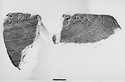
Inscribed fragment from upper left corner of grave stele.
The corner, the rough picked top and the back, are preserved, but the corner acroterion has been broken away.
Below the inscribed surface is the ... 24 March 1933 ... Hesperia 21 (1952), p. 375, no. 28, pl. 96 ... Agora XVII, no. 97, p. 46. |
Inscribed fragment.
Inscribed face only preserved.
Pentelic marble. Found in modern context over the East Stoa, at west of it. Leica ... 2nd. century A.D ... Hesperia 21 (1952), p. 376, no. 29, pl. 96 ... Agora XV, no. 344, p. 259. |
| Corner of inscribed block.
Funeral base.
Fragment Κ 14 a), top and left side preserved; broken away on the right, the back, and below.
Part of one line of the inscription preserved, with three letters ... Ca. 500 B.C ... Hesperia 21 (1952), p. 375, no. 27, pl. 96 ... Agora XVII, no. 751, p. 141. |
| Four fragments, together making up most of the upper wall, mouth, and handle of a pitcher with vertical handle, round mouth with plain rim, and probably convex bottom.
Thick fabric, apparently wheel ... 8-10, 12 April 1948 ... Desborough (1952), p. 54 ... Hesperia 18 (1949), p. 296, no. 21, pl. 67 ... Agora XXXVI, no. T11-21, pp. 94, 96, fig. 2.45. |
Part of an inscribed base.
Broken away at the left.
A moulding, now mostly destroyed, above and below, in front, on side, and in back.
Grave monument.
Pentelic marble. Not found in 1990. Found in the wall ... 22 February 1934 ... Hesperia 21 (1952), no. 24, pl. 96 ... Agora XVII, no. 441, p. 98. |
| Two joining fragments give somewhat less than half. Floor: a pair of sphinxes facing, flanked by others. Rim: incised rosettes, two suspension holes. Reverse: part of a large sphinx which fills all the ... End. 2nd. qtr. 6th. c ... Hesperia 21 (1952), pl. 30d ... ABV, p. 47, no. 107 (Polos Painter) ... Agora XXIII, no. 1399, pl. 96. |
| From upper wall of an amphora. Head of a youth, wreathed, to right, holding two spears. Above egg. Relief contour; hair rendered in thick glaze; two berries of wreath at forehead in faded white.
ADDENDA ... 6 June 1951 |
| Inscribed fragment.
Broken at right side and back.
Top seems to slope up toward the back but probably original.
Left side probably re-cut.
Hymettian marble. Found in modern wall, over the eastern corner ... 5th. century B.C ... Hesperia 82 (2013), pp. 442, 448, nn. 18, 34 ... Hesperia 21 (1952), p. 374, no. 25, pl. 96 ... Agora III, no. 39, p. 29. |
| Intact. A bulging oinochoe with wide trefoil mouth. Spreading foot nearly flat beneath; handle from lip to shoulder. Lip glazed; rings around neck, vertical bars on handle; on shoulder, four pendents on ... 30 March 1936 |
| Broken off above waist. Left foot (which was attached with iron dowel) missing, and small part of throne.
Figure, wears transparent chiton and heavier himation. She is seated on a rocky throne, with left ... 19 June 1951 |
| Inscribed fragments.
"POLETAI" record.
Confiscated property of those who profaned the Mysteries.
Fragment ΙΙ 2 a), inscribed face only preserved.
Thirteen lines of the inscription preserved.
Belongs to ... 414 B.C. |
Mended from many fragments, with missing pieces restored in plaster and painted, notable among them the left horizontal handle and part of the wall below it. Glaze fired greenish around left handle; abraded ... Ca. 430 B.C ... Amyx, Hesperia 27, 1958, pl. 48:b; Matheson, Polygnotos, p. 427, cat. no. ... Trendall, The Red-Figured Vases of Apulia, Oxford 1978, p. 21, no. 94); also 836; P 30054 (Hesperia Suppl. ... Mielsch, RM 86, 1979, p. 236, pls. 50, 51). |
|
|