|
|
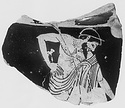
| Fragment preserves a little of neck of pot, angle emphasized by reserved groove between, bordered by relief contour. Considerable horizontal curve indicates smallish pot. Glazed inside. Half-draped bearded ... 31 March 1932 ... Hesperia 17 (1948), pl. 66, no. 2 ... ARV, p. 115, no. 50 ... ARV2, p. 158. |
| Slightly chipped; otherwise intact.
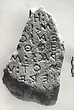
A rectangular plaque with a neat round hole pierced through it at the center of one end. Undecorated. Stained with iron rust at the center of one side.
Yellow sandstone ... 13 March 1947 ... Hesperia 43 (1974), p. 359, Nr. ... Hesperia 17 (1948), p. 158, pl. ... BCH 71-72 (1947-1948), pl. LXVI 1, lower. |
| Inscribed fragments.
Fragment Ο 231 a), inscribed face only preserved.
Boustrophedon.
Joining fragment ΒΒ 48, smooth left side preserved.
Thirteen lines of the inscription preserved, as joined.
Fragment ... a) (Ο 231) 21 February 1935
(ΒΒ 48) 13 October 1938
b) (ΒΒ 92) 22 February 1939
c) (ΒΒ 158) 20 March 1939 |
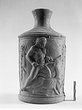
| Intact. Flat bottom and straight side wall; upward sloping shoulder, ribbed; narrow neck with plain slightly flaring lip; ridged vertical handle, base of neck to edge of shoulder. Mould-made in two pieces, ... 30 May 1947 ... Museum Guide (2014), p. 181 ... Hesperia 20 (1951), p. 276, noted ... Hesperia 17 (1948), pl. |
| Inscribed fragment of stele.
Two large joining fragments, the upper of which preserves some of the flat top of the stele proper, with a dowel hole for the attachment of the pedimental top. Upper right ... 140/39 B.C ... Shear (1994), p. 241, no. 70 ... Hesperia 48 (1979), p. 179 ... Hesperia 17 (1948), p. 17, no. 9. |
| Profile complete; missing fragments restored in plaster. A heavy flaring base, with a rounded upper part; between the two a floor, pierced by a large hole. Carrying holes in the base, front and back. At ... 27 June 1947 ... Hesperia 54 (1985), p. 402, pl. 103b ... Guide (1962), p. 158 ... Hesperia 17 (1948), pl. |
Wall fragment. Glaze dull and misfired reddish here and there on inside and outside; slightly abraded. Max. dim. 0.107. H. A. Thompson, Hesperia 17, 1948, pl. 67:4; Matheson, Polygnotos, p. 354, cat. no ... Ca. 440 B.C ... Thompson, Hesperia 17, 1948, pl. 67:4; Matheson, Polygnotos, p. 354, cat. no. P 37.
Theseus and the Minotaur. ... Bryn Mawr College, 1972), p. 158, who points out that the lyre occurs in the victory dance on the François Vase, Florence 4209 (ABV 76, 1; Paralip. 29, 1; Addenda 21; M. |
|
|