|
|
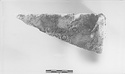
| Inscribed fragment.
Fragment from upper right corner of stone; monument.
Top has narrow smooth band along front, and slopes away behind. Right side rough picked with smooth, sunk band at front edge; elsewhere ... Ca. 200 A.D ... Hesperia 17 (1948), p. 42, no. 33 ... Agora XVII, no. 249, p. 70. |
| Inscribed fragments.
Treasure record of Athena.
Fragment Π 39, broken all around; right edge preserved; face much flaked away.
Twenty lines of text preserved; stoichedon, except for some irregularities ... After 346/5 B.C ... Hesperia 67 (1998), p. 75 ... Hesperia 25 (1956), pp. 101-109 ... Hesperia 17 (1948), p. 33, no. 16. |
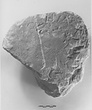
| Standing figure, perhaps a warrior, the right leg advanced, the right arm raised high above his head; a cloak hangs behind him, and a narrow fold of drapery passes across his chest from the right shoulder ... 29 July 1947 |
| Inscribed fragment.
Broken on all sides.
Part of two lines of the inscription preserved, near the top of the fragment.
Poor grayish marble. Found in the wall of the modern house 637/4, east of the southern ... 4th. century B.C ... Hesperia 17 (1948), p. 36, no. 20 ... Agora XIX, no. H 58, p. 33. |
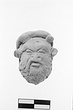
| Bearded satyr or silen with large ears; his bald brow crowned by a rolled wreath decorated with leaves.
The head, open behind, made separately for attachment.
Complete except for the tips of the ears broken ... 24 July 1947 |
| Mended from two pieces; end of nozzle, lug, and handle missing.
Lug on side; ribs on the rim. Stubs of band handle.
Black glaze over all.
Type XVIII of Corinth collection, type 48A of Agora collection ... May 1947 |
| Inscribed fragment of grave stele.
Inscribed face and part of rough picked back only preserved.
Stone with a list of names probably of those who fell in some campaign.
Sixteen lines of the inscription ... Ca. 450 B.C ... Hesperia 33 (1964), p. 21, no. 4, pl. 2 ... Hesperia 17 (1948), p. 45, no. 37 ... IG I2, no. 941. |
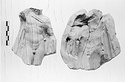
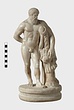
| Mended from several pieces, complete save minor chips.
Farnese type, the figure leaning heavily on his club, but the body rendered as more youthful with the muscles less exaggerated.
Pentelic (?) marble ... 21 May 1947 |
|
|