|
|
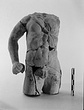
| On left hip traces of scabbard (?) hanging from strap which passes over right shoulder; handle of sword (?) grasped in right hand, blade broken off.
Mended from many pieces; head, left arm and legs from ... 26 July 1946 |
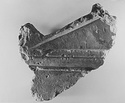
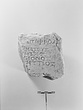
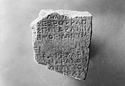
| Inscribed fragment of early Christian Epitaph.
The left edge preserved; other edges broken.
Part of three lines of the inscription preserved.
Pentelic marble. Found in Turkish well, east of the Southwest ... 21 April 1934 ... Sironen (1997), p. 187, no. 121 ... Hesperia 16 (1947), p. 25, no. 3 ... Agora XVII, no. 1060, p. 188. |
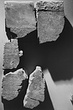
| Inscribed fragments.
List of names, arranged by tribes: names from Aigeis, Pandionis, and Leontis.
Fragment X 39, inscribed face, left face and original back preserved.
Eleven lines of the inscription ... Mid. 3rd. century B.C. |
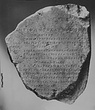
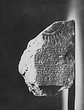
| Fragment of inscribed stele.
Broken away above, below, and at left. Part of right side preserved, worked with toothed chisel. Back rough, with long drilled grooves.
Seventeen lines of the inscription preserved ... Ca. mid. 3rd. century B.C ... Pentelic marble.
Cf. Hesperia 16 (1947), p. 189, no. 94.
Hesperia 23 (1954), p. 234, no. 3. |
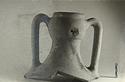
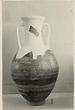
| Neck and handles preserved. Rounded lip; convex bulge in neck at line of upper handle attachment.
On neck, dipinto in red: Λ
Graffito below:
Pinkish-buff clay, buff at surface. Previously North Basement-Jar ... 5-6 July 1946 ... Hesperia 69 (2000), no. 7, p. 25, fig. 3 ... Hesperia 16 (1947), p. 212. |
| Inscribed stele.
Broken to right and behind. The top slants downward toward back.
Below the smoothed upper part is a large rough setting tongue.
One line of the inscription remains.
Hymettian marble. Found ... 1st. century B.C. |
| Inscribed fragment.
Part of left side (tooth chisel) preserved; otherwise broken.
Four lines of the inscription preserved, one to two letters in each.
Pentelic marble. Found in modern wall, over the floor ... After 128/9 A.D. |
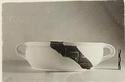
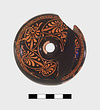
| Two non-joining fragments.
a) Mended from two pieces, preserves part of rim and body and one handle.
b) Part of floor and body.
From a shallow bowl with heavy ring foot and flat rim to which a double pierced ... 6 July 1946 ... Hesperia 16 (1947), p. 212, pl. XVIII:3 ... Agora XXXII, no. 893, fig. 28, pl. 48. |
| a) Mended from three pieces, preserves floor and part of rim.
b) Non-joining rim fragment.
Moulded ring foot; very flat floor with shallow hollow at center; rim turned down and in; fine groove around ... 5-6 July 1946 ... Hesperia 16 (1947), p. 212, n. 42 ... Agora XII, no. 1061, fig. 10, pl. 37 (3 views). |
| Broken at both ends; much rusted and encrusted.
At one end of fragment, part of cylindrical tongue, to fit into shaft of handle, preserved; separated by flange, edges broken, from other end of fragment, ... 15 January 1944 |
| Inscribed fragment of early Christian Epitaph.
Fragment preserves right side of an inscribed Latin cross with parts of four or five letters below and to right.
Coarse marble with greenish veins. Found ... 1931 |
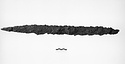
| Complete, but broken into two pieces.
Slightly curved, flat, pointed blade, with triangular tongue to fit into handle. Agora sample no. 641. Geometric Grave. In Ethafoam, low RH 1270 Leica, XXVI-60, XXVII-74, ... 15 January 1944 |
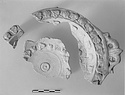
| Mended from many fragments; about one-third of rim and upper body and two other fragments missing. Shallow bowl; flaring ring foot; lip plain on outside, thickened on inside, flat top surface tilted in; ... 5-6 July 1946 |
| Three non-joining fragments of an egg-shaped vase, an aryballos.
a) Part of lower body and of bottom.
b) Part of shoulder and of ribbing on body.
c) Ribbed fragment from body.
The body is divided by three ... 17-24 May 1940 ... Hesperia 16 (1947), p. 211, pl. 47:3 ... Agora XXX, no. 987, pl. 96. |
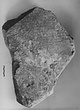
| Inscribed fragment.
Original surface on face and right edge only.
Possibly an Ephebic Decree of the third century. Some of the demotic of Hermodoros or Herortious seems to be preserved.
Part of eight lines ... 244/3 B.C. |
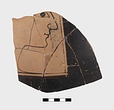
Two non-joining fragments, a of body, b of shoulder. Burned (clay is gray). Max. dim. a) 0.064, b) 0.035. H. A. Thompson, Hesperia 16, 1947, pl. 47:3.
Fragment a shows the lower legs and feet of a man ... Ca. 410 B.C. |
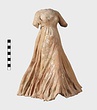
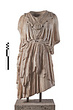
| Woman, probably Nike, moving-flying or running-forward with very full drapery blown black. Drapery slipped down over one shoulder and breast.
Head, lower arms and small fragments missing; mended from many ... 26 July 1946 ... Histoire et Archéologie 81 (1984), p. 34, fig. 6, no. 81 ... Hesperia 16 (1947), p. 208, pl. 45, no. 3. |
| Inscribed fragment of early Christian.
Back preserved; fragment of revetment.
Four letters remain.
Pentelic marble. Found in late Roman context, west of the northern part of the Stoa of Attalos. Leica ... 25 May 1936 |
| Both handles, part of neck and shoulder, and small bit of lip preserved; filled in with plaster, shoulder to lip. Reserved panels with maeander, banded above and below, on front and back of neck. Ladder ... 15 January 1944 ... Hesperia 37 (1968), p. 85, noted under no. 2 ... Hesperia 16 (1947), p. 197 ... Agora XXXVI, no. T17-3, pp. 182, 183, figs. 2.104, 2.105. |
| Fragment from inscribed stele.
Upper left corner, including part of pedimental top, preserved. Side worked with tooth chisel. Back rough picked.
Part of six lines of the inscription preserved.
Hymettian ... 177/6 B.C. |
| Inscribed fragment of columnar grave monument.
Circumference preserved; broken above and below.
One line of the inscription preserved, and remains of another above.
Pentelic marble.
Early Christian. Found ... 16 March 1936 |
| Piece from top of inscribed stele.
Pediment top.
Left side and a trace of back preserved; broken away at right and below.
Preamble of decree; Archon Alexander.
Hymettian marble.
Cf. Hesperia 16 (1947), ... 174/3 B.C. |
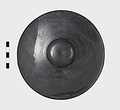
| Profile complete but most of bowl, including both handles missing; restored in plaster. Low ring foot; shallow convex body; short outward tilted rim. Foot and lower wall glazed outside. On body, front ... 15 January 1944 |
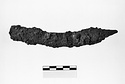
| The blade, much rusted and encrusted, is complete, but in three pieces, from tip to small tongue at top to fit into handle. One projecting bronze stud for attachment preserved just below tongue.
Traces ... 15 January 1944 |
Most of shoulder with start of neck, about half of body. P.H. 0.076; diam. at shoulder 0.082. H. A. Thompson, Hesperia 16, 1947, pl. 47:3; LIMC III, 1986, p. 454, no. 335, pl. 335, s.v. Dionysos; Burn, ... Ca. 410 B.C ... Thompson, Hesperia 16, 1947, pl. 47:3; LIMC III, 1986, p. 454, no. 335, pl. 335, s.v. Dionysos; Burn, Meidias Painter, p. 115, cat. no. MM 118.
Dionysos and maenads. |
| Fragment from an inscribed stele.
Edges broken; back, rough picked, preserved, worked smooth to within ca. 0.10m. of the present bottom of the stone, where a boss-like mass, rough picked, projects.
Seventeen ... Late 3rd. or early 2nd. centuries B.C ... Hesperia 16 (1947), nos. 62, 94 ... Hesperia 40 (1971), p. 63, nos. 3, 11 ... Hesperia 3 (1934), p. 12, no. 16. |
| Both handles, most of neck and rim missing; restored in plaster. Flaring ring foot; ovoid body, slightly concave neck, rounded lip.
At point of greatest diameter a zone of maeander, flanked above and ... 15 January 1944 |
| Fragments of an inscribed stele.
Opisthographic decree and inventory; Archonship of Aristolas.
a) (Ι 432), the top and back of the stele are preserved, but mouldings (back and front seem to have been ... 161/0 B.C. |
| Inscribed fragment.
Part of one edge, the right of face A, preserved; otherwise broken.
Eight lines of the inscription preserved on face A; six on face B; opisthographic.
Pentelic marble.
ADDENDA Belongs ... 165/4 or 180 A.D. |
| Two non-joining fragments.
a) Most of shoulder and part of upper body, made up from three pieces. Heads of two women right, the front one carrying a large bowl with handle, uncertain object at edge of ... 17-24 May 1940 ... Burn (1987), p. 115, no. MM 118 ... Hesperia 16 (1947), p. 210, pl. 47:3 ... ARV2, p. 1326, no. 76. |
| Inscribed fragments.
List of names; "POLETAI" record.
Fragment Ζ 331 a), inscribed fragment.
Broken on all sides.
Nine lines of the inscription preserved, with a space between the fourth and fifth.
Fragment ... First half of 4th. century B.C. |
| Inscribed fragments.
Decree, Archonship of Alexander.
Fragment Ρ 151 a), inscribed face only preserved.
Five lines of the inscription preserved.
White marble.
Fragment Ω 20 b), a non-joining fragment ... 174/3 B.C. |
| Three pieces, put together with plaster, from rim, neck and shoulder of a pot with stepped rim and thin glaze wash inside: probably a wide-mouthed amphora. Good black glaze overall; on the shoulder, a ... July 1946 ... StMisc 18 (1971), p. 49, no. 87, pl. L ... Hesperia 30 (1961), pp. 360-361, no. ... Hesperia 16 (1947), p. 210, pl. |
| Fragment Θ 26 a), from right side of inscribed block; fine picked on one side, rough picked on the back.
Fragment Κ 115 b), back and left side preserved. Fifteen lines of the inscription preserved.
Fragment ... 127/6 B.C ... Hesperia Suppl. 15 (1975), p. 2, no. 2 ... Hesperia 30 (1961), p. 13, no. 8 ... Hesperia 16 (1947), p. 169, no. 66. |
| About two-thirds of body preserved; broken at bottom, and both arms missing. The right arm broken off just below the shoulder, the left ends in a smooth-cut surface just above the elbow, with a hole for ... 28 April 1947 |
|
|