|
|
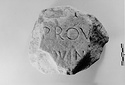
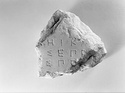
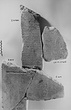
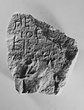
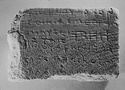
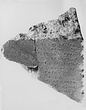
| Fragments of Latin inscription.
Fragments Λ 46 a and Κ 100 b), broken all round.
Part of three lines of the inscription preserved, on each fragment.
Fragment Λ 119 c), also broken all round; on it, part ... a) (Λ 46) 13 January 1934
b) (Κ 100) 22 February 1934
c) (Λ 119) 21 February 1934 ... Hesperia 10 (1941), p. 239, no. 40. |
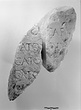
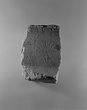
| Inscribed fragments.
Fragment Τ 166 a), inscribed face only preserved.
Six letters remain.
Fragment Ρ 445 b), joins. Inscribed face only preserved.
Five lines of the inscription preserved.
Pentelic marble ... a) (Τ 166) 18 February 1936
b) (Ρ 445) 26 April 1937 ... Hesperia 10 (1941), p. 239, no. 40. |
| Inscribed base.
Part of a circular base.
The top and bottom preserved; broken away in back.
Prytany dedication; Archonship of Pythodotos; set up by the Prytanies of Kekropis.
Four lines of the inscription ... 343/2 B.C ... Hesperia 16 (1947), p. 184, no. 90 ... Hesperia 10 (1941), p. 40, no. 7. |
Inscribed fragment.
Top, left side and back preserved; also part of bottom.
Top of surface of stone finished smoothly, until 0.160m. from the top; below that left rough, for insertion into ground.
Boundary ... 8 February 1936 ... Hesperia 75 (2006), p. 100, n. 68 ... Hesperia 10 (1941), p. 40, no. 8. |
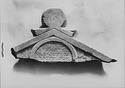
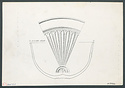
| Part of pedimental top from inscribed stele.
At the center of the pediment, a circle, within which the inscription.
Pentelic marble.
ADDENDA Part of I 10. Finished Found in walls of late pit, east of ... 25 May 1933 |
| Chipped all around; back and bottom broken off, but the inscription complete.
Sanctuary of Apollo Xanthos. Found in Hellenistic context, in the channel of a well outside the Market Square, to the southwest ... Ca. 400 B.C. |
| Inscribed fragment.
Inscribed face only preserved.
Preamble of decree.
Four lines of the inscription preserved.
Pentelic marble.
Cf. IG II2, no. 25. Found in a Byzantine well in the north wall of the ... 4th. century B.C ... Hesperia 10 (1941), p. 262, no. 66 ... Agora XVI, no. 40, p. 55. |
| Inscribed fragment.
Rough picked back preserved; broken on all sides.
Part of an imperial letter from Marcus Aurelius and Commodus.
Thirty-two lines of the inscription preserved.
Pentelic marble.
ADDENDA ... 178 A.D. |
| Broken on all sides.
Parts of four lines of the inscription preserved.
Hymettian marble. Found in mixed Hellenistic and Roman context, outside the Market Square, to the southwest, in the disturbed area ... 4th. century B.C ... Hesperia Suppl. 9 (1951), p. 31, no. 12 ... Hesperia 10 (1941), p. 53, no. 16 ... H 86, p. 40. |
| Mended from many pieces; only about one-quarter of sides preserved.
Base medallion: rosette. Sides decorated with flutes alternating with vertical rows of raised rings. Above fluting, double groove, surmounted ... 22 April 1932 ... Hesperia Suppl. 10 (1956), p. 105, under no. 108 ... AJA 45 (1941), p. 218, n. 69 ... D 40. |
| Inscribed fragment.
Part of a stele, the top and right side smooth, the back rough but apparently original. The front surface seems to have been defaced deliberately with a chisel, at least the three upper ... 309/8-308/7 B.C ... Hesperia Suppl. 9 (1951), pp. 29-30, no. 7 ... Hesperia 10 (1941), p. 54, no. 18 ... H 78, H 84, pp. 39, 40. |
| Inscribed fragment.
Toothed right side and rough picked back preserved; otherwise broken.
Twelve lines of the inscription preserved.
Hymettian marble.
ADDENDA Joins with I 1870 (B 664).
Cf. Hesperia ... Mid. 3rd. century B.C ... Hesperia 23 (1954), p. 302, no. 40 ... Hesperia 35 (1966), p. 221 ... Hesperia 10 (1941), p. 273, no. 71. |
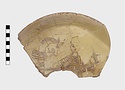
| From a large dish with flat floor, upturned rim, and a low ring foot. One rim fragment does not join. Akritas, at right, holds a bow. At left, the head of the dragon bends over, its neck pierced with five ... 12th.-13th. c. |
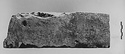
| Broken on right end and along inner edge.
At the left end there remains a trace of a cutting for a half-housing joint.
Cyma reversa type crowned with an ovolo molding. On the front a band of palmettes ... 1932 |
|
|