|
|
Cistern System #3: East Chamber at 69/Λ, joined by a crooked passage to 69/ΛΣΤ. Under the southwest corner of the Hellenistic Building to the north of the Temple of Hephaistos ... 175-125 B.C ... Under the southwest corner of the Hellenistic Building to the north of the Temple of Hephaistos. |
Two pebble floors of Roman date, broken into at the SE and north, covered a 6x5m trench in ΕΛ, bounded by the unexcavated east trench and a wall from Byzantine Building D (Wall A). Under these pebble floors ... 220 - 150 B.C. |
Laura Gawlinski ... Pebble floors of Roman date covered the northern half of a 6x6m square trench in ΕΛ, bounded to the west by the post-Herulian Wall and to the east by a wall from Byzantine Building D (Wall A) to the east ... Hellenistic/ 220-150 B.C ... Pebble floors of Roman date covered the northern half of a 6x6m square trench in ΕΛ, bounded to the west by the post-Herulian Wall and to the east by a wall from Byzantine Building D (Wall A) to the east. ... Bedrock and fill with significantly less inclusions (also Hellenistic in date) found beneath. |
Chamber of water system with one blind tunnel and two cisterns connected by tunnel. Pottery consistent throughout, late Hellenistic. Late 2nd c. B.C.
Ten stamped amphora handles. Most of bowls long-petal ... 100-75 B.C. |
A pit, perhaps a well, extending beneath the foundations of [Building D, the Primitive Bouleuterion] the Hellenistic Metroon. Not completely dug due to its position. A dumped filling so far as dug, apparently ... Ca. 575-525 B.C ... A pit, perhaps a well, extending beneath the foundations of [Building D, the Primitive Bouleuterion] the Hellenistic Metroon. |
Just east of Building II near its south end. The tiles were in place.
Upper filling (to 3.00m.) of Hellenistic-Byzantine dump all discarded.
POU fill a gradual accumulation of typical Justinianian ware ... 6th c. A.D. POU-7th c. A.D ... Just east of Building II near its south end. ... Upper filling (to 3.00m.) of Hellenistic-Byzantine dump all discarded.
|
Pit (Well?) under Building A, Room 2. Coins:
9 May 1949 #1-#2
11 May 1949 #4
12 May 1949 #3 (not a coin, bronze fragment in lotted metal tins ΠΠ 295). Estimated Grid
Remains of coloring matter found with ... Hellenistic-Early Roman |
| Identified as pyre by SIR.
In room E. Burnt "pocket" found while digging red earth that contained late Hellenistic pottery, including a fragment of Pergamene (discarded). No pit was discerned, but concentration ... 3rd quarter 4th c. B.C ... Burnt "pocket" found while digging red earth that contained late Hellenistic pottery, including a fragment of Pergamene (discarded). No pit was discerned, but concentration in a "pocket" suggests that the pyre was in its original position and the layer in which it was buried contained late Hellenistic intrusions. There is no evidence for the relationship of the pyre to building phases. No bone was recorded. |
Evidence of stratification into five layers, although joins between the layers. Layer VI added when the construction of the Roman building above required it. No subdivisions assigned.
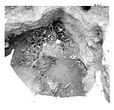
Flask-shaped cistern ... Early 3rd-late 2nd c. B.C ... Layer VI added when the construction of the Roman building above required it. ... Flask-shaped cistern chamber located on the northern slopes of Agoraios between the NW corner of the Hellenistic Building and the Temple of Aphrodite Ourania. As found, it lay beneath the floor of one of the rooms of a Roman Building. It was 1.10m in diameter at top, 3m at bottom. |
Cistern System #3: West Chamber at 69/ΛΣΤ, joined by a crooked passage to 69/Λ. Under the southwest corner of the Hellenistic Building to the north of the Temple of Hephaistos. Upper fill of early 1st ... 175-125 B.C ... Under the southwest corner of the Hellenistic Building to the north of the Temple of Hephaistos. |
| Pocket, identified as sacrificial pyre by SIR. Possibly disturbed. Outside south wall of building. Concentration of pottery in a small pocket below a "Hellenistic" fill. There is no mention of bone or ... First quarter 4th c. B.C ... Outside south wall of building. Concentration of pottery in a small pocket below a "Hellenistic" fill. ... The pyre dates shortly after the proposed date for the beginning of the second phase of Building E; the chronology may be sufficiently flexible to allow association with this reconstruction of the building. |
Cistern-chamber on the northwest side of Kolonos Agoraios, 10 to 12m west of the end of the Hellenistic Building. Dimensions at bottom 2.50m x 2.75m.
The west chamber of a cistern system composed of two ... Use filling early 1st-2nd c. B.C ... Cistern-chamber on the northwest side of Kolonos Agoraios, 10 to 12m west of the end of the Hellenistic Building. |
Fillings associated with reuse of walls in north part of area.
Red fill under and in North Building ... 5th c. B.C. with Hellenistic/ Roman disturbance as late as 3rd c. A.D. |
| In room A. Concentration of artifacts and burning in stratum, no pit discerned. The pyre lay below a Late Hellenistic fill with a smooth earth surface. It is described as a black patch of earth with sherds, ... 350-250 B.C ... The pyre lay below a Late Hellenistic fill with a smooth earth surface. It is described as a black patch of earth with sherds, resting on a rough and uneven surface topping a fill that dates largely in the 4th c., to at least 325, with seven Hellenistic sherds perhaps intrusive from the level above. ... Strosis II, on which the pyre rested, covered the walls of Room A, demonstrating that the pyre postdates a change of plan or abandonment of this part of the building, other parts of which survived to the Late Hellenistic period. |
| Marcie Handler ... The remnants of a disturbed pyre in a layer of dumped Hellenistic fill. The fill was found in the area on top of and east of the eastern wall of the Classical Commercial Building at its north end. Fragmentary ... Ca. 225 B.C ... The remnants of a disturbed pyre in a layer of dumped Hellenistic fill. The fill was found in the area on top of and east of the eastern wall of the Classical Commercial Building at its north end. Fragmentary pyre pots were mixed into the fill, which dated to the period after 225 BC. ... the pyre pottery may very well have come from a pyre buried under a floor in the building just to the west of here. |
Tiled well, ca. 30m south of the Tholos. Associated with Building D. Hellenistic Group A with Late Roman fill in upper 3.00m. Objects A 245 and P 4597 are from fill on floor around well-head, contemporary ... 325-260 B.C ... Associated with Building D. Hellenistic Group A with Late Roman fill in upper 3.00m. |
| Matt McCallum ... The pyre was uncovered in a small, triangular area between the BZ Building foundations (but at a lower level) and the northern scarp of the current excavation area. It rested in a patch of orange-brown ... 1-7 August 2006 ... The pyre was uncovered in a small, triangular area between the BZ Building foundations (but at a lower level) and the northern scarp of the current excavation area. It rested in a patch of orange-brown fill left over after scarping operations related to the BZ Building foundations in 2004.
... The preliminary date for this pyre is Early Hellenistic. This will no doubt be refined once the pottery is examined in detail. |
| David Scahill ... Behind northeast corner of Classical Building; east wall C. Below Hellenistic levels and early Classical pit. Chamber cut through bedrock, depth ca. 0.90m., diameter ca. 2m., roughly square in shape, angling ... LH III A:1 ... Behind northeast corner of Classical Building; east wall C. Below Hellenistic levels and early Classical pit. |
Hellenistic fill South of Middle Stoa near NW corner of Heliaea. This fill contained material later in date than that which made up the middle Stoa Building Fill.
Only the coins (and a few amphora handles ... To ca. 140 B.C ... Hellenistic fill South of Middle Stoa near NW corner of Heliaea. This fill contained material later in date than that which made up the middle Stoa Building Fill.
Only the coins (and a few amphora handles [why only these?]) |
| Well cut into bedrock under late Roman building in ΕΛ. 1.2m in diameter with small cutting of unclear function at south edge about 0.2m wide. Walls cut straight down, tapering near bottom to 0.8m. Footholds ... Late Archaic ... Well cut into bedrock under late Roman building in ΕΛ. 1.2m in diameter with small cutting of unclear function at south edge about 0.2m wide. ... There were 14 layers of fill from two periods-the Roman resurfacing of the area using Hellenistic fill (possibly associated with Deposit T-U 21:1, but not kept as such since floors were damaged in area directly above) and dumped fill from the late 6th/early 5th c. ... Layers:
Hellenistic fill under Roman floors
I.(86.34-85.93m) rubble
II.(85.93-85.58m) dark brown rubble
III.(85.57-85.30m) more stony rubble
IV.(85.30-84.80m) very rocky, almost sterile, increase of clay and sand
V.(84.80-84.03m) less rocks, almost sterile, increase of clay and sand
Late 6th/early 5th B.C dumped fills
VI.(84.03-82.64m) mix of clay and sand deposits, dog skulls
VII.(82.64-81.79m) mostly sand
VIII.(81.79-81.39m) light brownish-grey clay, almost sterile
IX.(80.39-80.99m) mix of grey clay, brown clay and sand, much ceramic
X.(80.99-80.24m) sandy, more ceramic
XI.(80.19-77.74m) sandy, enormous stones (some 100kg+). |
House R, fill under drain tiles and fillings associated with house K in industrial area, including what was C 19:15, plus C 19:16 and
C 19:17.
a) House built as dwelling in second half of 5th.c.
b) Used ... Ca. 5th and 4th c. B.C ... Rebuilt as an industrial establishment about middle of 4th. c.
c) Area built over in Hellenistic times.
A small amount of material can probably be associated with the original period of the house (cont. 662) and at some points where the excavation was carried to bedrock pottery of the 6th c. was found. Most of the material comes however from the second and third phases noted above: either the marble-workers' shop, or the heavy filling of dumped earth and marble chips thrown in over the area when the level was raised for the remodelling of the building at about the middle of the 4th c. |
|
|