|
|
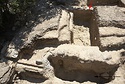
| Pyre in Room 2, area west of street (RSY=Pyre 12).
In courtyard. Artifacts, bone, ash, carbon, and cinders in pit in floor sequence. The rectangular pit was cut into a white strosis with marble chips (ΠΠ ... 315-300 B.C ... Pyre in Room 2, area west of street (RSY=Pyre 12).
... Artifacts, bone, ash, carbon, and cinders in pit in floor sequence. The rectangular pit was cut into a white strosis with marble chips (ΠΠ 282), filled with red earth, and the surface then trodden hard. The pyre is thus subsequent to the creation of the marbleworking surface, but the hard-trodden surface indicates continuing use of the area. |
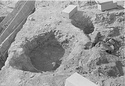
| Laura Gawlinski ... Ovoid pit cut into bedrock or sterile fill just north of preserved floor surfaces in the so-called Strategeion. Length (west-east) 2.6m; widens at 1.25m from the east scarp so that at west pit is 0.75m ... 4th B.C ... Ovoid pit cut into bedrock or sterile fill just north of preserved floor surfaces in the so-called Strategeion. Length (west-east) 2.6m; widens at 1.25m from the east scarp so that at west pit is 0.75m wide, at east 0.85m wide. ... It appears likely that this pit cut into at least the lower floor layers to the south.
|
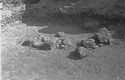
| C.G. Thomas ... Geometric grave. Bones discarded.
Tomb located about 2m west/west-southwest of the EG1 child inhumation, beneath the restored line of a hypothetical wall connecting the western "apse' and the south wall ... Middle Geometric II ... Tomb located about 2m west/west-southwest of the EG1 child inhumation, beneath the restored line of a hypothetical wall connecting the western "apse' and the south wall of the Geometric House. ... Oriented more or less to the points of the compass, the trench measured about 0.80m (east-west) by about 0.70m (north-south). The filling consisted of hard earth, most of it burned and struck through with charcoal, which was especially thick on the floor of the trench, where some pieces were as much as 0.05m across. |
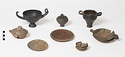
| Rodney S. Young ... Grave 7 in notebook (E.L. Smithson: Grave XXI: PG). Bones discarded. Disturbed and damaged cremation (originally trench-and-hole), the east end cut away, probably contained the burial urn.
JP
It consisted ... Late Protogeometric ... JP
It consisted of a rectangular trench cut through hard-packed fill and slightly into bedrock to a depth of 0.48m. the trench oriented east-west, had a preserved length of 0.70m and a width of 0.60m. The east end where the cinerary urn would have originally been located in an urn-hole, was almost completely cut away by the Hellenistic water channel that skirted the tomb to the south. evidence of heavy burning, in the form of reddened earth, was noted on the ground around the mouth, rim, floor and three sides of the trench. |
|
|