|
|
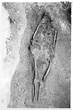
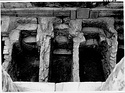
| Grave in cella of Hephaisteion. Grave XIX in notebook. One skeleton. Nails and wood. Two skeletons are mentioned by Angel, AA 82 and AA 83 ... 21 February 1939 ... Grave in cella of Hephaisteion. Grave XIX in notebook. |
| Rodney S. Young ... Grave 18 in notebook.
Adult inhumation; skeletal material; no offerings. Submycenaean?
JP In some records as Grave XIX bis. (see Agora XXXVI, Tomb 31, p. 284) ... LH IIIC/EPG (date uncertain) ... Grave 18 in notebook.
... In some records as Grave XIX bis. (see Agora XXXVI, Tomb 31, p. 284). |
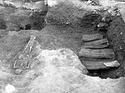
Mycenaean Grave W. of Circular Building. Measuring 1.40m by 0.55m and it was covered with a few rough stone covering slabs, under which lay the skeleton of an adult with the head to the north and the knees ... Myc. III A2-B ... Agora XIII, pp. 212, 274, pls. 49, 67, 86 (Grave XIX). |
| Grave 7 in notebook. Area disturbed in Roman times; outlines of the shaft had been obliterated.
The northwest end, however, was preserved in a cutting in the rock of the sloping hillside. This cutting, ... 750-700 B.C ... Grave 7 in notebook. ... The earlier burial, Grave XX, occupied the bottom of the cutting; the later, Grave XIX, rested on a filling of ash 0.38m above it. |
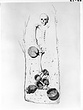
| Grave 7b in notebook. Inhumation in Tholos Cemetery; The skeleton positioned directly below the male in Grave 7, but with direction reversed, i.e., head at southeast end. Most grave offerings at lower ... 750-725 B.C ... Grave 7b in notebook. ... Most grave offerings at lower end. ... Probably covered, but slabs removed for Grave XIX. |
| Grave in opisthodomos of Hephaisteion. Grave LI in notebook.
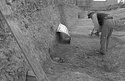
No mention of bones. Neg. KK 363, XIX-8 (dismantling of the walls of the graves( ... 10 March 1939
16 March 1939 ... Grave in opisthodomos of Hephaisteion. Grave LI in notebook.
... KK 363, XIX-8 (dismantling of the walls of the graves(. |
| Rodney S. Young ... Disturbed burial (no remains), probably an infant pot inhumation.
Inhumation grave 17 in notebook. (E.L. Smithson: Grave XIX: PG).
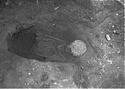
Shallow oval cutting containing a banded amphora on its side, mouth ... LPG ... Inhumation grave 17 in notebook. ... Smithson: Grave XIX: PG).
Shallow oval cutting containing a banded amphora on its side, mouth to west, sheathed in a large two-handled cooking jar, split irregularly lengthwise, south to east. ... JP
Young: "It is possible that a baby whose bones have completely disappeared was placed in the larger coarse amphora, and that the other amphora was a Beigabe (offering)" The fact that no precedent exists in Athens at this time for a full-sized amphora as an offering in an infant or child grave renders such a suggestion unlikely.
|
|
|