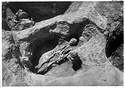
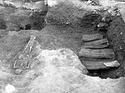
[Agora Deposit] D 16:10: Pit 6

Pit 6 in Grave area. South cut, Metroon Section. Pit with burning ... Late 5th. c. B.C ... Pit 6 in Grave area. South cut, Metroon Section.

[Agora Deposit] D 16:9: Pit 4

Pit 4 in Grave area (= Cistern). Not completely cleared. Filling probably late Hellenistic, though with some earlier material ... Hellenistic ... Pit 4 in Grave area (= Cistern).

[Agora Deposit] D 16:8: Pit 2

Pit 2 in Grave area. Small deposit in a pit; a fragment of a red-figured nuptial lebes recalls the early Kerch style of the second quarter of the 4th c.; the deposit as a whole runs somewhat later ... Ca. 375-315 B.C ... Pit 2 in Grave area. Small deposit in a pit; a fragment of a red-figured nuptial lebes recalls the early Kerch style of the second quarter of the 4th c.; the deposit as a whole runs somewhat later.

[Agora Deposit] B 19:4: Geometric Grave, RSY Grave A

RSY Grave A. Under the Roman House with three rooms floored with mosaic near the southwest side of the area. The burial consisted of a pot laid on its side over the bedrock, presumably containing a child ... 7 August 1947 ... RSY Grave A. Under the Roman House with three rooms floored with mosaic near the southwest side of the area. ... They were not burned. The grave had been disturbed in early times by the building of a wall (6th or 5th century B.C.) which in part overlay it; only the part of the pot immediately over the stereo was preserved. it was an amphora with banded body and conventional ornaments on the reserved neck, probably late 8th century.

icon

[Agora Deposit] N 11:1: Cist Grave in Ο

N.A. Doenges Evelyn Lord Smithson ... "Near or in Grave" (width 0.50m) Grave to the east of the southeast corner of the great court of the Gymnasium. Shallow and superimposed on Well N 11:5. It is a simple cist oriented north and south, with ... 750-725 B.C ... "Near or in Grave" (width 0.50m) Grave to the east of the southeast corner of the great court of the Gymnasium. ... The other two skulls were found in the area of the grave, but above it, and since there were other grave-like but empty cuttings in the vicinity it is likely there was a small group of graves here ... Hesperia 22 (1953), p. 39: noted as grave to the east of the southeast corner of the great court of the Gymnasium.

[Agora Deposit] T 16:1: Pit Grave, Adult Inhumation

R. Ross Holloway ... Protogeometric Grave in Koletti Garden. Male inhumation. Tomb first encountered and partially damaged by workmen who were digging a cess pit for the restored Koletti House on Polygnotos street. The tomb ... "Submycenaean"/Early Protogeometric ... Protogeometric Grave in Koletti Garden. ... Within the pit, the skeleton of a man aged 18-21 years at death, and described as somewhat decayed, was laid out on his back in a fully extended position, head to the southeast. the fill of the tomb appeared to consist of sterile redeposited bedrock and it was hastily dug by the workmen prior to the arrival of a trained excavator. the floor of the tomb was encountered at 1.95m below the level of the court in the area of the cess pit, ca. 1.15m below the level of the tiled pavement along the east side of the Kolletti House

icon

[Agora Deposit] G 12:7: Inhumation of a Man

Grave 7 in notebook. Area disturbed in Roman times; outlines of the shaft had been obliterated. The northwest end, however, was preserved in a cutting in the rock of the sloping hillside. This cutting, ... 750-700 B.C ... Grave 7 in notebook. Area disturbed in Roman times; outlines of the shaft had been obliterated. ... The earlier burial, Grave XX, occupied the bottom of the cutting; the later, Grave XIX, rested on a filling of ash 0.38m above it.

icon

[Agora Deposit] E-F 13:1: Prehistoric Burial

Laura Gawlinski ... Burial of a woman (young adult female ca. 18-20); precise dating difficult due to disturbance by later features, but the amount of Neolithic and Geometric pottery extracted from the trench is significant ... Prehistoric ... No cutting found for grave, but area seems to have been demarcated by rows of stones to the north and south, bedrock to west.

icon

[Agora Deposit] C 9:19: Urn cremation

Rodney S. Young ... Destroyed urn cremation. No remains. Originally assigned as part of Tomb C 9:14 (Grave 7) JP "Large fragments of an urn were found in the packing of a Hellenistic water channel which cut through a LPG ... Final Mycenaean/Submycenaean ... Originally assigned as part of Tomb C 9:14 (Grave 7) JP "Large fragments of an urn were found in the packing of a Hellenistic water channel which cut through a LPG burial area and obliterated the urn and urn-hole of LPG grave C 9:14." ... P 6723, although surely an urn, rust-stained inside from the iron jewelry and within a meter of Grave C 9:14, is much earlier than the offerings in that grave and must have come from still another burial trench in the line of the water channel; a narrow burned strip along the edge of the channel opposite the fragments may be part of that trench. ... Agora XXXVI mentions (p. 298) as part of Grave 5 (should read 7)

icon

[Agora Deposit] O 17:9: Disturbed Pyre

Initially was recorded as disturbed saucer grave, but identified as pyre by SIR. Found by gardener washing out of scarp during the winter rains. The location is just south of an east-west road; there ... 1962 ... Initially was recorded as disturbed saucer grave, but identified as pyre by SIR. ... The location is just south of an east-west road; there were traces of houses in this general area. There are signs of burning on some pottery.

[Agora Deposit] E 14:14: Cutting in Bedrock

The almost complete red figure hydria set into this cutting suggests the possibility of a 5th c. burial put into a much earlier grave cutting; however, the remainder of the filling appears thoroughly disturbed ... 450-425 B.C- Late Roman disturbance ... The almost complete red figure hydria set into this cutting suggests the possibility of a 5th c. burial put into a much earlier grave cutting; however, the remainder of the filling appears thoroughly disturbed. ... For possible burials in this area cf. also the white ground lekythos P 6052, Γ 1754, Volume XXX, p. 2064.

icon

[Agora Deposit] C 11:2: Pit tomb, inhumation

Rodney S. Young ... Grave 20 (E.L. Smithson: Grave X: PG). Bones discarded. Pit tomb, inhumation (on bier or in coffin?), perhaps of a child. Little ash and carbon in the filling, but the grave offerings were unburned. JP ... Developed Protogeometric ... Grave 20 (E.L. Smithson: Grave X: PG). ... Little ash and carbon in the filling, but the grave offerings were unburned. ... It was in this layer that five of the six pots associated with the grave were encountered, toward the SE corner.

[Agora Deposit] S 19:4: Possible Tomb Group

Rodney S. Young ... (E.L. Smithson: Grave XXXVI:PG). Early fill over bedrock. No remains. Two fragmentary unburned vases were found together on bedrock, beneath Roman and Byzantine fill. Disturbed earth over bedrock for several ... Early Protogeometric ... Smithson: Grave XXXVI:PG). Early fill over bedrock. ... The excavator noted "cinders" among the Early Iron Age pottery in the fill in the immediate vicinity, which may further support the existence in the area of early tombs.

icon

[Agora Deposit] H 17:2: Pit Tomb, Child Inhumation

Dorothy Burr Thompson ... Child's Grave (E.L. Smithson: Grave XXVIII: G). Cf. Container Lot ΣΤ 165 (fill over geometric grave). Neat, rectangular, unlined trench, cut into bedrock to a preserved depth of 0.20m,below the level ... Early Geometric I ... Child's Grave (E.L. Smithson: Grave XXVIII: G). ... The tomb was located in the area between pits A and D, and was just over 2m to the east of the preserved west wall of the Geometric House. ... Mentioned as Grave XXVII in Agora XXXVI.

icon

[Agora Deposit] D 16:2: Urn cremation

Margaret Crosby ... Grave 1 (Grave XXVI: EG) Urn cremation (trench-and-hole), adult male? [JP] Boots or Booties Grave. Near the west branch of the Great Drain, about 100m to the southwest of the Agora horos inscription ... Early Geometric I ... Grave 1 (Grave XXVI: EG) Urn cremation (trench-and-hole), adult male? [JP] Boots or Booties Grave. Near the west branch of the Great Drain, about 100m to the southwest of the Agora horos inscription. ... The ground level at the time of the burial must have lain somewhat higher; a deep disturbance of Byzantine times had gone to bedrock in the area of the grave and destroyed all evidence as to the original levels.

[Agora Deposit] B-C 10-11:1: Hellenistic-Early Roman Fill over Bedrock

Hellenistic-Early Roman fill over bedrock, along west side of Kolonos Agoraios. Consistent dumped filling; occasionally there is a late Roman fragment intruded from the filling above, but this seems not ... 26-29 February 1936 2-12 March 1936 ... Consistent dumped filling; occasionally there is a late Roman fragment intruded from the filling above, but this seems not to affect the deposit which suggests some large scale operation, serving to level the area and to fill in the pits and grave cuttings of earlier periods.

icon

[Agora Deposit] D 16:6: Pyre in Cut in E-W Street

Pyre in cut in E-W street, layer 7 (Pyre 14). North edge of Piraeus street, west of the Great Drain Bridge, in the area west of Areopagus. RSY-Pyre. Pottery, a little burnt bone, and patches of charcoal ... 250-240 B.C ... North edge of Piraeus street, west of the Great Drain Bridge, in the area west of Areopagus. ... Lot ΠΠ 246, over saucer grave.

icon

[Agora Deposit] R 20:1: Urn Cremation

John Travlos ... (Grave XXXII: EG) Urn cremation (trench-and-hole). Published as cremation burial of a warrior. The tomb was probably originally oriented north-south, with the urn-hole at the south end. The north side ... Transitional Early Geometric II-Middle Geometric I ... (Grave XXXII: EG) Urn cremation (trench-and-hole). ... The deceased is the oldest individual thus far identified among the cremation burials in the area of the later Athenian Agora.

icon

[Agora Deposit] N 21-22:1: Tomb of the Ivory Pyxides

Mycenaean Chamber Tomb occupies a considerable part of the western half of section ΕΕ; lies about half way up the north slope of the Areopagus towards its eastern end, just below the highest point of the ... Myc. III A:1 ... The rock from which it is cut, is the greenish clayey shale which underlies most of the Agora area. The dromos has a preserved length of about eleven meters. ... There is only one grave cutting in the floor of the chamber, neatly placed in the SW corner (1.80m length; 0.60m width; 1.20m depth). ... Body and offerings were removed from the grave not long after they had been placed there (Mycenaean times); the chamber must had been entered by digging down from the top in the western half.